There is no single best cat tunnel for every cat — the right one matches the passage your cat will actually use, the play the tunnel is meant for, and the room and routine around it. Check the openings and interior first, compare shapes against play and layout second, then weigh sound, fabric, construction, care, and storage. The sections below take those checks in the order worth making them.
Check the Space Your Cat Will Actually Use
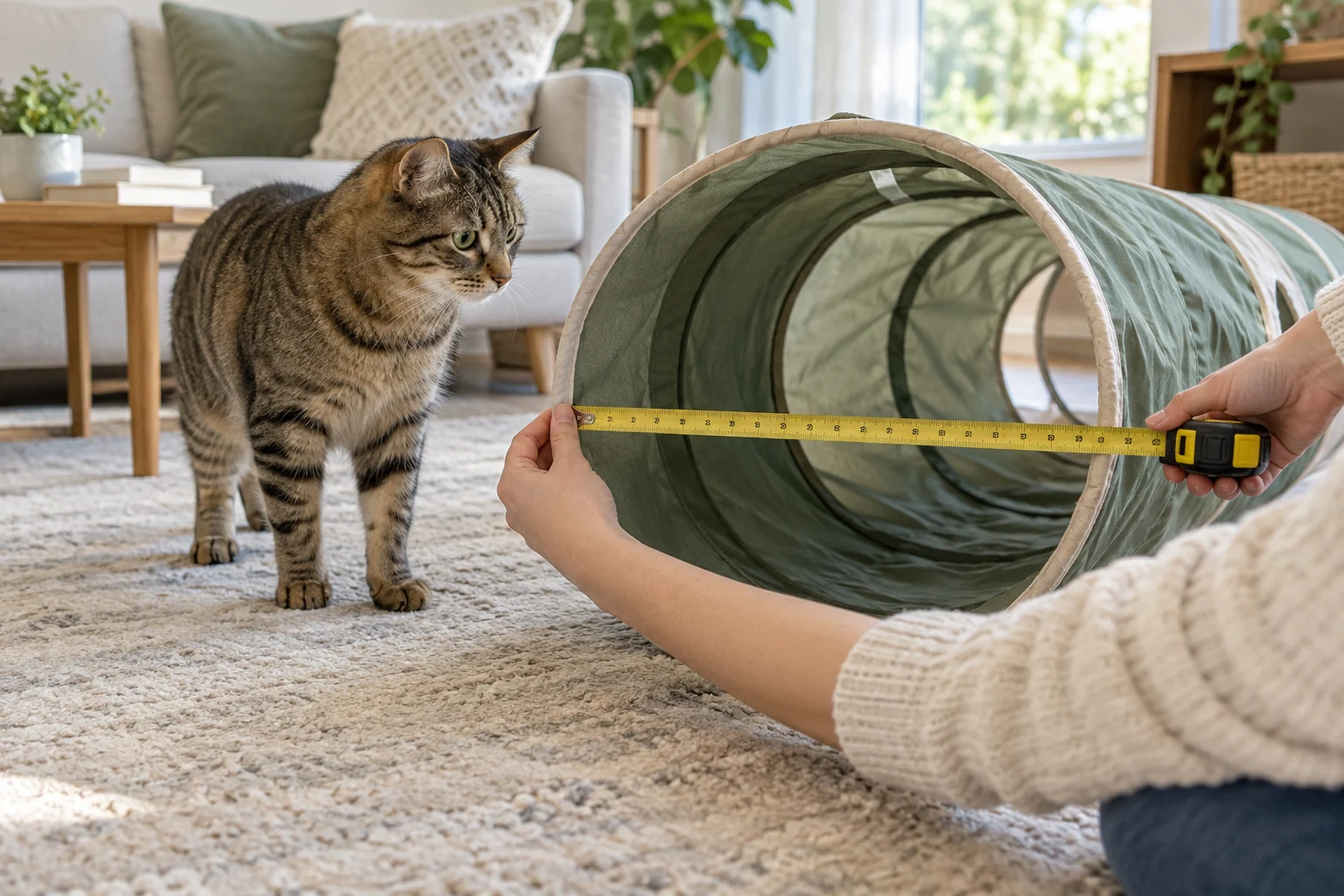
The size that decides whether a tunnel works is the space your cat passes through, not the size printed on the box. Listings usually lead with the overall expanded dimensions — outer span, total length, sometimes a packed size. Those numbers describe the footprint on your floor. They don’t say how big each opening is, how much room the cat has inside the channel, or what happens where the tube bends or branches, and those are the spaces a cat actually experiences.
Four measurement points answer different questions:
| Measurement point | What it describes | Why it matters |
|---|---|---|
| Opening (entry) size | The usable hole a cat steps into | The first thing a cat interacts with; a tight entry can decide the whole purchase |
| Internal channel | Room inside the tube while the cat moves | Walking through, turning around, settling in — all of it happens here |
| Bend or junction clearance | Space where the tube curves or splits | Often the tightest point on curved and multi-entrance designs |
| Open footprint | Floor area the expanded piece occupies | Whether it fits the room — but it isn’t passage space |
Outer width, opening size, and usable interior are three different numbers, and a wide-looking tunnel can still have small openings. Where a listing gives a dimension without saying what it measures, ask the seller to name the measurement point — especially the difference between the outer span of the whole piece and the actual entry. A listing that answers that clearly is telling you something useful about the seller, too.
For large cats, the same checks apply with more at stake. Looking for the best cat tunnel for large cats doesn’t produce one usable answer, because no universal minimum diameter fits every cat: an “XL” label alone does not establish usable passage space, and neither breed names nor body weight convert into an opening size.
The better evidence is behavior you already have. Watch the spaces your cat willingly uses — the gap behind the sofa the cat slides through without hesitating, the box it claims, the carrier it walks into — and treat those openings and interiors as a personal reference for what will get used.
Then give passage and lingering separate attention: a large cat may be able to squeeze through a channel and still never treat the tunnel as a place to stay, because turning around or settling inside doesn’t work at that size. None of this requires forcing the cat through a display model in a store — voluntary use is the evidence that counts.
Match the Shape to Play and Room Layout
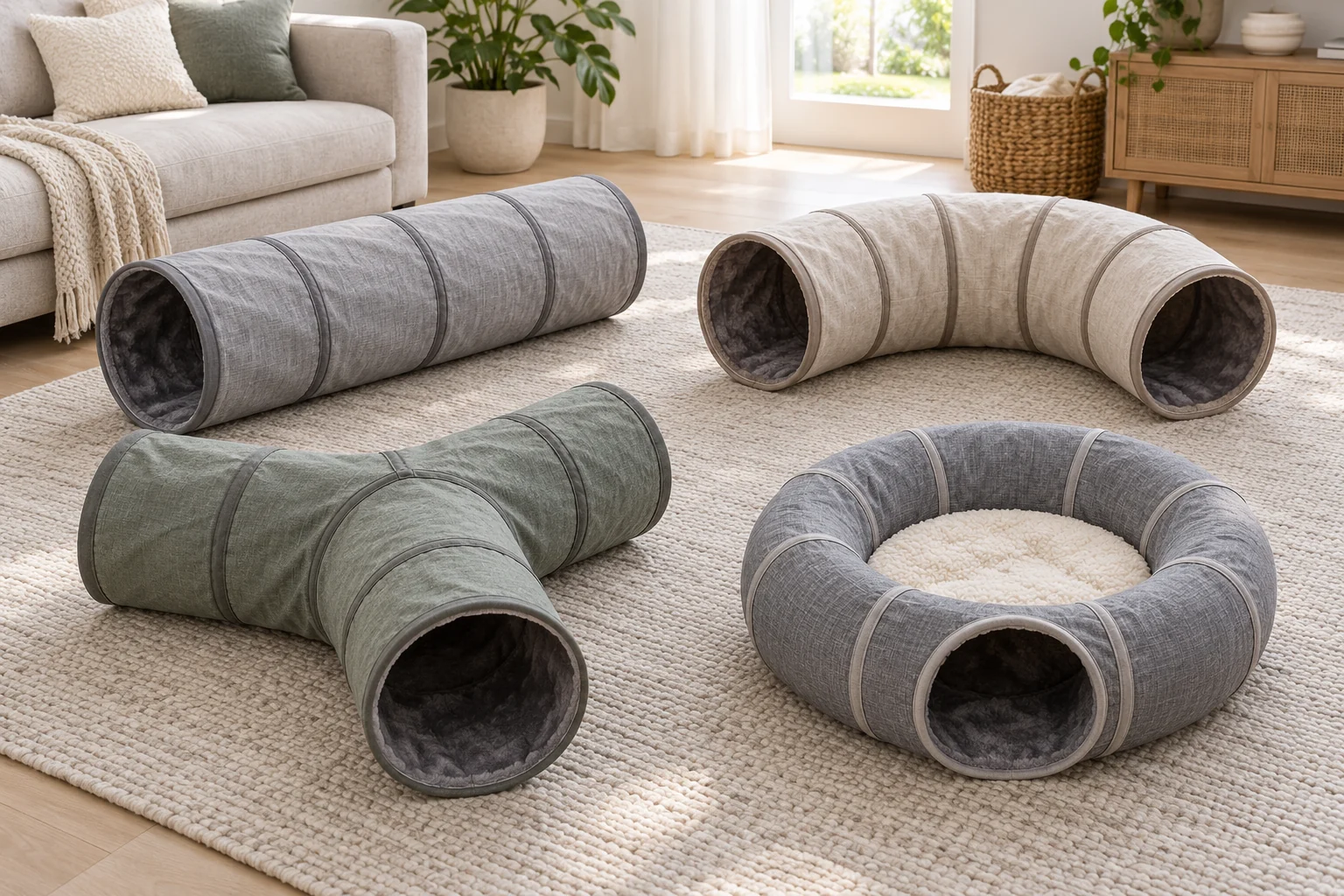
Shapes aren’t styles; they’re tools for different games:
| Shape | Built for | What to check against your room |
|---|---|---|
| Straight run | Chasing through at speed, end-to-end races | Needs a clear stretch of floor; the least forgiving in a small room |
| Curved | Turning the path, peeking around the bend, ambushing | Follows wall lines and corners; check where the entries end up |
| Multi-entrance (three-way, cross) | Exit choices and hide-and-pounce games | Largest footprint; every entry needs usable placement |
| Tunnel-plus-bed combo | Pass-through plus a napping spot | Most permanent footprint; only worth it if the bed gets used |
The shape to pick is the one that matches what your cat actually does. A cat who sprints needs a runway, and the straight piece gives the cleanest path; a cat who waits inside and pounces gets more from curves and side exits; a cat who naps in enclosed spaces may use the bed end more than the tube. The play you already watch tells you which job the tunnel will get.
Layout decides the other half. After expansion, check what the piece does to the room: whether it blocks a walkway, whether it lands where a door needs to close, whether an entry ends up flush against a wall or a sofa — an opening that faces a wall is one a cat may simply never use. Curved pieces follow corners and wall lines; straight ones want open floor; multi-entrance pieces tend to sit in the middle of a room. Measure the spot you have in mind and compare it with the open footprint rather than the packed box.
Multi-cat households get one more check: extra exits are not extra harmony. More openings give a pursued cat somewhere to go, but they don’t change how two cats get along. Watch how the exits actually work with your cats — whether one claims an opening while another waits outside, or whether one uses the tunnel to hide from the other in a way that has stopped being play. A tunnel gives a shared game new routes; it doesn’t settle a relationship that’s tense everywhere else.
Compare Fabric, Visibility, and Noise Where the Tunnel Will Live
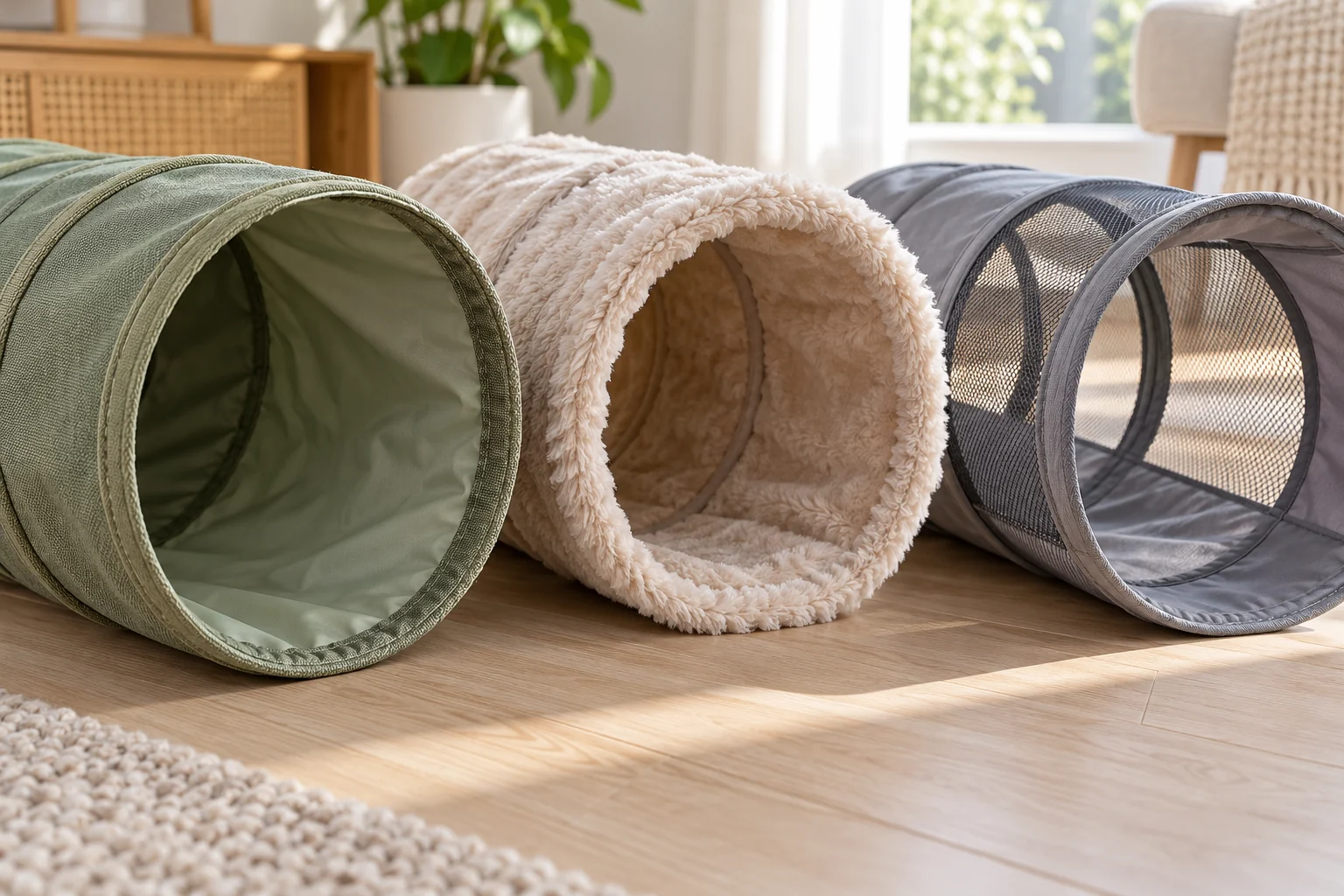
Buyers tend to merge three things that deserve separate attention: the feel of the outer shell, the sound of the inside, and how enclosed the cat is once inside.
The sound question you can answer before buying. Many tunnels have a crinkle liner that rustles under a cat’s weight, and cats split on it — some charge at the noise, some leave the room. You already have the evidence: how your cat responds to crinkle toys, paper bags, or noisy packaging at home. Match the tunnel to that answer, and weigh the room as well — a crinkle liner in a bedroom reads differently than one in a play area. Where a listing says “crinkle” and nothing more, ask whether the sound comes from a separate inner liner or the shell fabric itself.
Visibility works the same way. Mesh panels and windows let light in and let the cat look out, which can help a hesitant cat accept the piece — and they take away some of the den-like enclosure that ambush play depends on. A fully closed tube reverses the trade. Neither layout is better for cats as a group; the question is which one your cat’s play rewards.
Fabric is where material names mislead. Lightweight shells, plush walls, mesh, and stiffer structured fabrics each behave differently in a specific product, and no fabric name proves durability, washability, or safety on its own — “plush” doesn’t mean sturdier or gentler, and “polyester” doesn’t tell you what happens in the wash. A tunnel is also fabric over a support frame, so the shell’s job isn’t a blanket’s job. What settles the question is the specific model’s textile and construction details, not the category word in the title — which is why the next section starts with the model and not the material.
Look at Construction and Care Before Buying
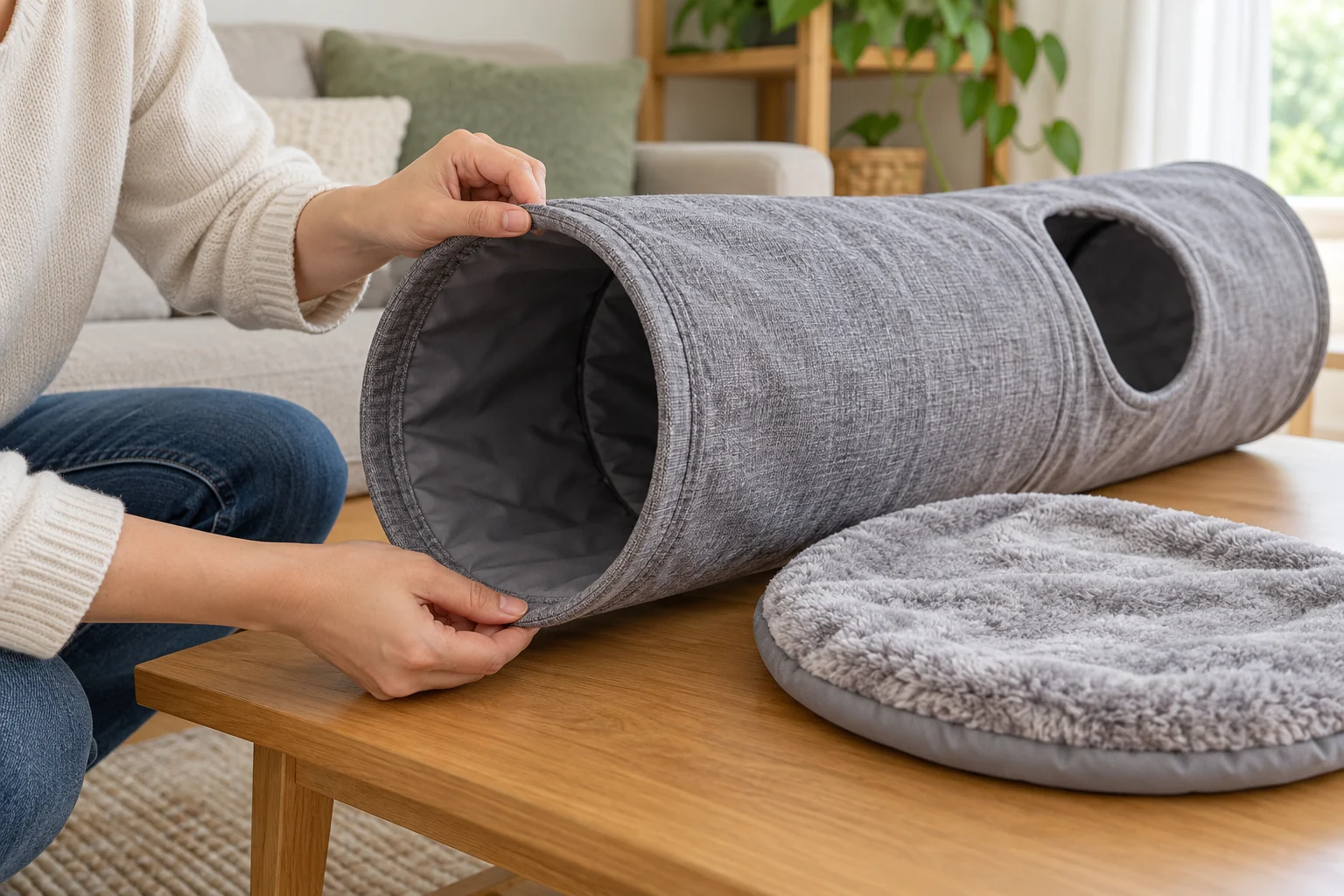
Judge the whole piece, not the marketing photo. Four checks matter at purchase time:
- How the support is enclosed. Most collapsible tunnels hold their shape with a flexible frame enclosed in the fabric. Ask how the frame runs along its length and finishes at the openings — edge binding, sleeves, and seams decide how the piece wears.
- Seams and opening edges. The entries take the most rubbing, so look at how their edges are finished and where panels join.
- Attached toys and parts. Dangling toys at entrances are common. Check whether each attachment is fixed or removable, since that decides what can be taken out of play without affecting the tunnel itself.
- Detachable pieces. Removable liners or mats, and how they attach, change both cleaning and how the piece ages.
None of this is a strength test — it’s a look at how the piece is finished before you own it.
“Washable” is the word that needs the most scrutiny. A washable mat or a washable liner is not a machine-washable tunnel: care instructions apply per component, and the frame typically stays sewn in place. Before buying, ask what the model’s care instructions allow — surface wipe, hand wash, machine wash — whether any part detaches for washing, and how the piece dries. That answer decides daily life with the tunnel, and it can’t be reconstructed from a fabric name.
Once the tunnel is in use, a quick look from time to time catches what play does. Visible damage — a seam opening at an entry, fabric worn through, a frame wire pushing out of its sleeve, a loose attachment — means the piece comes out of use, and the manufacturer’s instructions for that product take over. What to do with a damaged tunnel isn’t something a general guide can decide for every model; repair, replacement parts, or replacement follow the maker’s guidance rather than an improvised fix.
Whether a cat can be left alone with the tunnel likewise depends on the model’s own instructions, the piece staying complete and undamaged, and how your cat actually plays — a guide can’t hand you a blanket rule, and none of it adds up to a guarantee. A cat that’s hard on attached parts changes the answer for unsupervised sessions; that judgment belongs to the specific product and the specific cat.
Check Everyday Storage and Useful Extras
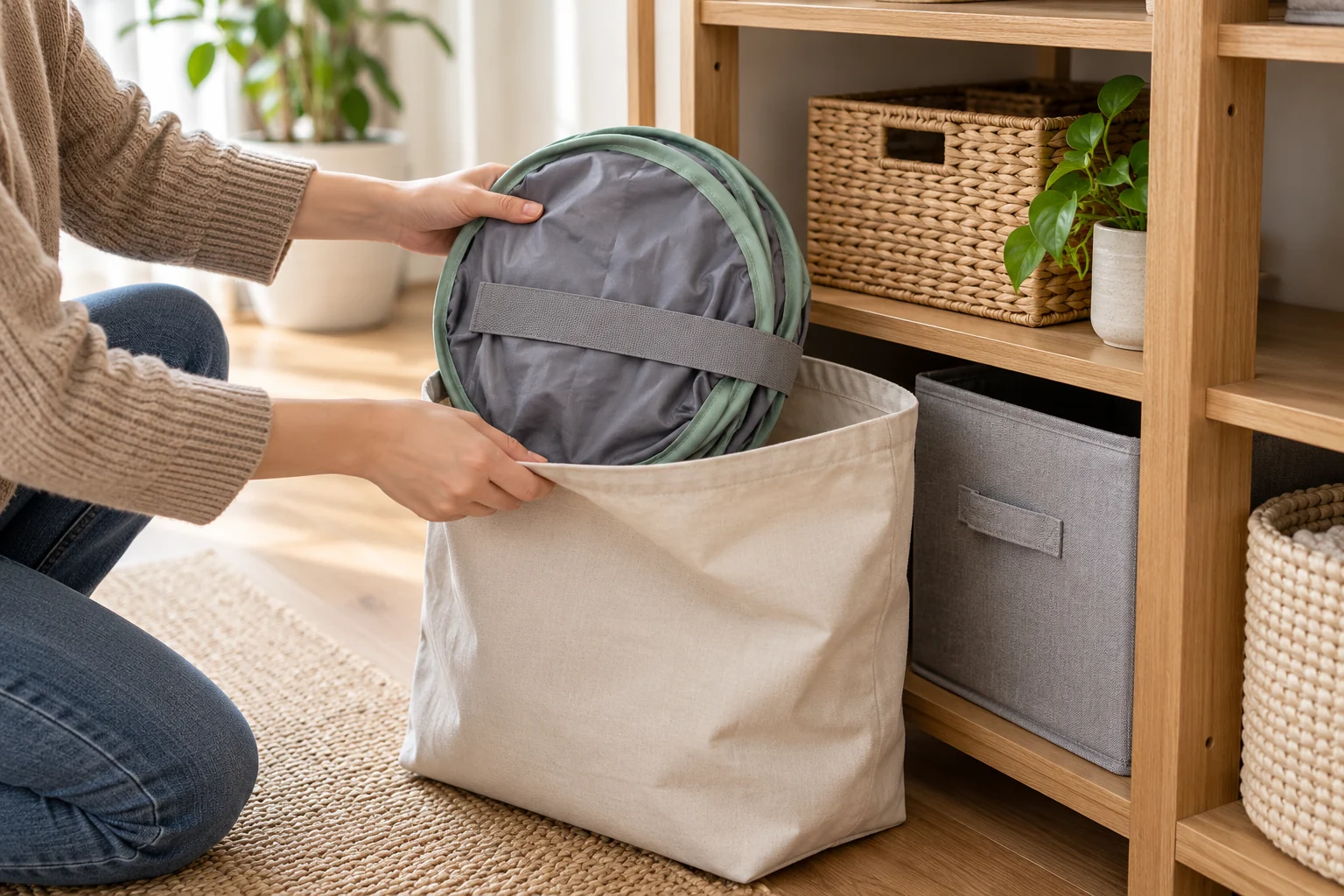
A tunnel that fits the room when it’s open isn’t the same as a tunnel you’ll keep using. Decide which of two lives it will have before you buy.
If it stays out permanently, the open footprint is the main fact: measure the spot and compare it with the open dimensions, including where the entries land. Know, too, that on smooth flooring a light tunnel can travel when a cat dashes through — where it ends up is part of living with it. A piece that stays out becomes furniture; the room has to tolerate it long-term, which is why the shape and layout checks matter most in this scenario.
If it comes out for play and goes away after, the folding routine is the real product. “Collapsible” on its own says almost nothing: some tunnels twist-fold flat into a disc, others fold into a bulky bundle. Check the actual method and the folded size — shelf, closet, under the sofa — and how the folded piece stays closed: attached ties, a strap, velcro, or a bag. A tunnel that’s annoying to put away tends to live open on the floor whatever the plan was. And where a listing shows a packed or shipping size, remember that describes the box in transit, not the folded piece your shelf has to hold.
Extras earn their place or they don’t. Attached dangling toys, connectable sections that build a longer run, a bed at the end, decorative trim — each is worth paying for when it matches the play and the room it will live in, and each is just a higher price when it doesn’t. More pieces don’t make a better tunnel; they make more to store and more to check. A budget usefully narrows the candidate list, but no price point buys a durability guarantee, and price alone can’t rank tunnels that differ in shape, material, and construction.
FAQ
Why isn’t my cat using the cat tunnel?
An empty tunnel doesn’t automatically mean the purchase was wrong, or that anything is wrong with the cat. Give it a fair try, with a few gentle changes, before deciding.
If the tunnel is new, allow voluntary discovery time. Put it where the cat already spends time, leave the openings unobstructed, and let the cat find it — some cats need several visits before a new object stops being a stranger. Carrying the cat in usually works against you; so does pushing it through an opening.
If a tunnel that used to get used has gone quiet, change one thing at a time. Move it to a different spot, or rotate it out for a while and bring it back — the same trick that revives an ignored toy. Check for interference too: a crinkle liner the cat was never sure about, or another cat who has claimed the piece. Trailing a teaser toy through the openings can turn the tunnel back into part of a game rather than a static object.
If the reluctance comes with other changes — eating less, hiding beyond the tunnel, anything else that’s new alongside it — that’s a question for a veterinarian, not a buying guide.
Make the Choice — and Describe It Clearly If You’re Sourcing
Done right, the comparison narrows itself: two or three candidates whose passage space fits the cat, whose shape fits the play and the room, whose sound and visibility the cat will accept, and whose care and storage the household can live with. Almost every listing leaves some of those numbers out, so the last step is questions, asked before payment — which measurement point each dimension names, what the care instructions allow, how the piece folds and what it closes with. A seller’s answers close the gaps the product page leaves open.
If you source or specify tunnels rather than buy one — for a brand, a retail program, or a private label — the same list becomes your brief. Shape, openings and open dimensions, the textile and support structure, seam layout, folding and packed dimensions, quantities, target market, and timing: those are the details a supplier needs in order to quote and sample the item you mean rather than the item they guess. The cat tunnel and teaser collection page shows how each of these is specified per SKU, and you can share your item list, packaging plan, quantities, and target market through the contact page to discuss the options.