Can you wash a dog bed in the washing machine? Only the parts whose care instructions say so — and each part has to be checked on its own. A cover that unzips may be machine washable while the foam inside it is spot clean only; some beds are built to go into the washer and dryer whole, and many are not. The reliable sequence is the same either way: identify the part, confirm its care instructions and your machine’s limits, wash it with an allowed method, and dry it completely before the bed goes back together. The sections below walk through each step.
Find Out Which Parts You Can Wash
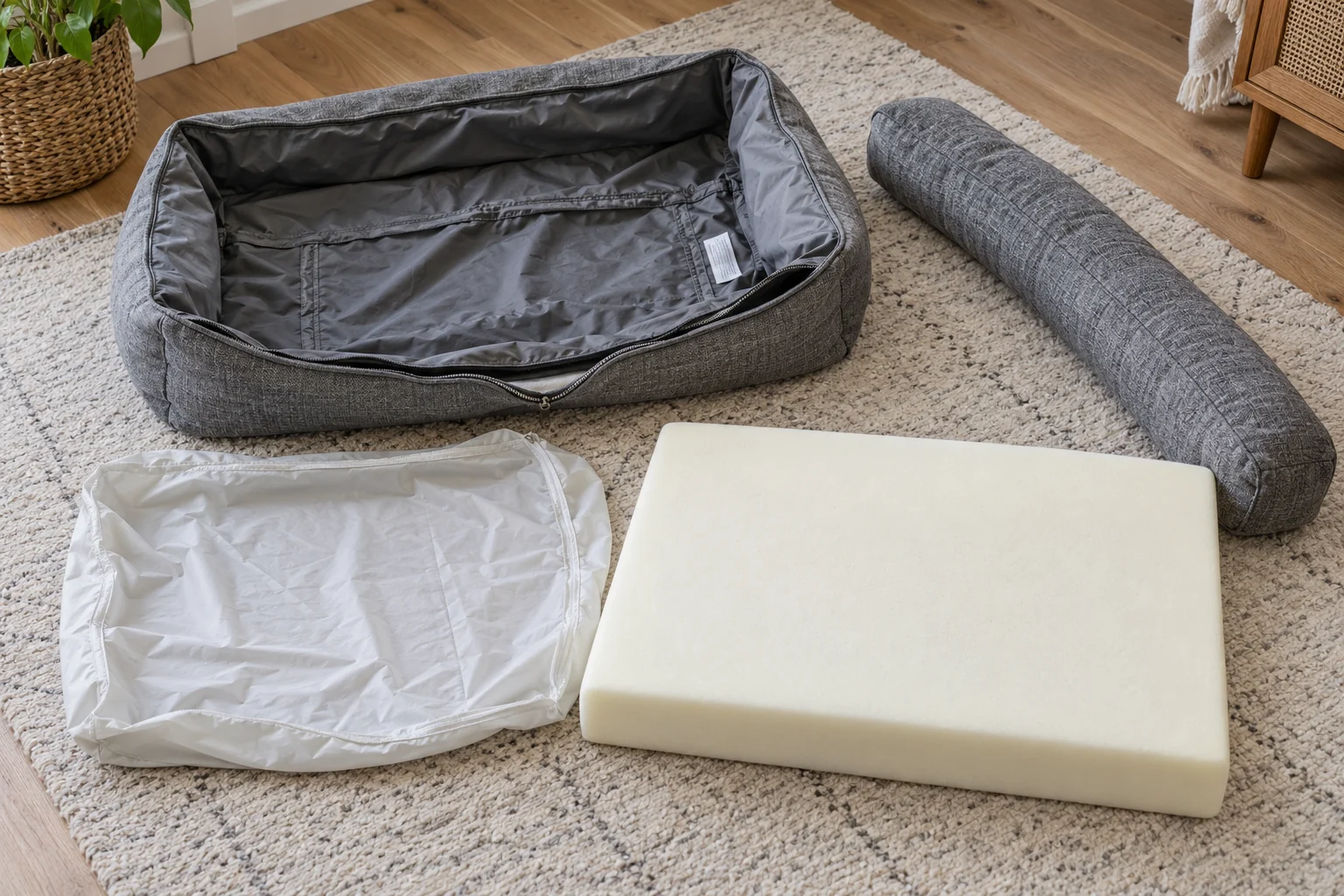
A dog bed is an assembly of components, not one fabric with one rule. The usual lineup: an outer cover; sometimes a protective liner between the cover and the filling; a foam or fiberfill insert; and filled bolsters or rails around the edge. One-piece beds sew all of that shut. Care instructions are written per component, and the tag you find most easily — usually stitched into the cover seam — often describes that cover alone. So the question of whether you can put a dog bed in the washer is really a question about each part, one at a time.
| Part | What it is | What to confirm before it gets wet |
|---|---|---|
| Outer cover | The fabric shell your dog sleeps on; fully or partly removable on some beds | Whether this exact cover is machine washable, hand wash only, or spot clean only |
| Protective liner | An inner layer between cover and filling, often sold as water-resistant | Whether the liner itself can be washed or only wiped, and what its coating allows |
| Filling or foam insert | Solid foam, shredded foam, or fiberfill cushioning | Often the strictest part — many inserts are spot clean only and must not be soaked |
| Bolsters and rails | Raised, filled edges and side cushions | May use different fabric or fill than the sleeping panel; check them separately |
| One-piece bed | Everything sewn shut, no closures at all | Whether the model permits whole-bed washing at all; many allow surface care only |
Those permissions are not interchangeable, and reading them loosely is how parts get ruined. “Removable” tells you a part comes off the bed. “Washable” tells you some form of washing is allowed. “Machine washable” names the appliance — and “tumble dryable” is a separate line again, because plenty of covers go in the washer but not the dryer. A label that grants one of these has not granted the others, so apply each line to the part it’s printed on, not to the whole bed.
Permissions also differ between products — sometimes within one brand’s own range. FurHaven, for example, publishes separate washing guidance for its indoor covers, outdoor covers, and foam inserts, because those components are built differently. The lesson isn’t FurHaven’s settings; it’s that you check the component in your hands rather than trusting a brand name, a material category, or a similar-looking model.
If the label is missing or worn unreadable, look for the model’s own instructions — the product page, the brand’s FAQ, or hangtag photos in the original listing — or ask the manufacturer. A fabric name is not a care instruction: two covers both sold as “canvas” can carry different washing limits, and a construction you can’t identify isn’t made safe by choosing a gentler cycle. To see how covers, liners, and fillings actually differ, our guide to dog bed materials goes through each component and what it tolerates.
Prepare the Bed Before Anything Gets Wet
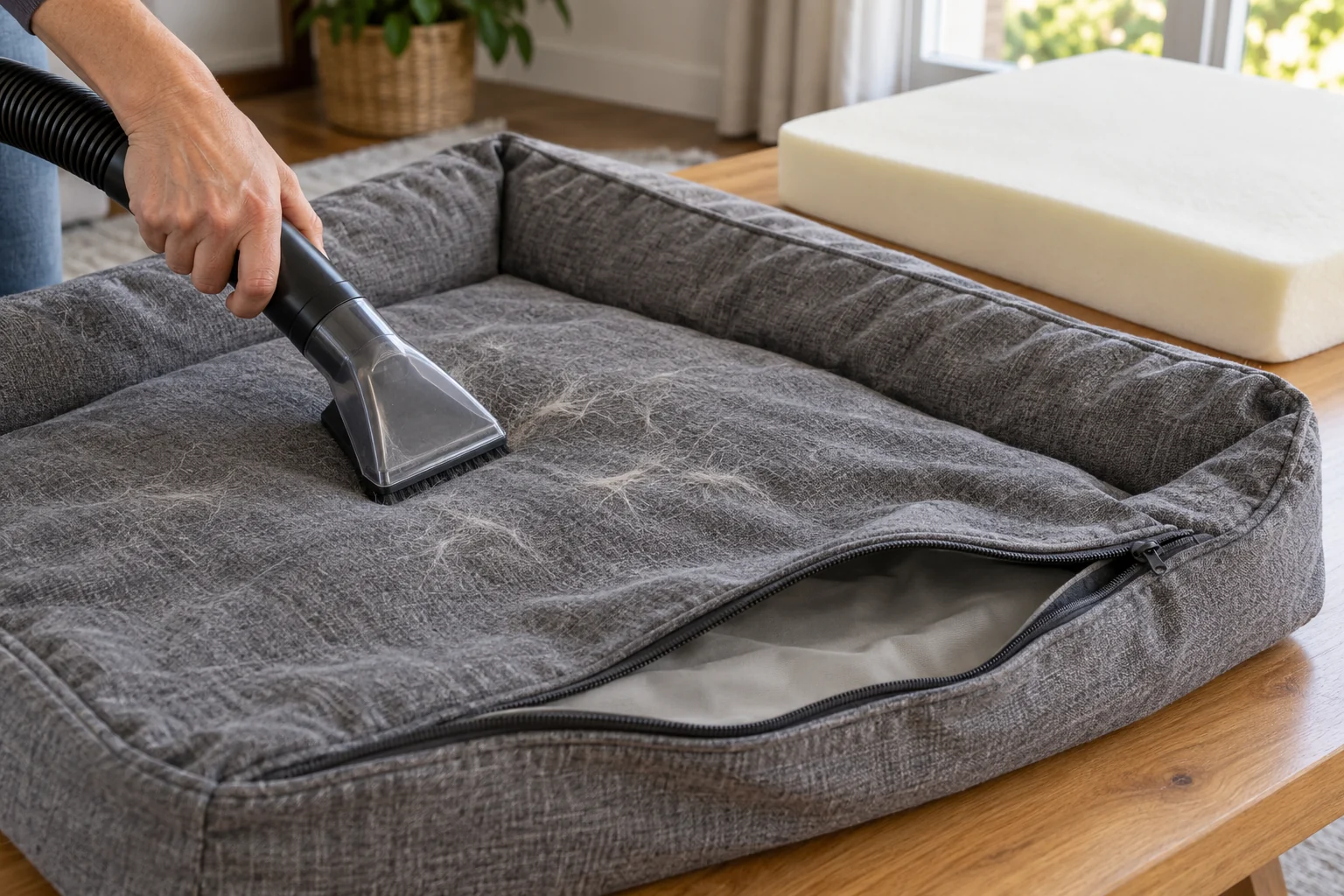
Take the bed apart only as far as its design allows. Unzip covers, lift out inserts, and remove bolsters where the construction intends them to come off. Don’t cut stitches, pry at a sewn panel, or detach a liner that’s fixed in place — if a part wasn’t built to come off, it gets cleaned where it sits.
Get the hair off while everything is still dry. Run a vacuum with its upholstery attachment across the sleeping panel, along the seams, and down the sides, then follow with a lint roller or rubber brush on plush surfaces. This step earns its place: wet fur mats into the weave, sheds into the wash water, and ends up in the machine instead of in the bin.
Inspect what you’ve taken off. Torn fabric, an open seam, a cracked zipper slider, or filling pushing through a seam all mean the bed has a problem that washing won’t fix — water and tumbling work a failing seam open rather than cleaning it. Deal with the damage first; don’t wash a broken bed and put it straight back into service.
Stains carry two sets of instructions, and both apply: the care label for the part, and the stain product’s own directions. If a remover calls for a method the care label forbids — a long soak, hot water — find a compatible approach or ask the manufacturer, rather than shortening the product’s required contact time and hoping for the same result.
Choose detergent the same way. Measure by the product’s label and the load, and pick something suited to the fabric and to a dog who sleeps nose-down against it — if your dog has sensitive skin, a detergent labeled for that case plus an extra rinse is the careful combination. More detergent than directed mostly becomes residue in the fabric, not extra cleaning.
Choose the Washing Method Each Part Allows
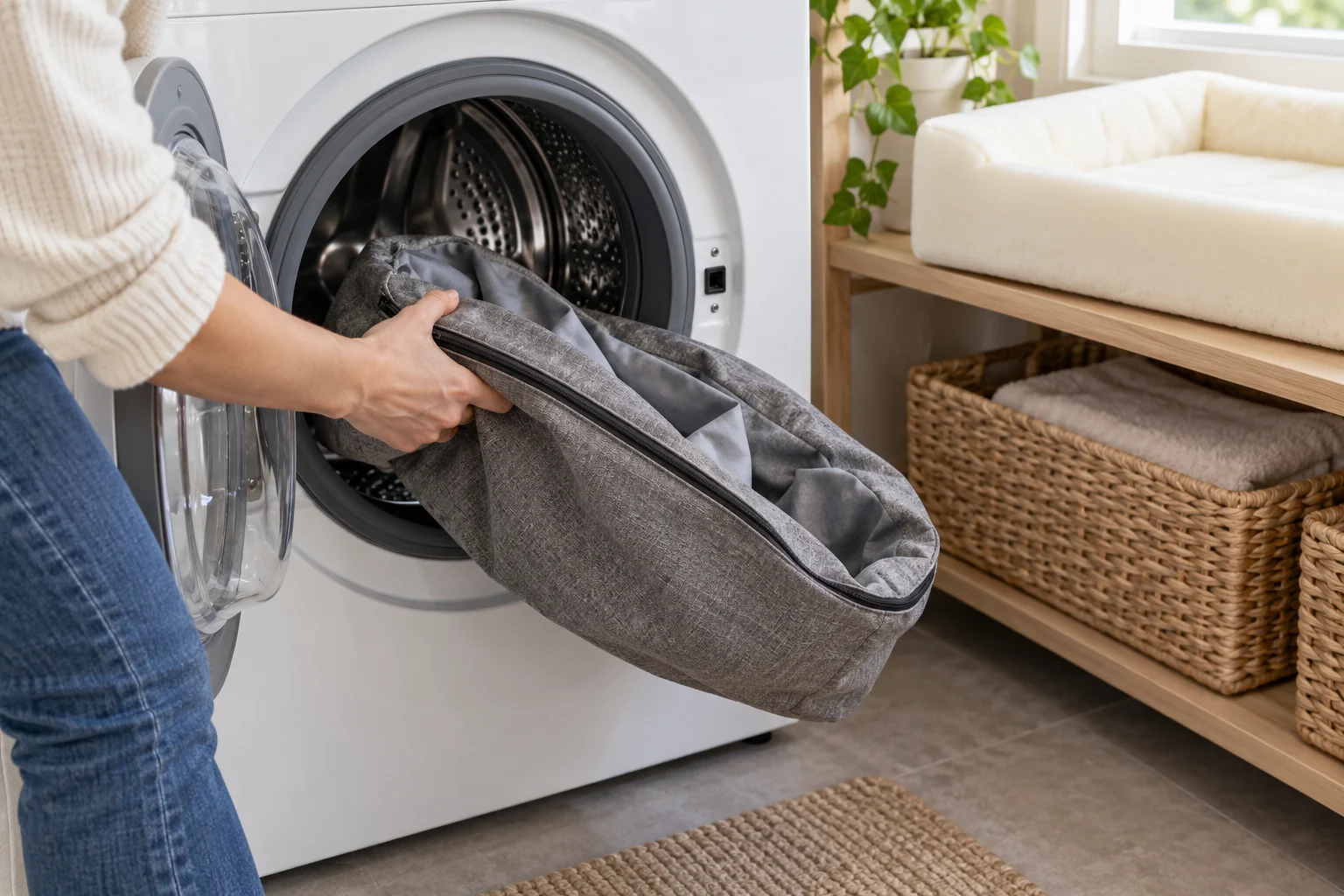
Once the parts are identified and prepared, the method follows from the permission — and neither direction is automatic. A bed with no removable cover hasn’t thereby gained a license for the tub, and a part that can’t go in the machine hasn’t thereby earned a soak. There are three branches.
Machine Wash the Cover — or a Whole Bed, if the Model Allows It
This is the branch most care labels describe, and the one most people mean by washing a dog bed cover. Before anything goes in, run two checks:
- The part’s permission. The instructions for this component name machine washing, and the temperature and cycle they name are the ones to use. There is no universal hot-or-cold rule for dog beds; the right setting is the one this label and your machine’s manual both support.
- The machine’s suitability. A bulky part needs room to tumble. If the door barely closes on it, the wash won’t be effective and the load can strain the machine — a part that fits only when compressed hasn’t really fit. A washer that’s too small for the item is a reason to use a larger-capacity machine or another allowed method, not to force it in.
Zip the cover closed before it goes in, so the zipper and the drum don’t snag each other. After the cycle, check the drum and lint area for hair the load left behind — a quick clear-out keeps it out of the next load of clothes.
Whole-bed machine washing is a specific design, not a default. Some manufacturers do build beds to go into the washer and dryer in one piece — West Paw, for instance, designs certain beds that way and publishes the machine-capacity requirements that come with them — but those instructions belong to those products. If your model’s documentation explicitly allows whole-bed washing, follow it, including its capacity notes. If it doesn’t say so, treat the bed as its parts, each under its own rule.
Hand Wash Only What Permits Soaking
Hand washing is an allowed method in its own right, not a fallback for parts denied the machine. Before any water goes in, confirm that the component’s instructions actually name hand washing — a “not machine washable” tag doesn’t grant it.
Where it is allowed, the sequence is straightforward: a basin or tub big enough for the part to move in; water at the temperature the instructions specify; a detergent that suits the fabric. Gently squeeze the fabric through the water, rinse until the suds are gone, then press the water out rather than wringing — twisting is hard on seams and can tear foam. Follow any soak time the instructions give, and where none is given, don’t improvise a marathon soak or borrow one from another guide; different fills and fabrics tolerate different exposure.
Spot Clean Foam, Liners, and Beds That Don’t Come Apart
Spot cleaning is the default for the strictest parts: many foam inserts and coated liners carry it as their only washing permission. The technique stays consistent — a cloth dampened with water or a mild solution the part’s instructions allow, worked from the edge of the mark inward; blotting rather than scrubbing; the filling behind the fabric kept dry; the area allowed to dry before anything goes back over it.
A one-piece bed belongs in this branch only if its care instructions permit surface cleaning. Follow the model’s instructions for the sleeping panel, sides, and base, working one section at a time.
One boundary is worth naming: this is daily cleaning, not disinfection — the two answer different questions, and neither substitutes for the other. Where a dog is unwell or a household has a specific hygiene concern, follow the guidance for that situation and the product’s instructions rather than turning up the wash temperature and hoping.
Dry Each Component Fully Before Reassembly
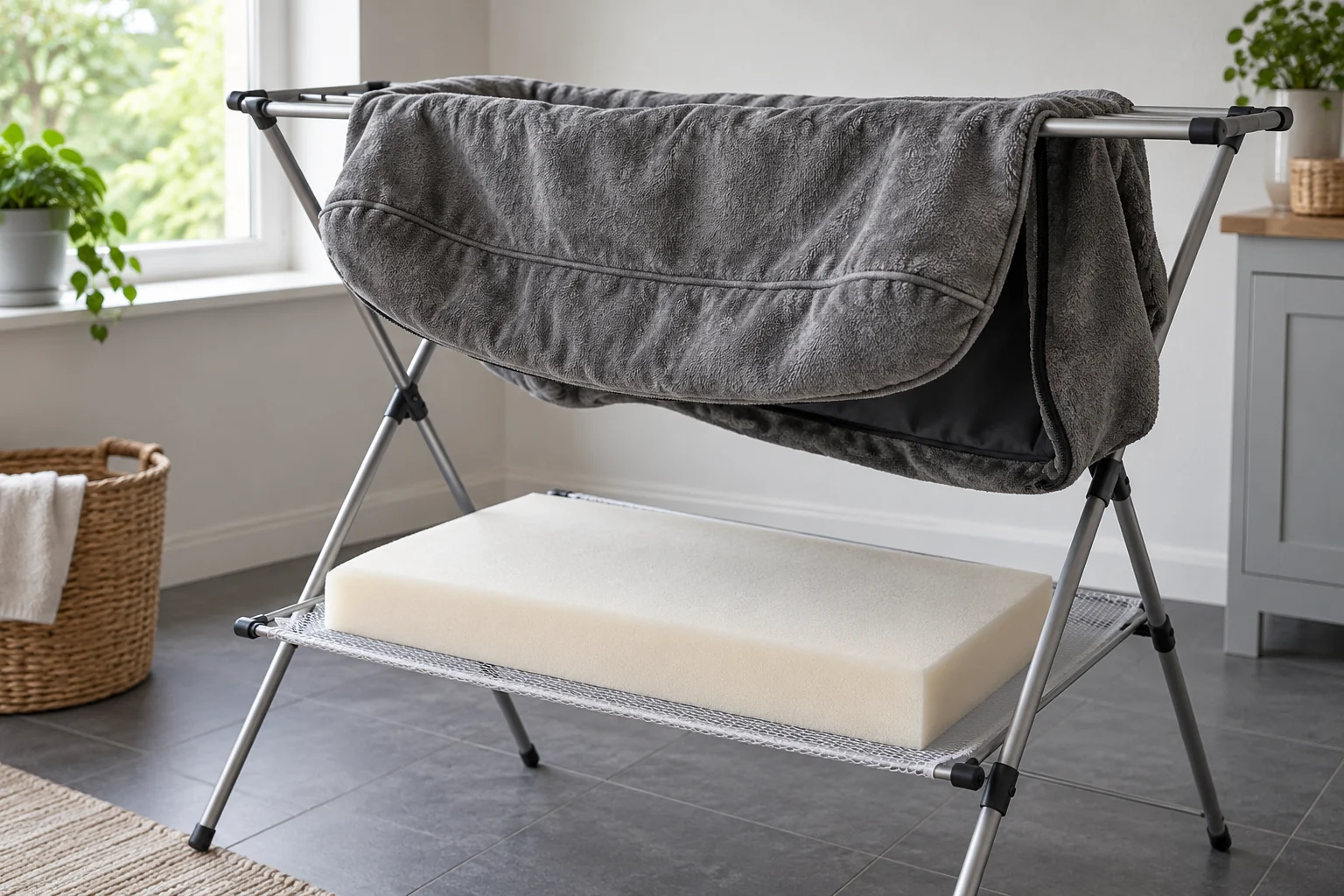
The dryer has its own permission line, separate from the washer’s. So, can you dry dog beds in a tumble dryer? The parts whose labels say so — nothing more. A component that came through the wash fine can still be damaged by heat its label never allowed: if the instructions name a dryer setting, use that setting, and if they don’t mention the dryer at all, don’t assume low heat is safe. Air drying is the default without an explicit dryer permission.
Air drying also follows the component’s instructions for placement. Some parts can be hung; heavy, waterlogged foam is better flat. Where the instructions don’t specify, give the part flat support, air on all sides, and a ventilated room — thick foam holds its water longest and benefits most from airflow. Direct sun is not a required finisher and not a disinfection step; prolonged exposure degrades some fabrics and coatings, so follow the product’s guidance rather than defaulting to the brightest spot outdoors.
Thick components dry slower than they look. A damp core can feel dry at the surface and carry no smell at all — neither check proves the inside is ready. Work by touch where you can reach: inside surfaces of covers, folded seams and edges, bolster corners, the thickest middle of an insert. Anything still cool or damp goes back to a permitted drying method. No honest universal hour estimate exists here; drying time depends on the part’s thickness, the room’s airflow, and the humidity.
Reassembly waits for every part. Zipping a damp insert back into its cover traps the moisture where air can’t reach it, so each component goes back only when it is fully dry and still in good condition — reshaped inserts, closed seams, working zippers. Return each part to the position it came from, close the zips fully, and if a cover comes back slightly snug after washing, work it on evenly instead of hauling on one seam.
Make the Next Clean Easier
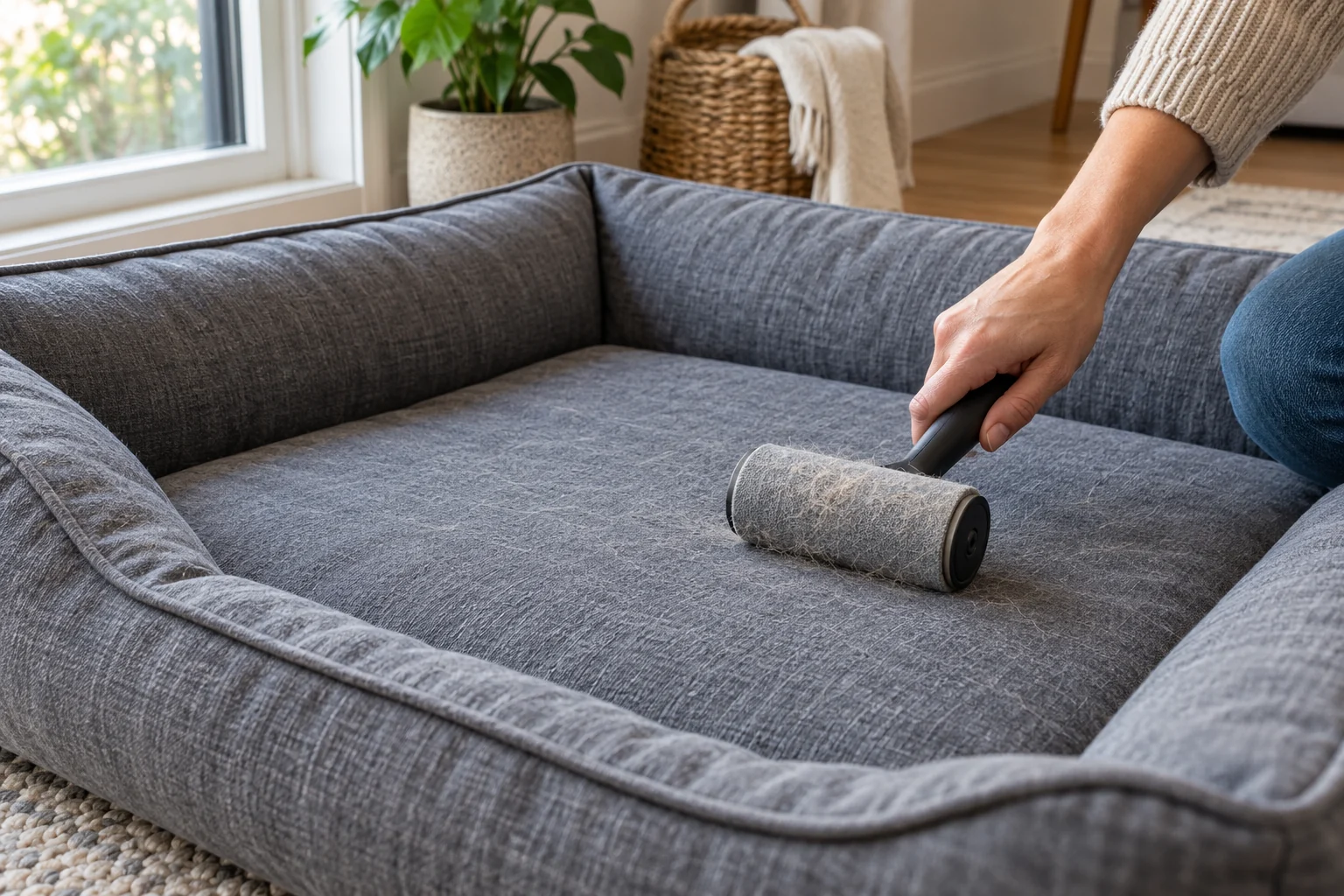
Most of the heavy work in a bed wash is hair and old marks, and both shrink with routine attention. Between full cleans, vacuum or lint-roll the sleeping panel, treat spots and accidents the day they happen with a method the label allows, and let the bed air in a ventilated room when it needs freshening rather than a full wash. Light surface care between washes keeps the deep clean rare.
How often should the full clean happen? It depends on the dog’s coat, the household, and how hard the bed is used. As one example of a routine, the CDC’s guidance on cleaning pet supplies suggests washing pet bedding about weekly — a workable baseline for a bed in daily use, not a requirement. Scale it to reality: heavier shedding or muddy walks call for more attention, and a bed used occasionally needs less. Scale it to the label, too — a weekly clean of a spot-clean-only insert means surface care on that rhythm, not a weekly soaking.
If a smell survives a permitted wash, or a part comes out misshapen or never quite dries, the answer is back in the model’s instructions and the component’s condition — not a hotter cycle or a scented spray. Heat the label doesn’t allow risks the parts you’re trying to save, and fragrance covers an odor without changing what causes it.
If care requirements have become the deciding factor in which bed works in your home, carry them into the next purchase: our guide to choosing a dog bed covers what to check about removable parts and care access before you order.
And if you specify or source beds rather than wash one, care requirements are set at sampling. It’s worth confirming with the supplier which parts detach, what each component’s care instructions will say, and how reassembly is checked on the finished product — that becomes the care label your customers rely on. The pet bed manufacturing page covers the formats and specifications you can bring to that conversation.
FAQ
Do laundromats allow you to wash dog beds?
Store by store — there is no universal policy. Ask the location you plan to use what its rules are on pet bedding, including any limits on size or condition; some laundromats welcome pet items, some restrict them, and some prohibit them outright. The bed’s own permissions travel with you: a larger commercial machine doesn’t loosen what the care instructions allow, so confirm the component’s label, the store’s rules, and that the machine suits the load before you fill it.
Can I wash dog bedding in the same machine as household clothes?
Generally, yes. The CDC notes that pet bedding and other pet items can be washed with the rest of the household laundry. The usual conditions still apply: follow each item’s care instructions, keep the load reasonable for the machine, and use products suited to the fabrics and to a dog sleeping on them. It isn’t an automatic pass for every bed — a spot-clean-only insert doesn’t belong in any machine, whatever else is in the drum. When a dog is ill or there’s a specific hygiene concern, follow the guidance for that situation rather than general laundry habits.
The Short Version
Three checks carry the whole job. What each part permits: read every component’s own instructions, not the cover’s alone. Which method that permission allows: machine, hand, or spot care, with the settings the label names. And whether every part is fully dry and back in place before the bed goes together again. A dog bed washed within its permissions comes through fine; the beds that get ruined in the wash are the ones washed beyond them.
If you’re developing a bedding range and want care requirements built in from the sample up, share the bed format, which parts you expect to be removable, the care performance you need, and your quantities and target market — contact us to discuss the specification.