Choosing safe chew toys for cats starts with the finished object: its size and shape, every material the cat can reach, attached parts, filling, surface condition, and what changes during use. Labels such as “natural,” “non-toxic,” “durable,” or “cat toy” leave those questions open. The individual cat’s habit of mouthing, gnawing, carrying, or dismantling the toy completes the decision.
There is no single material category that is safest for every cat. The practical goal is to screen one complete toy, watch the first uses, and remove it when the construction or the cat’s behavior no longer matches the intended activity.
Fit the Finished Size and Shape to the Cat
Begin with the complete toy. Treat its size label as a starting point. The object should be manageable enough for the cat to carry or hold as intended, yet too large to fit entirely into the mouth. A package marked “small” or “kitten” leaves that fit question open for the cat in front of you.
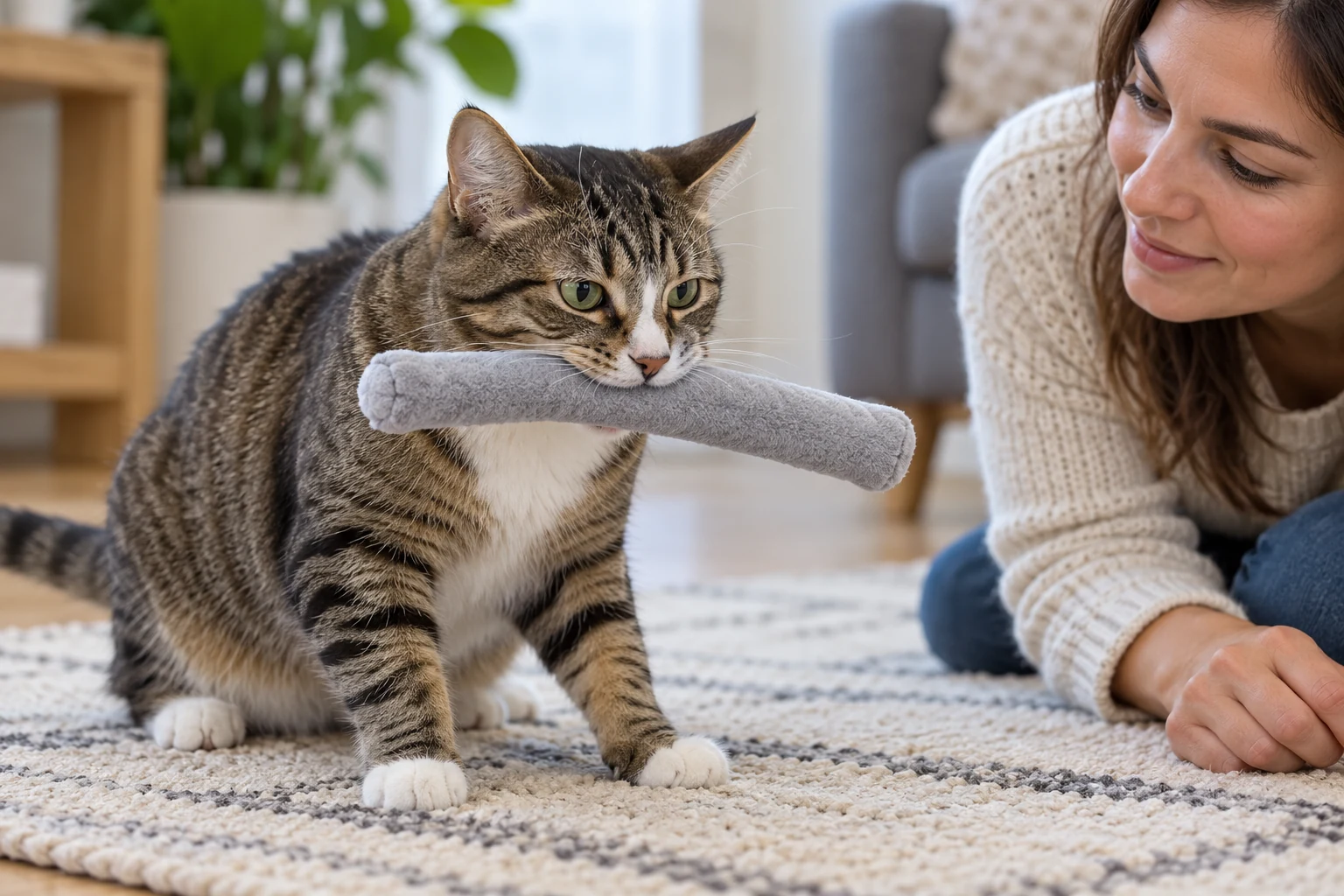
Shape changes the fit. A long soft body, a compact ball, a ring, and a toy with narrow ends can have the same catalog length while presenting very different gripping points. Find the part the cat is most likely to work backward into the mouth as well as the widest measurement.
| Finished feature | What to assess | Reason to reject the candidate |
|---|---|---|
| Overall body | Whether the cat can hold it without taking the whole item into the mouth | The complete toy disappears into the mouth or can be gulped |
| Narrow end or waist | Whether chewing concentrates force on a small section | The section bends, cracks, or begins to separate quickly |
| Opening or loop | Whether the cat’s jaw, tooth, claw, or collar could become caught during normal use | The opening distorts or creates an obvious trapping point |
| Raised detail | Whether it is part of the body or a separately attached decoration | The cat can grip and lift it away from the main structure |
| Internal moving piece | Whether it remains enclosed as the outer body wears | The cat gains access through an opening or damaged join |
Fit needs to be observed again after use. A toy that loses an end, opens at a seam, or compresses into a smaller shape may no longer present the same size decision as the new product.
Avoid a universal numeric rule. Cats differ in mouth size and in whether they carry gently, chew one edge, or try to swallow objects. The useful comparison is the actual toy in the actual cat’s mouth during intended use.
Read the Complete Construction Behind the Material Label
A material name describes only part of a chew toy. Fabric can surround filling or a sound insert. A molded body may include a seam, plug, coating, or embedded component. A wood or plant-based surface may have a finish, adhesive, or attached textile. Those details change what the cat reaches as the product wears.
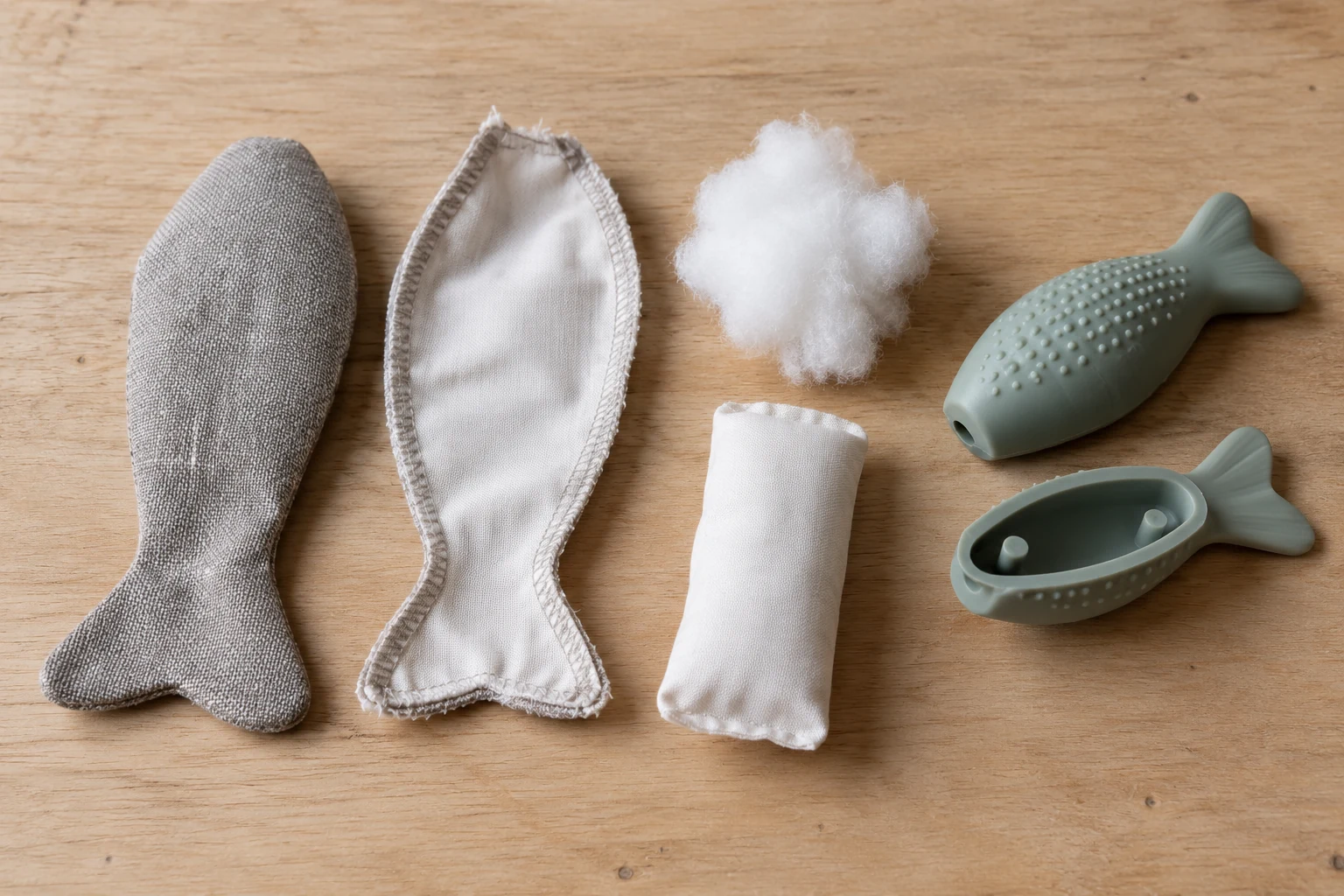
For any candidate, identify:
- the material at the chewing surface;
- what lies beneath or inside that surface;
- any colorant, coating, finish, scent, or treatment named by the maker;
- how separate parts join;
- the intended use and cleaning method for the complete item.
If those details are missing, the label cannot fill the gap. “Natural” does not identify every component, and “non-toxic” does not answer whether a piece can detach or whether the toy is appropriately sized. “Dental” is also not proof of a particular cleaning effect or suitability for a cat with an oral problem.
Surface condition matters as much as the original material. Run a finger over the item before use and examine it under good light. Set aside a unit with a sharp edge, split surface, exposed reinforcement, sticky residue, flaking finish, or an odor that is inconsistent with the product information. These observations do not identify a chemical or diagnose a hazard; they show that the received item does not match an intact finished toy.
Keep each conclusion tied to the version that produced it. A color, size, supplier, or design revision may change the coating, insert, attachment, or wall thickness. Store the product identity with any information you rely on.
Count Every Reachable Part and What Sits Behind It
Cats often work on the easiest feature to grip. A decorative ear, tag, loop, knot, cap, glued-on detail, or protruding insert can become the main chewing target even when the product is sold for its larger body.
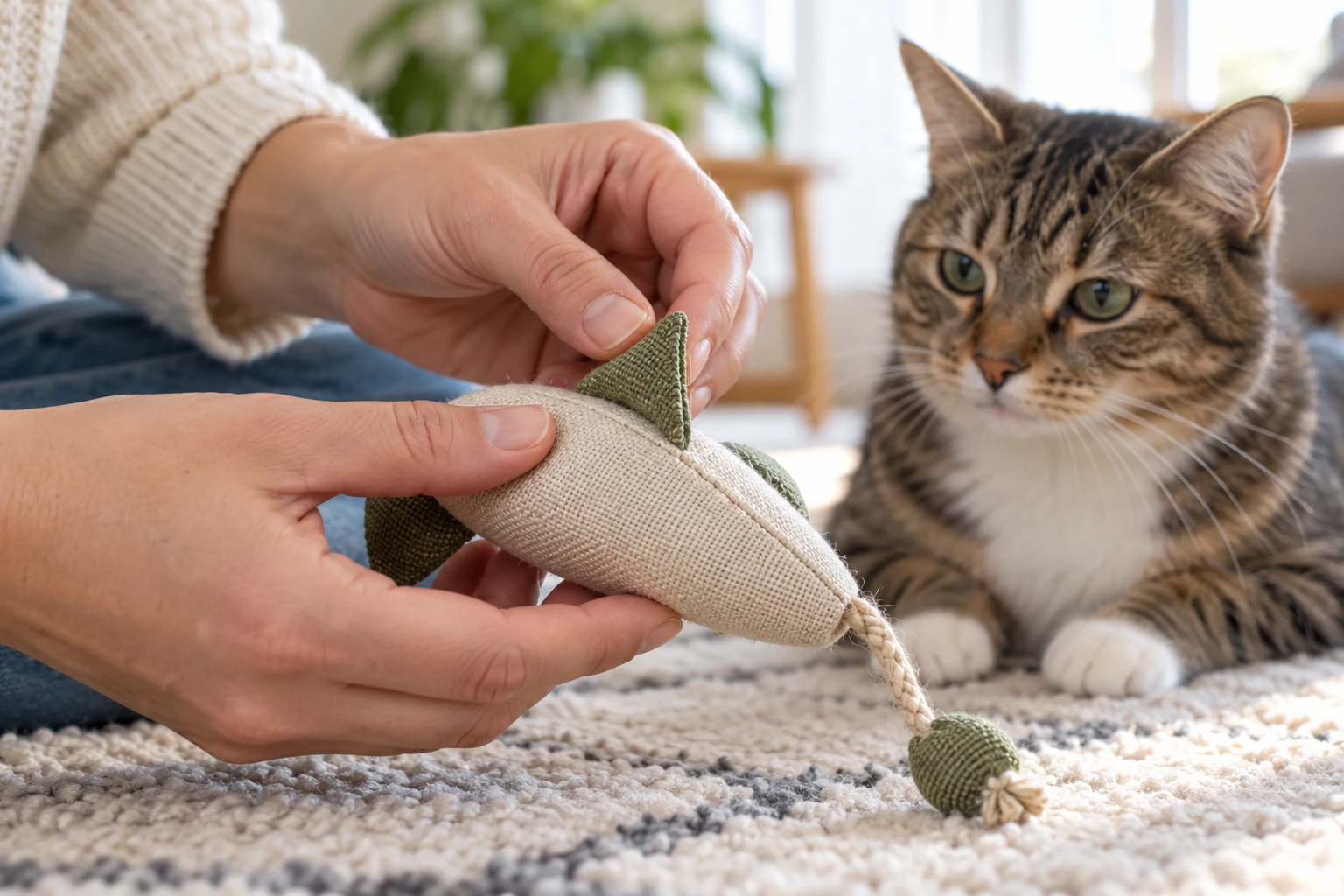
Look at each attachment from its outer edge back to the main structure. Is it molded as one piece, sewn into a seam, glued to a surface, tied through an opening, or held by a separate fastener? A home strength test is unnecessary. Map what can become loose, then notice any movement that was absent when the toy was new.
Soft toys need a second layer of review. Find the closing seam, press lightly around it, and identify any filling, scent pouch, crinkle insert, or sound component described by the maker. If the cat opens the cover or exposes the contents, the toy leaves use. Stuffing and internal pieces are not alternate chew surfaces.
The same principle applies to hard or molded toys. A plug, bell, battery door, or internal component described as enclosed still depends on the outer body remaining intact. Once an opening grows or a join separates, the original product description no longer represents what the cat can access.
Linear attachments and feathered play have their own safety questions and are outside this chew-toy guide. Keep them out of a chew-focused design and assess every attached play feature on its own terms.
Use the First Sessions to Learn How This Cat Chews
The first sessions are part of selection. Stay close enough to see the contact point and pause occasionally to inspect the wet toy, because saliva can make a lifted layer or shallow split harder to notice.
The cat’s action should change the decision:
- Mouthing and carrying: The body stays intact and the cat releases it easily. Continue observed use and review the same grip areas next time.
- Steady gnawing on one broad area: Look for compression, tooth marks, roughness, or surface loss at that exact point. A different shape may spread contact if damage concentrates quickly.
- Picking at a seam or decoration: Stop the session when the feature begins to lift. A larger body does not compensate for an accessible small part.
- Biting off material: Remove the toy. Supervision may let you interrupt the event, but it does not turn a product the cat can dismantle into a suitable chew.
- Trying to gulp the whole object: Choose a different size and geometry. Closer supervision leaves the fit unchanged.
Use directions still matter. Some products are designed for short, person-present sessions; others may exclude chewing despite their shape. If the instructions and the cat’s behavior conflict, stop that use.
Treat a successful first session as evidence about that unit and that cat at that time. Chewing can become more forceful as the cat learns where a toy gives way, and the condition of the object changes over time.
Retire the Toy When Its Condition Changes
Base replacement on visible change. A fixed number of days ignores how quickly the specific cat alters the specific toy. Its useful lifespan ends when the object no longer remains intact under that use.
Before returning it, compare the high-contact area with a part the cat rarely touches. That contrast can reveal gradual thinning or roughness that is hard to judge from memory.
| Change you find | What it means for use |
|---|---|
| Seam opening or exposed filling | The interior is now reachable; remove the toy |
| Loose decoration, cap, plug, or insert | A formerly attached part can separate; remove the toy |
| Missing piece | Stop use and account for what is missing |
| Crack that opens under light handling | The body no longer behaves as an intact unit |
| Flaking, splintering, sharp wear, or peeling surface | The original chewing surface has changed; remove the item |
| Permanent size or shape change | Reassess fit as a changed object |
| Damage around an enclosed mechanism | Retire the mechanism with its weakened housing |
Cleaning does not repair structural damage. Follow the care method for the complete product, then inspect seams, joins, and surfaces after cleaning before the toy returns to use.
If a piece is missing or you think the cat may have swallowed part of the toy, remove the remainder and keep the product information. Contact a veterinarian for advice based on the cat and the item involved. Treatment and observation timing belong in that professional conversation.
Separate a Home Choice From a Buyer Specification
For a pet owner, the decision ends with one cat and one product. A buyer developing or comparing a line needs enough detail to tie observations to the exact sample and prevent them from spreading to every item with the same material name.
A useful sample record includes:
| Field | Record for the exact sample |
|---|---|
| Intended activity | Mouthing, carrying, short chew session, food holding, or another defined use |
| Finished dimensions and weight | Whole object plus narrow sections, openings, and protrusions |
| Component map | Chewing surface, body, filling, inserts, attachments, coatings, and connectors |
| Construction | Molded transitions, seams, joins, closures, and access to internal components |
| Product directions | Intended user, use setting, supervision language, exclusions, care, and retirement conditions |
| Observation record | Where the cat applied force, what changed, and when the sample left use |
| Version identity | Model, size, color or formula variant, supplier reference, date, and revision |
This information supports comparison and carries no safety certification. If a material, coating, test method, or claim matters to the product, request the specific document that covers the selected component and finished version. Apply the report only to the sample, color, and construction it covers.
For consumer-facing information, state what the product is designed to do and the conditions that end use. Avoid “indestructible,” “safest,” or material-wide assurances that the observed sample cannot establish.
FAQ
What are safe things for cats to chew on?
There is no universal category that is safe for every cat. Start with a cat-specific toy that is too large to fit wholly in the mouth, has no reachable loose parts, identifies its complete construction, and remains intact during observed use. Remove it if the cat begins to dismantle it.
What can I give my cat to chew on instead of plastic?
Changing the label from “plastic” to “natural” leaves size, attachments, coatings, and wear unresolved. Compare complete cat-toy products by finished fit, component information, surface condition, and the way your cat uses them. Treat household objects and plant materials as unevaluated rather than automatic substitutes.
What are the best toys for cats to chew on?
The best match is a finished toy the individual cat can hold as intended without swallowing whole, opening seams, or removing pieces. A soft carry toy, molded chew form, or other design may work differently for different cats, so the first sessions decide whether the format stays in use.
What can I give a teething kitten to chew on?
Choose a product intended for kittens or cats, assess the whole size and every attachment, and watch how the kitten uses it. Remove the toy if material comes off or the whole object fits into the mouth. A toy label cannot assess pain, bleeding, difficulty eating, or uncertainty about a kitten’s mouth; ask a veterinarian about those concerns.
Conclusion
Take one chew toy you are considering and examine it as a finished object. If the whole item can fit into the cat’s mouth, a part already moves, the contents are unclear, or the surface is damaged, choose another candidate. If it passes that screen, watch the first session and record the exact area the cat chooses to chew; that point becomes the focus of every later condition check.