Choosing toys to keep cats busy starts with a small mix matched to the way your cat plays, rather than a large pile of similar toys. Use what your cat already chooses to chase, bat, hide in, scratch, wrestle with, or search for. Then decide which activities need you present, which fit solo play, and when fading interest or damage takes an item out of rotation.
This approach gives each toy a job. It also avoids treating “interactive,” “smart,” or “indoor” as a guarantee that a particular cat will engage with it.
Match Toys to the Way Your Cat Actually Plays
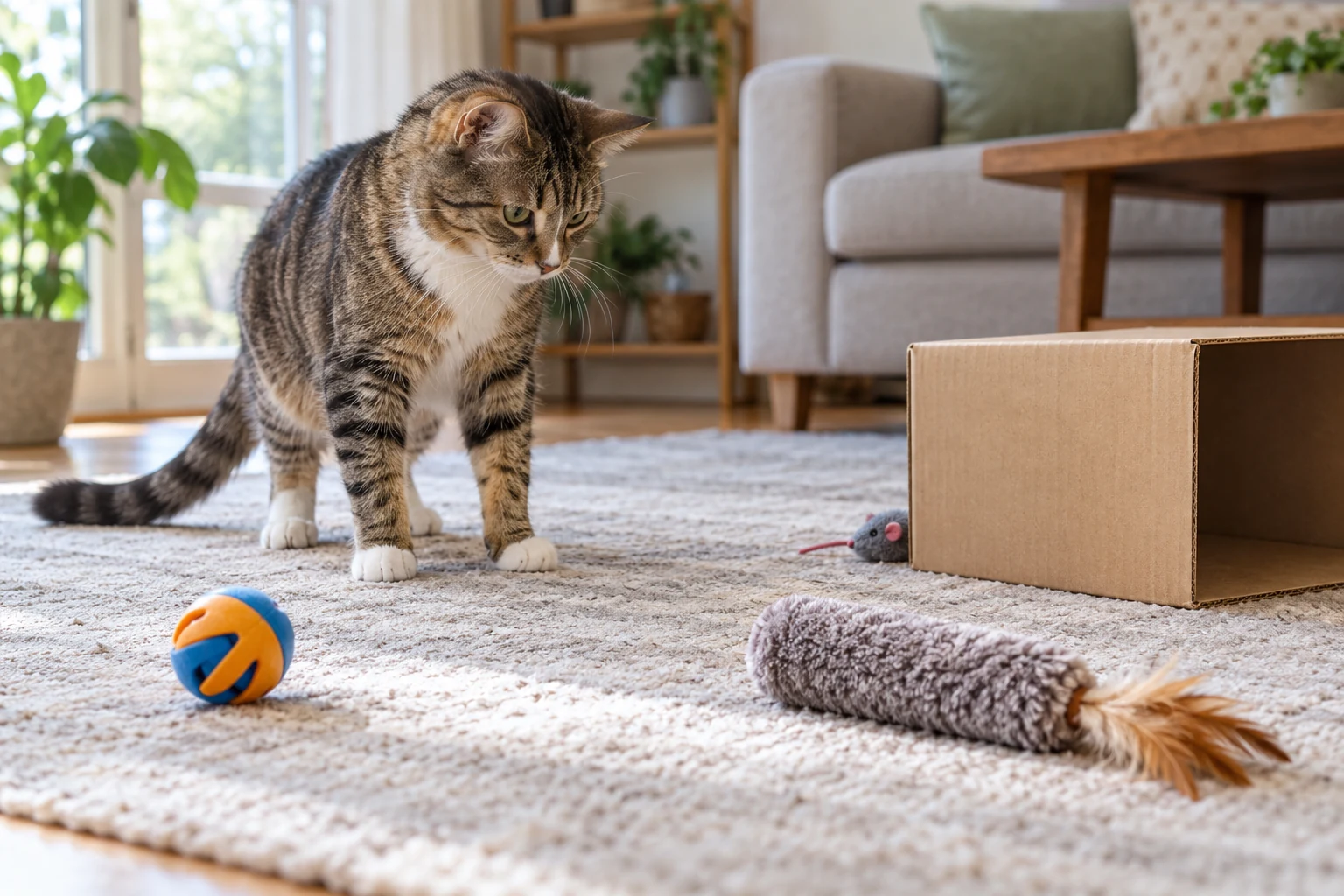
Start with the movement that earns a response. Shopping categories come later. Cats vary in what catches their attention: an object crossing the floor, a target disappearing behind cover, something light enough to bat, or food that takes a little work to reach. A short observation with toys you already own usually reveals more than a list of best sellers.
| What you see | A format worth trying | What to notice next |
|---|---|---|
| The cat follows low, quick movement | A rolling toy or an enclosed ball track | Whether the cat chases, waits to ambush, or loses interest once movement stops |
| The cat reaches under rugs or furniture | A concealed-motion game or a target moved behind a box | Whether partial hiding holds attention better than an exposed object |
| The cat jumps for movement above the floor | A person-guided wand or lure | The preferred height and speed, with the toy stored after the shared session |
| The cat grabs and kicks with the back feet | A suitably sized soft kicker | Whether the cat holds the body of the toy or works at an attachment or seam |
| The cat explores bags, boxes, and openings | A tunnel, open box, or hide-and-pounce setup | Whether the cat uses it for hiding, passing through, or waiting for a moving target |
| The cat paws at food or searches around the feeding area | A simple stationary or rolling food puzzle | Whether the starting difficulty lets the cat succeed without abandoning the task |
The first response does not have to become a permanent label. A cat may prefer floor-level chasing one week and spend more time hiding or carrying objects the next. Age, mobility, the room, and the way a toy moves can all change the response.
When comparing two toys, change one feature at a time. Try ground movement before buying several rolling products, or compare an exposed target with one that disappears behind cover. That makes the cat’s choice easier to read.
Build a Small Mix Instead of Buying More of the Same
Create variety through different play opportunities. Changing the color of the same object leaves its role unchanged. A practical mix can cover a few distinct roles:
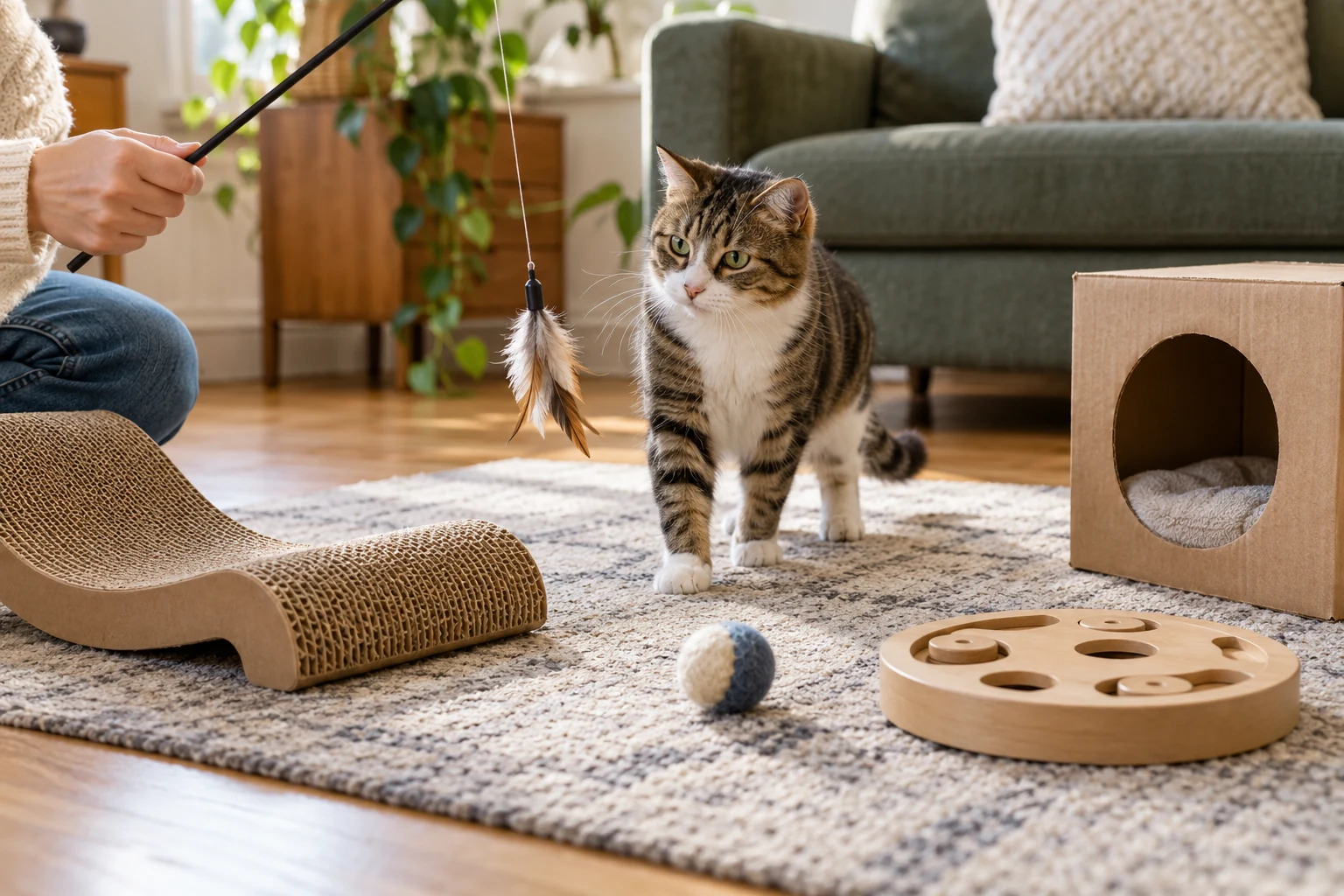
- Shared chase and capture: You control the movement and let the cat stalk, pursue, and catch the target during the session.
- Cat-powered batting: The cat starts the action by pushing a ball, spring, or enclosed track component.
- Hiding and ambush: A tunnel or box changes the space and gives movement somewhere to appear and disappear.
- Scratching: A stable scratching surface offers a different activity from carrying or chasing.
- Food search: A puzzle turns part of the cat’s normal food allocation into a task without adding an unlimited stream of treats.
A few roles at a time are enough. Choose one or two that match what the cat already does, then add a contrasting activity. A cat with several rolling balls may gain more from a hiding structure or a simple food-search task than from another ball with lights.
Food puzzles deserve a gradual introduction. They may be stationary, requiring the cat to reach into or move parts of a board, or mobile, releasing food as the object rolls. Begin with an easy setup and familiar food. If the cat cannot obtain anything, simplify the task; extra difficulty will only hide whether the format interests the cat.
Treat food used in a puzzle as part of the daily feeding plan. In a multi-pet home, placement also matters: another animal should not be able to take over the puzzle or block the cat’s access. Those details decide whether the toy offers a usable search activity in that household.
Decide What Can Be Available When You Are Away
A toy for solo play has to work without a person creating the movement, and it must suit what this cat does with it. The word “automatic” solves only the first part.
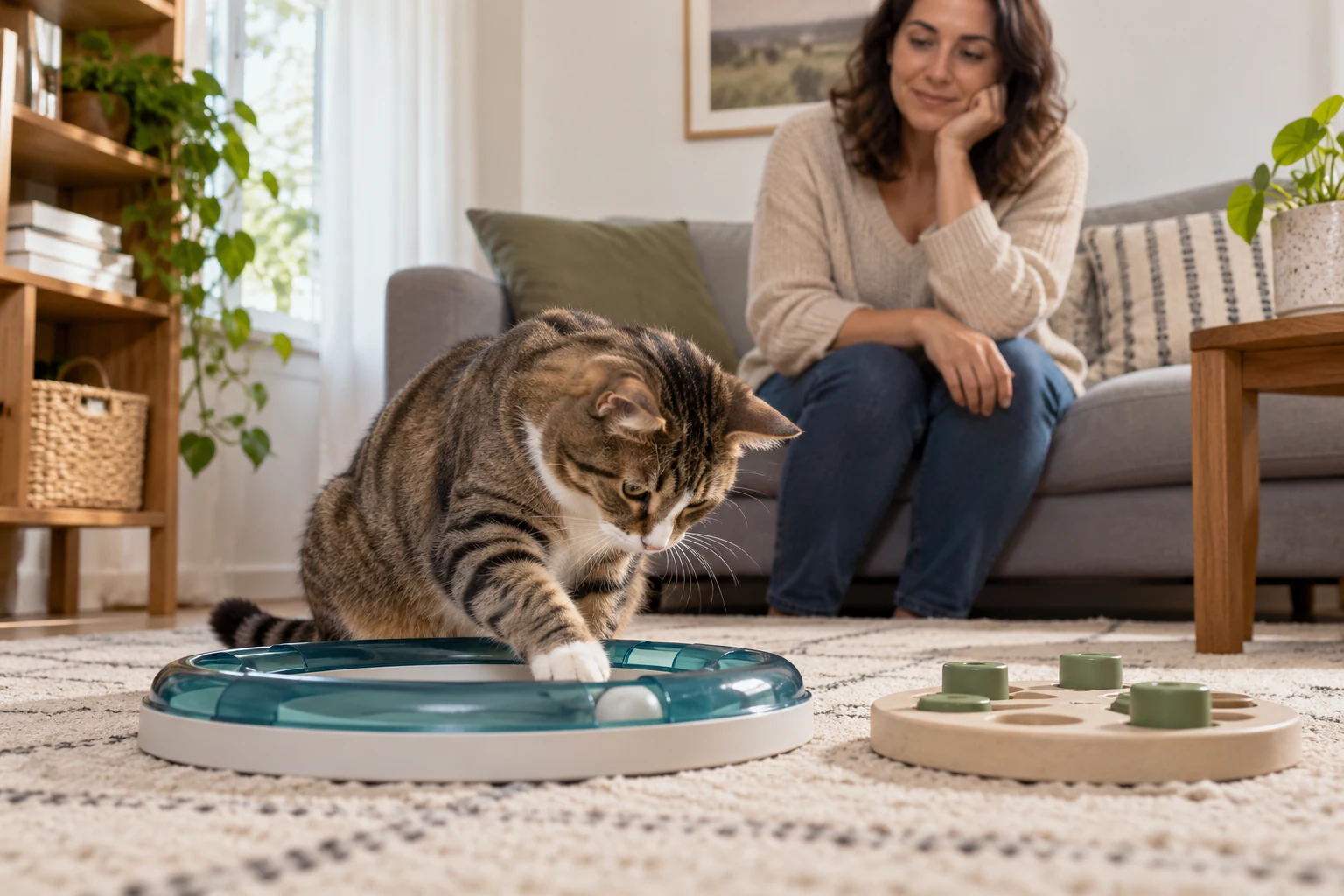
Watch a new toy through several ordinary sessions before deciding where it belongs. An enclosed track, stable puzzle, appropriately sized object for batting, or sturdy open tunnel may be reasonable for independent use when the cat interacts with the intended part and the item stays intact. A person-guided toy with a long line or an easily removed attachment belongs back in storage after play.
Electronic toys add practical questions. The battery compartment and moving mechanism should remain inaccessible during use, the base should stay stable on the chosen floor, and the motion path should not send the cat into fragile objects or an unsafe landing. Automatic shutoff may limit running time, but it does not establish that the whole product is suitable to leave out.
There is no useful “safe while home alone” label that replaces observation. If the cat chews a connector, opens a seam, traps the toy under furniture, or concentrates on a small removable feature, move that product into supervised use or choose another format.
Keep shared play in the mix. Independent options fill part of the day; a person can add changing speed, pauses, and direction for a cat that enjoys pursuit.
Let the Cat’s Interest Set the Rotation
Let the cat’s response set the rotation. An old toy may stay uninteresting even after time in storage. Keep a manageable selection available and store some alternatives out of sight. Swap one when its role has become repetitive or when the cat repeatedly passes it without engaging.
Leave a clear favorite available if the cat still uses it. Rotation is meant to restore contrast, not remove an object simply because a schedule says its turn is over. A tunnel used as a regular resting or ambush place may remain valuable even when the cat is no longer running through it every day.
When a stored toy returns, alter the context before buying a replacement. Move the track to a different open area, put the box near a route the cat already uses, or bring a rolling puzzle back at its easiest setting. One change gives you a readable result; changing the toy, room, reward, and timing together does not.
Interest is only one reason to remove an item. Condition takes priority. Open seams, exposed filling, loose pieces, damaged surfaces, or an accessible internal component end the current use even if the cat remains eager to play.
Adapt the Mix for Night, Home-Alone, and High-Curiosity Cats
Use the same play roles in versions suited to each situation.
For time home alone, favor cat-powered or reliably self-starting formats that have already passed observed use. Place them where movement will not send pieces under an appliance or block a shared resource. If food is involved, account for the portion and for other pets in the room.
For nighttime, sound and location matter. A soft object, stable food puzzle, or enclosed track may fit a sleeping household better than a hard ball on a bare floor. Moving the activity away from the bedroom can help with noise, but a toy cannot guarantee a quiet night or change a cat’s schedule on its own.
For a cat that solves simple tasks quickly, adjust one challenge at a time. Change the opening, movement pattern, hiding place, or route while keeping the task achievable. Judge a “smart” toy by how well its difficulty matches the cat’s current skill; mechanism count is irrelevant.
For more movement, use the play style that already produces a response. A cat that follows floor-level prey may travel farther for a rolling target or a lure moving between pieces of furniture. A cat that prefers ambush play may move more when the target repeatedly appears on opposite sides of a tunnel. Use the toy as an opportunity and measure the cat’s response; exercise results vary.
Bring a sudden or concerning change in nighttime activity, willingness to play, appetite, or mobility to a veterinarian. Continually increasing stimulation can obscure a change that needs professional attention.
Read Size, Parts, and Use Limits on the Finished Toy
Play style narrows the format, but the finished object still has to fit the individual cat and the way it will be used. Examine the unit in your hand as well as its broad material or category name.
For a ball, spring, or carry toy, consider whether the whole object or a separated part could fit into the cat’s mouth. For a soft toy, look at seams, tails, ears, sound components, and filling. For a tunnel or track, check the openings, supports, connectors, and access to the moving piece. On an electronic product, include the battery door and charging cover in the inspection.
The product directions should make its intended use and limits understandable. Keep a toy in person-guided play when that is how it is designed. A product the cat can rapidly take apart remains a poor match even during a supervised session.
A quick condition review can follow the points where the cat applies force:
- Look at the exact area the cat bites, kicks, scratches, or paws.
- Compare it with a low-contact area of the same toy.
- Remove the item if a component has loosened, an interior layer is visible, or the shape has changed in a way that creates a smaller detachable piece.
- Keep the model and care information with any replacement so the next comparison is about the same construction.
This is also why “durable” is incomplete. A useful description identifies the intended activity, finished dimensions, components, care method, and visible retirement conditions. Durability still has to be observed in the individual cat’s use.
Turn the Same Decisions Into a Clear Product Brief
For a buyer comparing cat-toy samples, play style should appear in the brief before materials and colors. “Interactive cat toy” is too broad to tell a supplier whether the target behavior is batting, carrying, hiding, scratching, food searching, or person-guided pursuit.
Record the format and the job it must perform, then keep the sample details tied to that exact version:
| Brief field | What to define |
|---|---|
| Intended interaction | Cat-powered, person-guided, food-search, hide-and-pounce, scratching, or another specific use |
| Finished dimensions | Overall size plus any opening, protrusion, detachable module, or internal moving part |
| Components | Outer body, filling, inserts, attachments, connectors, supports, and accessible mechanisms |
| Use limits | Where a person must participate, where storage is required, and which environments are excluded |
| Care and retirement | Cleaning method for the complete item and visible conditions that end use |
| Sample identity | Model, size, revision, and date so observations are not transferred to a changed construction |
That record supports one defined sample and play role. It also lets a buyer revise the sample without losing track of what changed; engagement still depends on the individual cat.
FAQ
How do I keep my cat entertained all day?
One device will not provide continuous entertainment. Combine a few different opportunities, such as a place to hide, something to bat, a scratching surface, a simple food-search task, and a shared play session, based on what the cat actually uses. Rotate a portion of the selection when interest fades.
What toys can keep a cat busy when home alone?
Choose cat-powered or self-starting toys that the cat has already used as intended while you watched. Enclosed tracks, stable puzzles, suitably sized batting toys, and sturdy open structures are possible formats. Store person-guided toys and any item the cat tries to dismantle.
What can I use to keep my cat busy at night?
Look for a quiet version of a play style the cat already likes. A stable puzzle, soft carry toy, or enclosed track may make less household noise than a hard loose ball. Place it thoughtfully, but do not treat the toy as a guaranteed solution for nighttime activity.
How can I mentally stimulate a cat that ignores toys?
Begin with an easy, observable task. Move a target in the way the cat already follows, hide part of it behind cover, or introduce a simple food puzzle with familiar food and an easy release. If interest in play has changed suddenly or is accompanied by other changes, ask a veterinarian about the cat rather than escalating toy difficulty.
Should I leave toys out for my cat at night?
Leave out only items that have stayed intact through observed use and work without a person. Put away toys with long lines, person-controlled attachments, accessible mechanisms, or any part the cat has started to loosen. Recheck the available toys before returning them to the floor.
Conclusion
Watch one ordinary play session before adding another toy. Identify the movement or task that holds this cat’s attention, then choose one contrasting format for a small rotation. On the next session, look for one result: whether the cat starts the activity without prompting, completes the task without frustration, or shows that the toy belongs in a different use setting.