Cleaning a cat tree is a part-by-part job: remove fur and loose debris first, wash only the textiles your model explicitly allows to be removed and washed, spot-clean fixed surfaces with a compatible cleaner, and keep liquid away from the core structure. Then let everything dry fully and put it back together properly before the cat climbs on again. The sections below cover each step and the conditions that keep it safe.
Check the Parts Before You Choose a Cleaner
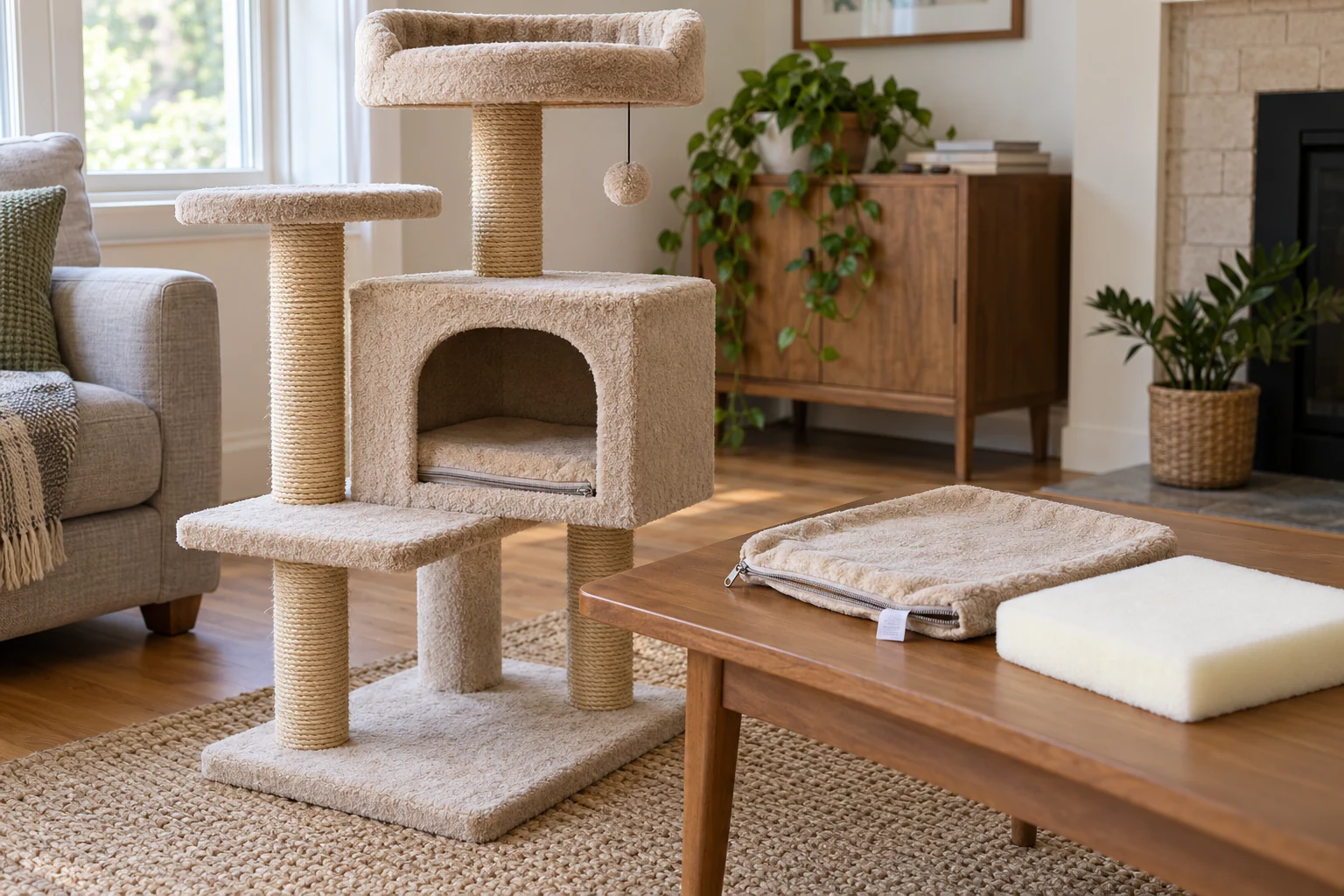
A cat tree is not one material with one cleaning rule. Whether you’re dealing with a compact scratching post or a floor-to-ceiling cat tower, the parts fall into the same few groups, and each reacts differently to water and cleaning products. Before anything gets wet, work out which of these you are actually treating.
| Part | What it usually is | First response | What to confirm first |
|---|---|---|---|
| Outer covers and beds | Fabric shells, sometimes with zippers or hook-and-loop closures | Remove only what the design allows to detach | Care label or model FAQ: machine wash, hand wash, or spot clean only |
| Inner padding and foam | Foam or fiberfill inserts | Usually stays with the tree unless designed to come out | Whether the insert itself is washable or only its cover is |
| Platforms and panels | A board core under carpet or fabric | Dry methods and light spot cleaning | How much moisture the core tolerates — never soak it |
| Sisal posts | Rope wound around a post | Vacuum and brush along the winding | Whether fraying is normal wear or loose wrapping |
| Hardware and connectors | Screws, brackets, wall anchors | Wipe if dusty | Nothing needs loosening for cleaning |
Color and appearance aren’t reliable material guides: a cover that looks like cotton can be a blend, and a soft-looking platform can hide a board core that must stay dry inside. If you’re unsure what a layer is made of, our cat tree building materials guide explains how outer fabrics, cores, and rope differ, and why that changes how each one is cared for.
Prepare before you start. Collect the care labels (still attached or saved from purchase), the manufacturer’s product page or FAQ, and enough floor space to lay out whatever you remove. Move the cat to another room — open cleaners, loose fur, and a curious cat are a bad mix. Detach only what the design intends to detach; never force a module apart or loosen a wall anchor to clean more deeply. A job that requires breaking the structure isn’t cleaning anymore.
Remove Fur and Loose Debris First
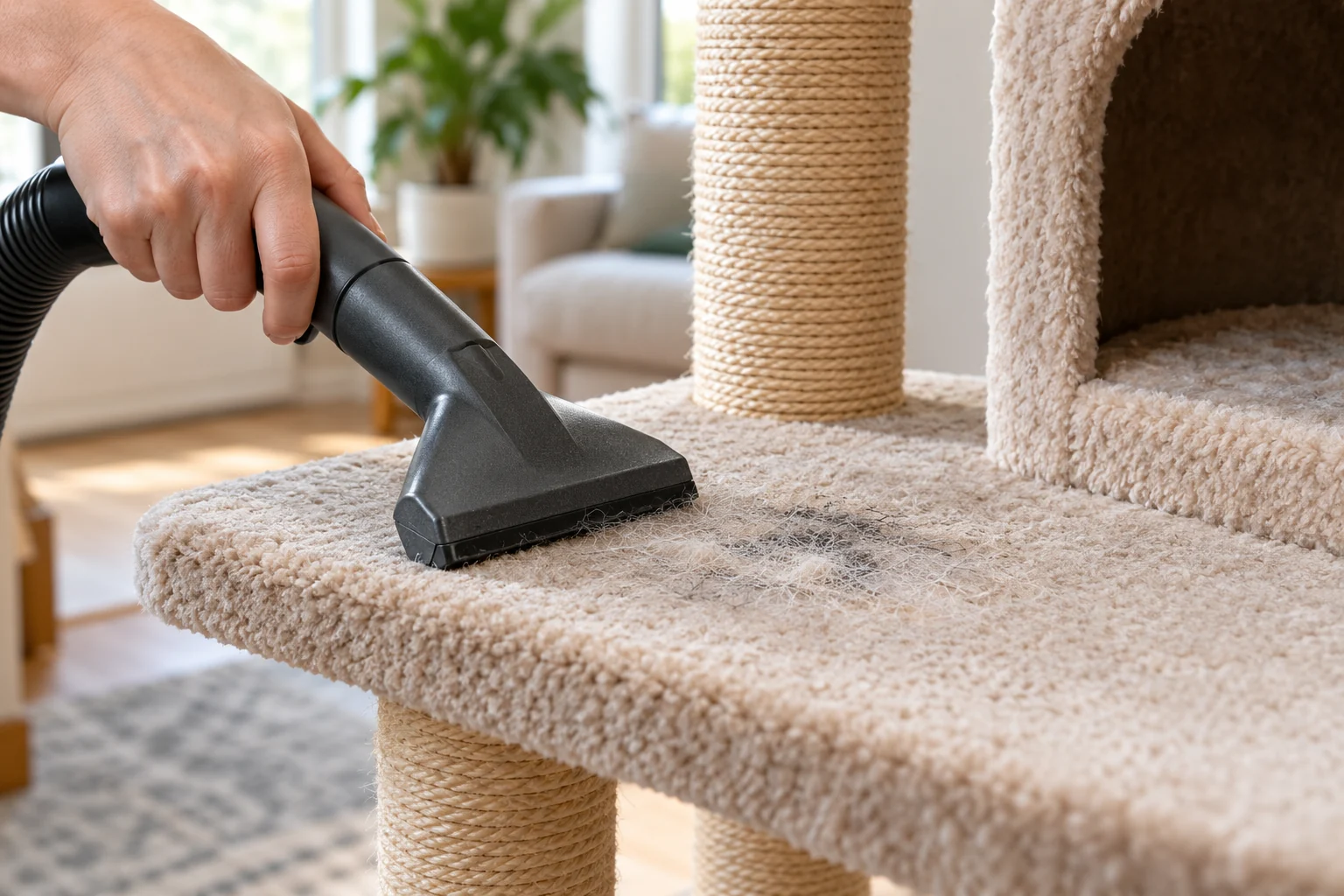
Everything dry comes off before anything gets wet. Wet fur mats into fabric, clogs cloths and sponges, and turns a simple wipe into smearing dirt around. Dry removal first keeps every later step shorter.
Work from the highest platform down to the base, so debris that falls lands on sections you haven’t cleaned yet:
- Vacuum with an upholstery attachment. Run it flat across platforms, along condo and cubby walls, and over the seams where fur collects. A crevice tool reaches corner joints and the gaps where platform meets post.
- Roll or brush the fabrics. A lint roller lifts what the vacuum leaves on smooth covers; a rubber brush or grooming glove pulls embedded fur out of carpeted surfaces in short strokes.
- Follow the rope on sisal posts. Vacuum or brush in the direction the rope winds instead of scrubbing across it — fur sits on top of the strands and lifts off easily.
- Finish at the base and the floor around it. Debris pushed off the tree collects at the bottom, so clear there last, including the underside edge of the base.
One caution: if brushing starts pulling at the surface, stop. Loose fibers shedding from a worn carpet layer are normal wear, but scrubbing harder to “clean through” a fraying area only damages it further. Fur removal should never cost you the surface itself.
How often this dry pass is needed depends on the household. A one-cat home with a short-haired cat goes longer between passes than a multi-cat home with heavy shedders. Let the platforms answer the question: when fur is visible in the fabric or drifting off during play, it’s time, regardless of the calendar.
Wash Removable Textiles Separately
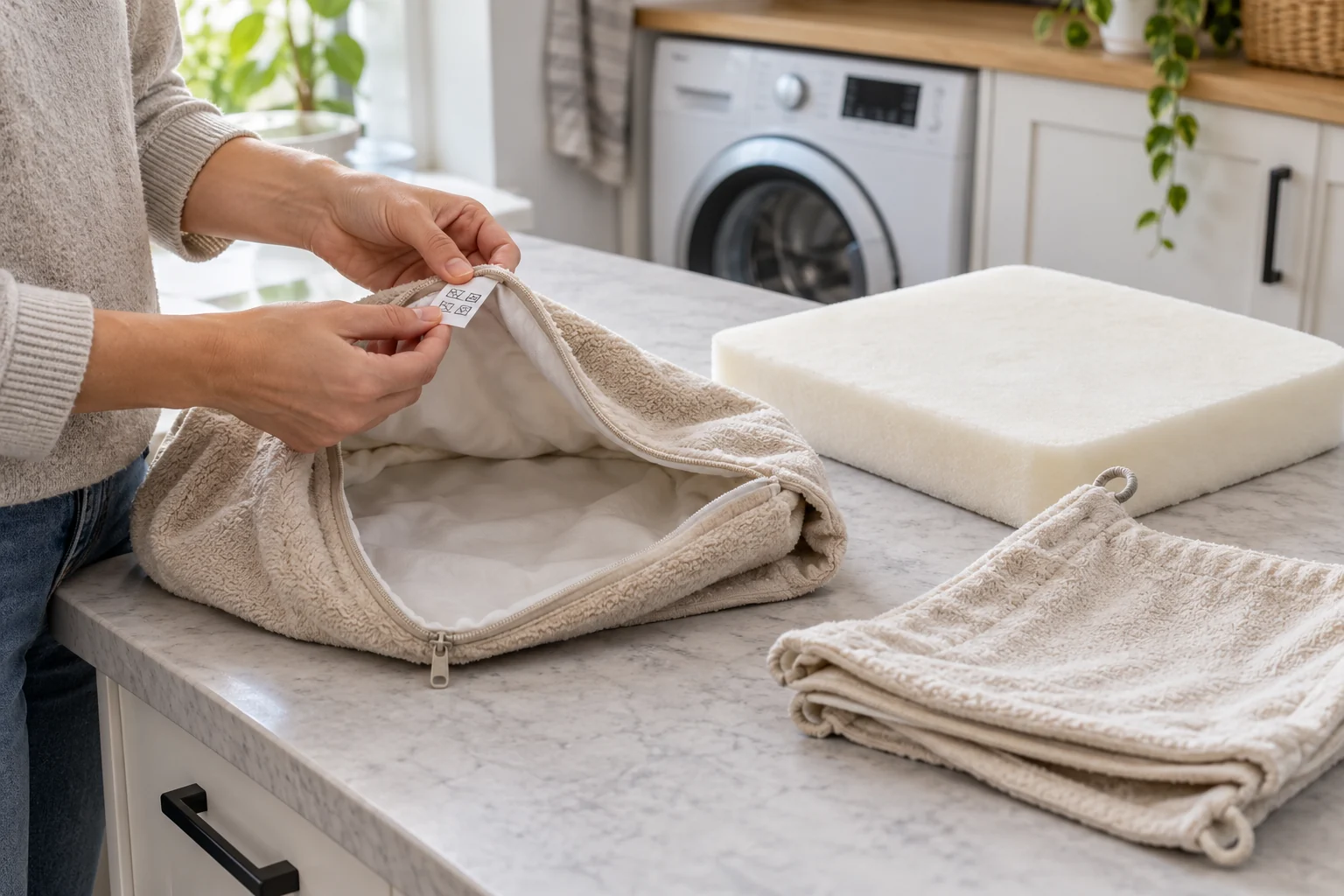
If your model has covers, mats, or a hammock designed to come off, those are the only parts of the tree that belong near a washing machine — and only if their own instructions say so. Check every piece separately: coming off the same tree doesn’t mean two pieces follow the same rules.
For each piece:
- De-fur it first with the same dry methods above. Washing a fur-loaded fabric packs the fur into the weave and into your machine.
- Read its care label or the manufacturer’s FAQ — whichever it came with. Confirm machine or hand washing, water temperature, and drying permission. Don’t assume a temperature because a similar-looking cover tolerated it.
- Wash only what the label permits, only as wet as it permits. Foam inserts are often spot-clean-only even when their fabric cover is machine washable; confirm the insert and the cover separately.
- Rinse and dry as directed. In practice, that means fully drying before anything goes back on the tree — more on that below.
Care requirements can differ even within one brand’s lineup. Catastrophic Creations, for example, maintains a care FAQ that separates its standard fabric covers from TPU-lined ones, with different cleaning instructions for different generations and materials of the same furniture line. The takeaway isn’t their specific rules — it’s that “fabric” alone tells you nothing about washability. Check the label or FAQ for your exact model, and don’t carry one product’s settings over to another.
With the covers off, take the chance to vacuum the exposed platforms and pads underneath — the spots you normally can’t reach.
Spot-Clean Fixed Surfaces With a Compatible Method
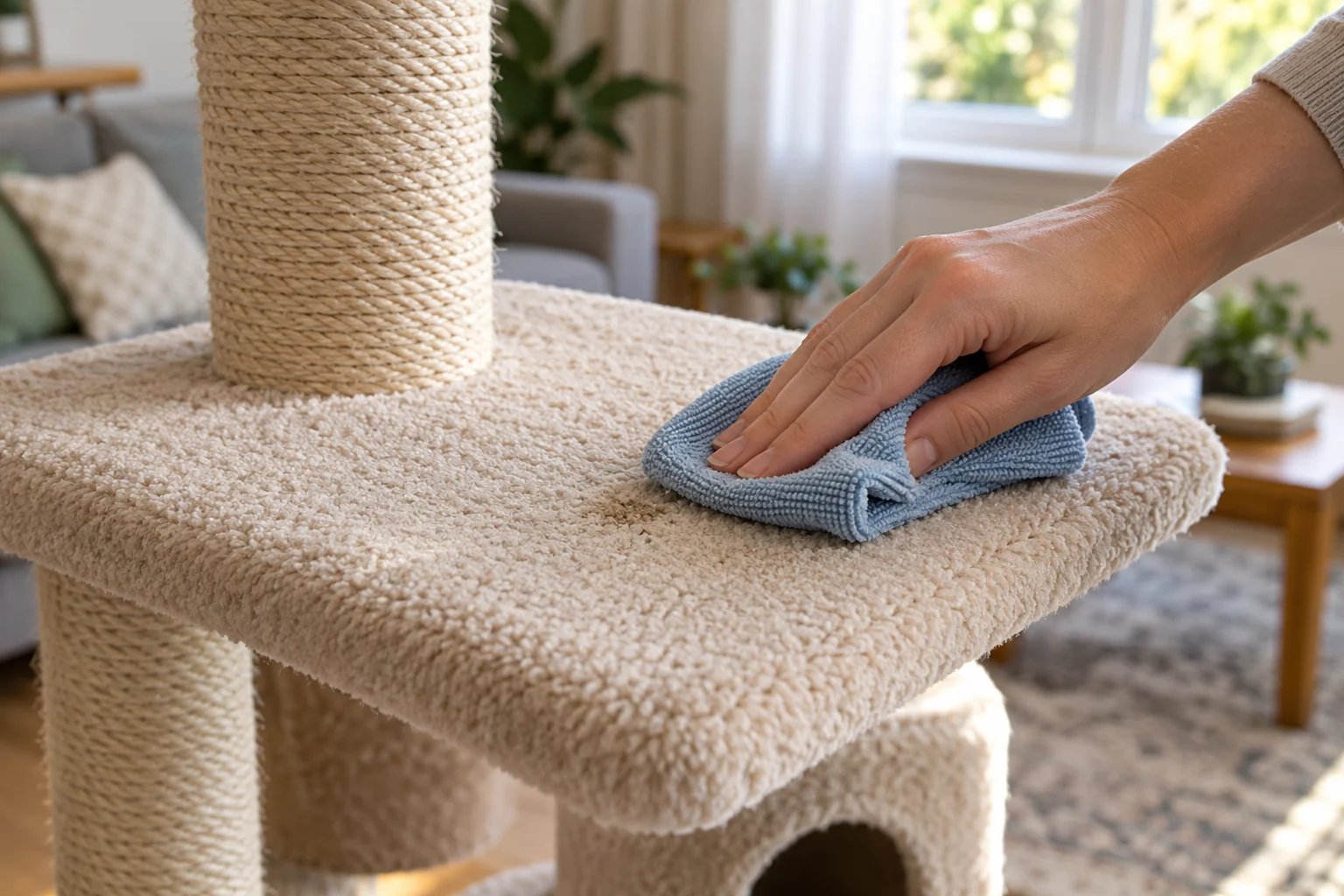
Everything still attached to the tree — carpet glued to platforms, fabric on walls, sisal posts, wooden or composite parts — is cleaned in place. That means two checks before any cleaner touches it:
- Can this part handle moisture, and how much? Board cores under carpet tolerate a damp cloth, not saturation. Your model’s care instructions set the ceiling.
- Is this cleaner suitable for this surface and this use? Product labels state which surfaces they’re for, how to apply them, how long the surface should stay wet, and whether rinsing is required. Both sides have to line up.
If a product’s method conflicts with the part’s care limits — say it requires soaking a surface whose core can’t be soaked — don’t override the care limit just because the fabric looks similar to something the product lists. Choose a method that satisfies both sets of instructions, or check with the manufacturer before proceeding. “Compatible” means the part’s rules and the product’s rules are both satisfied, not just one.
Fixed Carpet and Fabric
Dampen a cloth with water or a cleaner labeled for the surface, wring it out well, and work the spot from the outside in so the stain doesn’t spread outward. Blot rather than scrub. Use small amounts of liquid — the surface fibers should be damp, not the board underneath. Where the product label calls for rinsing, go over the area with a clean, water-only cloth and let it dry.
Hard Surfaces and Sisal
Hard platforms, wood steps, and plastic parts wipe down with a cloth and an appropriate cleaner, followed by a dry pass. For sisal posts, stay dry-first: vacuum and brush, and for sticky residue use a barely damp cloth along the rope and dry it promptly. Sisal holds water against the post it’s wound around, so less liquid is always better on this part.
Stains and Odors
Act on stains early — set-in soil is harder to lift and more likely to leave a mark. Treat odor at its source instead of covering it: a fresh scent is not evidence the spot is handled, and residue that still interests the cat will keep drawing it back to the same place.
It’s also worth keeping two words apart: cleaning and disinfecting are not the same job. Cleaning removes dirt, debris, and many germs physically; disinfecting kills germs chemically, under its own label rules. The CDC’s guidance on cleaning and disinfecting pet supplies is direct about the difference: follow product label directions, and don’t rely on vinegar — a popular household suggestion — to do a disinfectant’s job, because it isn’t a registered disinfectant. For a healthy household, regular cleaning is the appropriate routine. Disinfecting becomes relevant in specific situations — suspected infection, parasites — and those call for veterinary guidance and products used strictly per label, including the EPA’s notes on registered disinfectants: the right product for the surface, the contact time the label requires, and no improvised recipes.
Let the Parts Dry, Then Restore the Setup
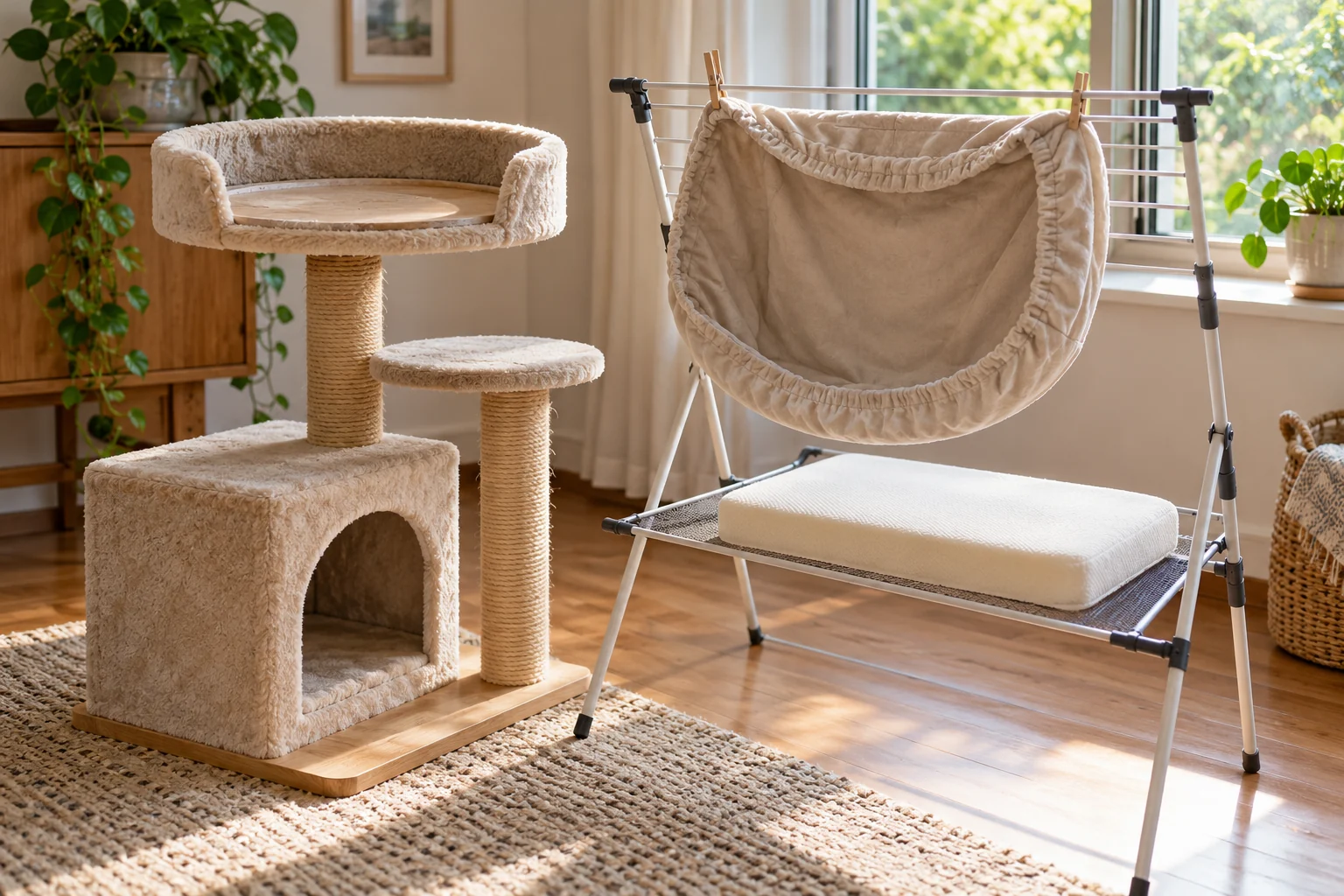
Nothing goes back on the tree — and the cat doesn’t come back to it — until the parts are dry. “Dry” means checked, not assumed.
Check each part separately:
- Covers and beds: the fabric surface first, then the seams, then the underside where fabric folds around edges. Seams hold moisture longest.
- Foam and padding: press on it. If it feels cool or heavier than its dry self, moisture is still inside — foam is the slowest thing on the tree to dry.
- Spot-cleaned fixed surfaces: touch the middle of the cleaned area, not the dry ring around it.
- Condo and cubby interiors: the corners and floor seams, where air moves least. Enclosed boxes need extra time.
A part that “feels dry” or “has been sitting for a few hours” isn’t a verified dry part. Moisture left in padding or board cores causes exactly the damage cleaning was meant to prevent — damp fabric over a board core is how odor and softening start. When in doubt, give it more time in a ventilated room.
Reassemble in the reverse of the order things came apart, and check the work: connections tight, posts seated, platforms level. Then test stability before the cat does — press down on the top platforms and give the tree a gentle shake. A wobble usually means a connection to reseat and retighten. If the wobble or visible damage remains after that, take the tree out of use until it’s actually fixed. A loose screw is a cleaning-day task; a cracked platform or a failing joint is a structural problem no cleaning routine addresses, and it’s the point where maintenance hands over to repair or replacement. Don’t glue structural parts back together — a glued load-bearing joint can fail without warning.
Hammocks and detachable beds follow their own instructions for reassembly order and hanging hardware, so don’t generalize one model’s routine to another. Special models — heated inserts, attached electronics — follow their product’s care rules and stay cat-free until fully dry and checked.
Keep the Routine Small and Regular
Consistency beats deep cleaning. A short dry pass with the vacuum during normal house cleaning keeps fur from packing into the fabric, and it’s the cheapest maintenance the tree gets. Let what you see set the schedule:
- Fur visible in the fabric or drifting off during play → dry pass now.
- A stain, or a spot the cat keeps returning to → spot-clean that part; the rest of the tree doesn’t need the same treatment.
- Removable covers looking tired or still smelling after drying → wash day for those pieces, per their labels.
- Posts, platforms, and seams, checked while you clean → catches fraying rope, loose hardware, and soft spots while they’re small.
What “regular” shouldn’t become is a standing appointment to wet the whole tree. Frequent light cleaning, with water only where it’s needed, is the routine; washing washable parts happens when those parts need it, not because a date arrived. Some cleaning guides suggest a monthly deep clean as a starting point — treat that as a reference, not a rule. The right frequency is the one your tree’s condition and your own schedule can actually sustain. If spare covers are available for your model, rotating two sets makes wash days painless: the tree stays in service while one cover dries.
FAQ
Can I steam clean a cat tree?
Only if both the tree’s construction and the steamer’s instructions allow it. Steam pushes moisture into materials — the exact thing most board-core trees are built to avoid — so treating the whole unit with steam is a decision for the manufacturer’s care documentation, not an improvisation. If your model’s instructions don’t mention steam, treat that as not approved and stay with dry removal and approved spot cleaning. And if steam is permitted for your unit, follow the steamer’s own surface guidance for distance and contact; steam cleaning is a cleaning method, not a sterilization treatment — those are different claims with different rules.
Can I use the same routine for a secondhand cat tree?
Mostly, with one honest limitation: the routine cleans what you can see, and a secondhand tree arrives with history you can’t see. Run the same steps — identify the parts, dry-clean first, spot-clean, dry fully — and add checks the unknown history makes important: examine every part for wear, staining, softening, or damage before investing effort in it; confirm what the materials actually are, since labels are often gone by the time a tree changes hands; and accept that ordinary cleaning removes dirt and fur but doesn’t rule out parasites, fungal spores, or other contamination the tree may carry. If there’s any reason to suspect a health issue — the previous household had a sick cat, or the tree was stored somewhere questionable — ask a veterinarian before bringing it home and near your cat. For a tree with known history, the routine above is the whole story; for one without it, the routine plus a professional opinion is the safe version.
The Short Version
A cat tree stays clean and structurally sound through one habit: match the method to the part. Fur and debris come off dry and often. Removable textiles get washed exactly as their own labels permit. Fixed surfaces get the least liquid that does the job, with cleaners chosen for the surface and used per the label. Everything dries completely and goes back together properly before the cat returns. The same routine protects the covering and the board core at the same time.
If you’re specifying cat trees rather than cleaning one — for a brand, a retail line, or a private label — this part-by-part logic is how care requirements get written into a product brief: which covers detach, what each fabric tolerates, what the core is made of, and how those choices change aftercare. PetsourcingPro builds custom cat trees and can work through those specifications with you; if you have structure, fabric, washability, and quantity requirements to discuss, send the details through the contact page.