Cat tree building materials include panels for the base and platforms, posts between levels, fabric coverings, scratching surfaces, and the hardware that joins them. A listing that says only “wood and sisal” leaves several of those parts unexplained. The material under the fabric may differ from the visible finish, and a rope-covered post may have a hollow core.
For a finished cat tree, the useful question is what each component is made of and how it can be maintained. For a DIY project, a shopping list is only the starting point: the parts need a construction plan with matching connections. This guide separates those decisions without turning a material name into a promise about the finished tree.
An Overview of Cat Tree Construction Components
The base, platforms, and cubby walls form the panelwork; posts connect the levels; coverings and scratching surfaces sit over or alongside that structure. Looking at these groups separately makes a vague product description much easier to read.
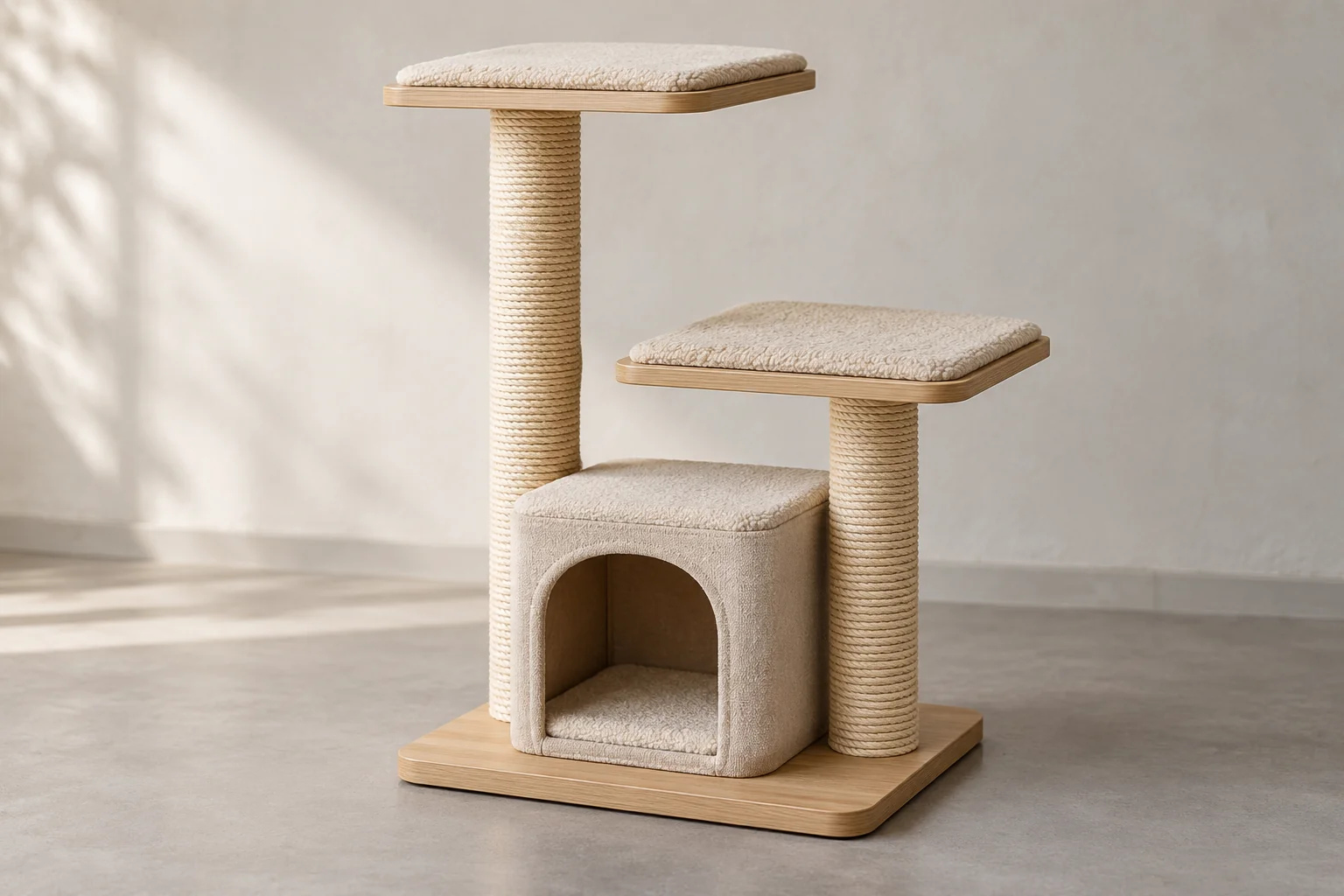
| Component | What the description should identify | A useful detail beyond the material name |
|---|---|---|
| Base and platforms | Solid wood, plywood, MDF, or particleboard | Panel dimensions, thickness, and exposed-edge finish |
| Support posts | Solid wood or a specified hollow core | End fittings and connections to the panels |
| Resting surfaces | Carpet, plush, fleece, or a separate cushion | Fixed covering or removable pad; care instructions |
| Scratching areas | Rope, woven fabric, carpet, or another named surface | Where it is attached and whether that part is replaceable |
| Connections | Bolts, screws, inserts, brackets, or other fittings | Hardware schedule and assembly instructions for that design |
These details belong to different parts. A plush bed says little about the platform underneath it. Likewise, a sisal-covered column describes its outer surface, not its core or connection. A component list should keep those layers distinct rather than call the whole tree “solid wood” because one exposed piece shows grain.
Structural Core Panels: Engineered Wood vs. Solid Timber
Solid wood, plywood, MDF, and particleboard are different panel options. Fabric can hide all four, so the appearance of a covered platform is a poor way to identify its core.
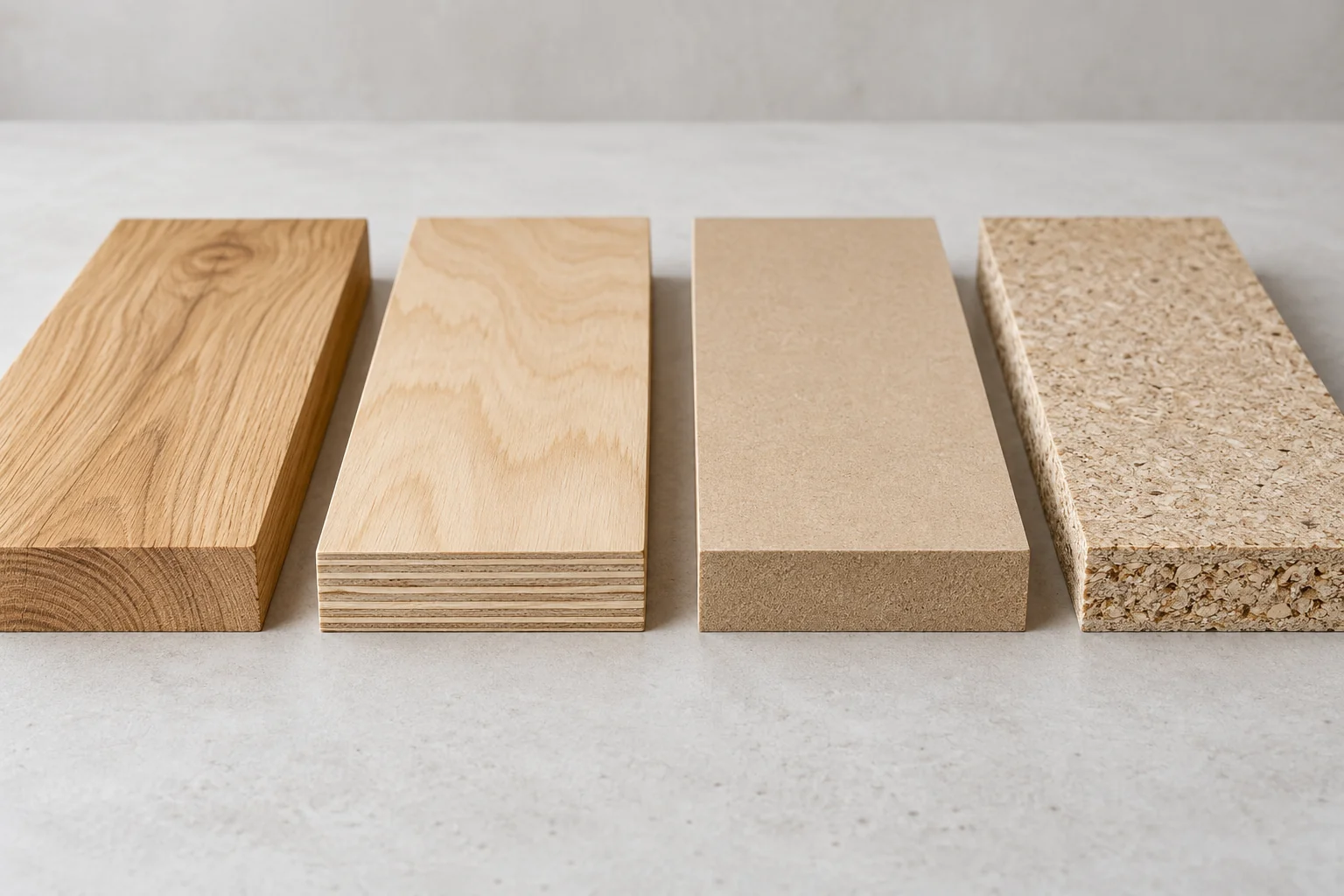
Solid wood and plywood
Solid wood is timber rather than a panel made from bonded particles or fibers. The species, piece dimensions, surface finish, and joint design still need to be specified. “Natural wood” is too broad to describe all of them.
Plywood is made from bonded layers of wood veneer. Its layered edge can be visible on an uncovered part. A decorative wood veneer on another board is different: a wood-looking top surface does not establish that the core is plywood or solid timber.
MDF and particleboard
MDF, or medium-density fiberboard, is made from fibers combined with a bonding system. Particleboard uses wood particles and a binder. They are distinct composite panels; MDF should not simply be listed as a type of particleboard.
A product specification should name the actual board. For a covered base, useful accompanying details include the panel thickness, edge treatment, and how the posts attach. Those details let you compare the same component across models without assuming that every board in a category performs alike.
What the panel name leaves unanswered
No material label establishes the load limit or stability of a complete cat tree. The base layout, posts, platform arrangement, and connections are part of that finished design. Avoid choosing a tall tree solely because its description says “heavy wood,” or dismissing a model solely because it uses a composite panel.
For a DIY tree, the panel and fasteners should come from the same construction plan. Choosing thicker board while keeping an unrelated post fitting does not resolve how those parts join. For a purchased model, use its stated dimensions and assembly information rather than a general board-thickness rule.
Vertical Support Posts: Solid Wood and Hollow Cores
A rope wrap can conceal either a solid post or a tube. The core and the end connection therefore deserve separate entries in a cat tree material list.
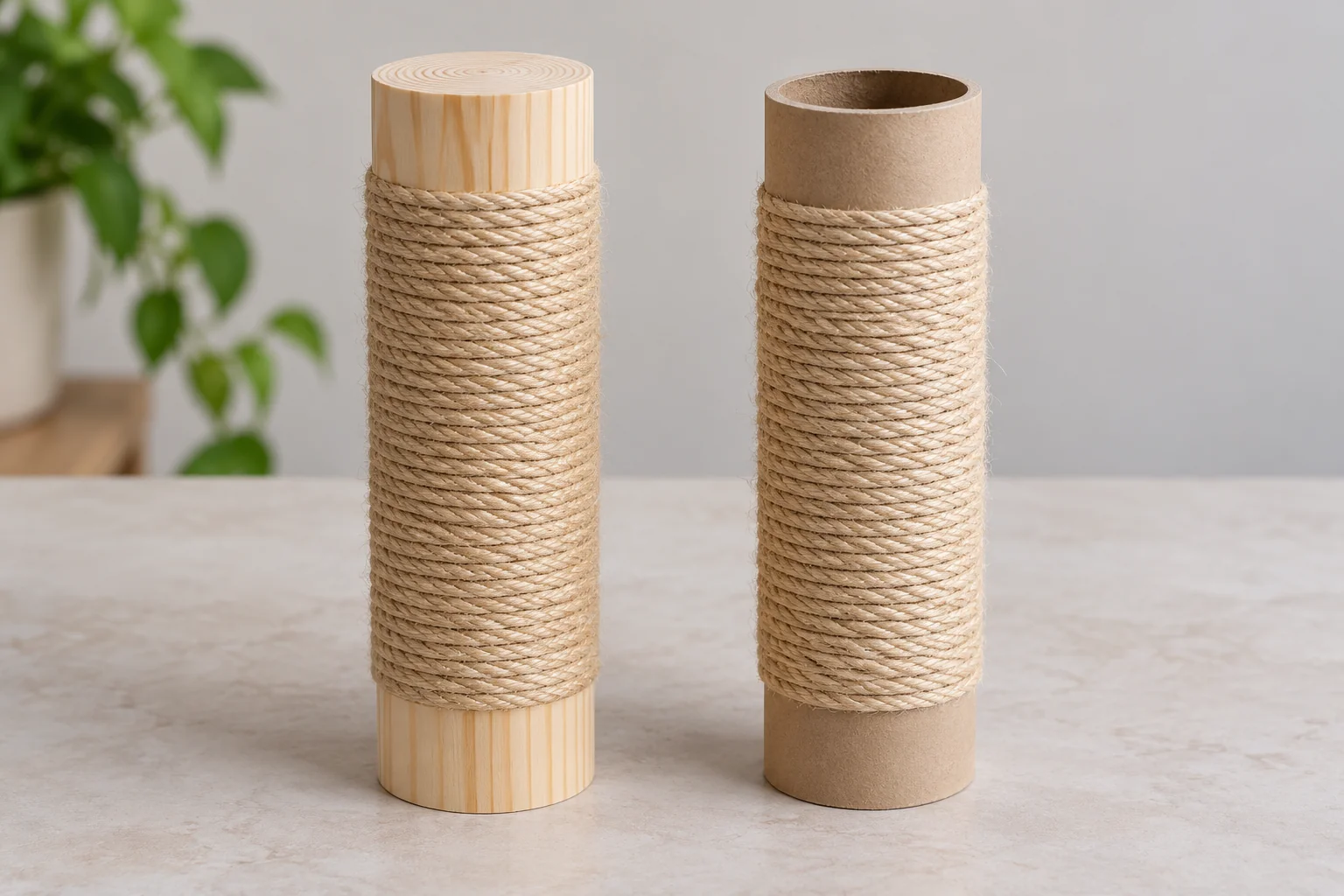
Solid posts
A solid wood post may attach through screws, bolts, brackets, or a design-specific fitting. Its visible size alone does not tell you how the joint is made. An assembly diagram is often more useful than a close-up of the rope because it shows where the fastener enters and which panel it connects to.
Paper-tube posts
Some trees use paper or cardboard tubes with fittings at their ends. The rope is outside the tube; the end fitting provides the connection to the adjoining component. A hollow core is a construction description, not proof that a tree is unsuitable or that it meets a particular load requirement.
Replacement posts need the right length and compatible end connections. Matching the outer diameter or rope color is insufficient if the hardware differs. If the original fitting is damaged or missing, obtain the specified replacement rather than improvise a joint from a similar-looking post.
Exterior Coverings: Carpet, Plush, Fleece, and Pads
Carpet and soft fabric may cover platforms, cubby interiors, or post sections. Separate that covering choice from the core: an attractive fabric cannot reveal what is underneath it.
Carpet texture and attachment
Carpet can have cut pile, loop pile, or a mixture. Cut pile has cut yarn ends; loop pile retains loops. These terms help describe the texture, but neither is a guarantee against claw catching or wear. A replacement also needs to suit the way the original covering is attached.
For a ready-made tree, look at coverage around corners, panel edges, and post openings. For recovering an existing part, use a compatible material and attachment method for that design. Loose edges, exposed staples, or damaged fastenings require attention before the cat uses the part again.
Plush, fleece, and removable cushions
Plush or fleece can be a fixed covering or the fabric of a removable pad. The distinction affects access for cleaning and replacement. “Soft fabric” does not tell you whether a pad comes off, and “removable” does not mean machine-washable.
The care label should describe cleaning and drying for the actual covering. A replaceable cushion may be convenient while the fabric lining inside a cubby remains fixed. Consider both surfaces instead of judging maintenance from the top bed alone.
Sisal and Other Scratching Surfaces
Sisal rope is wrapped around a component; woven sisal is fitted as a sheet. They create different surfaces and need different attachment arrangements. The practical details here are coverage, secured edges or rope ends, and access to a replacement part.
Rope thickness alone is not a reliable service-life comparison. Nor does “natural sisal” describe the glue, finish, or other materials in the assembled post. If a product makes a broader material claim, the description needs to identify which parts that claim covers.
Keep the surface choice separate from the tree’s panel and post structure.
Hardware and Assembly: Matching the Connections
The hardware schedule links the loose components to the finished design. It should identify the fasteners and show which fitting belongs at each connection. A bolt diameter on its own is not an assembly plan.
Before assembly, match the supplied parts to the diagram and follow the model’s sequence. Use any specified anchoring arrangement according to its instructions; there is no single height at which every tree needs the same wall fitting. Missing hardware, a damaged threaded connection, or a part that will not seat correctly is a reason to resolve the assembly problem before use.
DIY plans need the same connection detail. A materials list that includes boards, rope, and screws may omit how the posts attach, how edges are covered, or how a platform is supported. Do not treat the list as a complete structural design. This guide identifies parts and procurement questions; it does not prescribe load limits or certify a build.
Turning the Materials List into a Product Specification
For a household purchase, prioritize the details that are hard to recover from a photo: hidden core, post fittings, cover care, and replacement availability. A clear parts diagram and care instructions can answer more than another view of the assembled tree.
For a private-label manufacturing brief, put the proposed components into a bill of materials—a parts list tied to a specific design. Keep the visible finish and hidden core in separate fields. A panel entry can then read “plywood platform with fixed fabric covering,” rather than the ambiguous “wood platform.”
Useful specification fields include:
- Panel type, dimensions, finish, and edge treatment for each base, platform, and cubby part.
- Post core, length, covering, end fittings, and replacement reference.
- Fabric or cushion identification, attachment method, and care instructions.
- Scratching-surface coverage and how worn parts can be replaced.
- Hardware quantities, component identifiers, and assembly documentation.
- Packaging layout and protection for the specified parts in transit.
These are requested design details, not evidence that a supplier has tested every property. Any performance or compliance statement needs documentation matched to the proposed product and intended market. A generic material certificate or a photo of another model leaves that question open.
When making a product inquiry, include the intended layout and component list so the discussion concerns the parts you want specified, rather than an unspecified “premium material.”
FAQ
What materials are needed to make a cat tree?
A materials list usually separates panels, posts, coverings, scratching surfaces, and connecting hardware. A DIY project also needs a plan showing how those parts fit together. The list alone does not establish suitable dimensions, connections, or load limits.
What is the best material to use for a cat tree?
There is no single material for every component. Wood or composite panels form platforms, posts support the levels, and fabric or sisal supplies outer surfaces. Compare the finished model’s construction, care, and replacement details instead of assigning the entire tree one material winner.
What fabric is on a cat tree?
Common descriptions include carpet, plush, and fleece, sometimes with separate cushions. Ask whether each covering is fixed or removable and follow its care instructions. A soft bed on top does not establish the fabric or cleaning method inside a cubby.
Do cat trees need carpet?
No. Trees may have other fabric coverings, removable pads, or exposed finished panels. Look at the actual resting and climbing surfaces, how they are attached, and how they are maintained rather than treating carpet as a required component.
Is it cheaper to build your own cat tree?
That depends on the design and what you already have. Price the panels, posts, coverings, fittings, tools, and finishing work for the same plan before comparing it with a purchased model. Leftover carpet alone does not make the rest of the build cost-free.
Conclusion
Take a cat tree you are considering and write down its panel core, post core and fittings, covering, scratching surface, and hardware. The unanswered entries are the useful questions for the seller or your design brief. Resolve those gaps before comparing prices: two trees with the same beige fabric can contain different parts and offer different replacement options.