Cat scratching material should match the texture your cat uses, the direction it scratches, and the maintenance you can manage. Common options include sisal rope, woven sisal, corrugated cardboard, carpet, and wood. Compare the actual surface and construction rather than choosing by a material name alone: individual cats have different preferences, and a good covering still needs a suitable scratcher underneath it.
If your cat uses a rug but ignores a tall post, changing the material may solve only part of the problem. A similar texture offered on a floor pad gives you a different option to observe. For a product buyer, the same distinction helps separate the scratching surface specification from the finished post design.
Comparison of Core Cat Scratching Materials
Compare cat scratching materials by their visible texture, product format, and care requirements. Sisal rope forms rows of cord, woven sisal is a sheet, cardboard exposes corrugated paper edges, and carpet presents a pile or textile surface. Wood is another option, with its own surface condition to inspect.
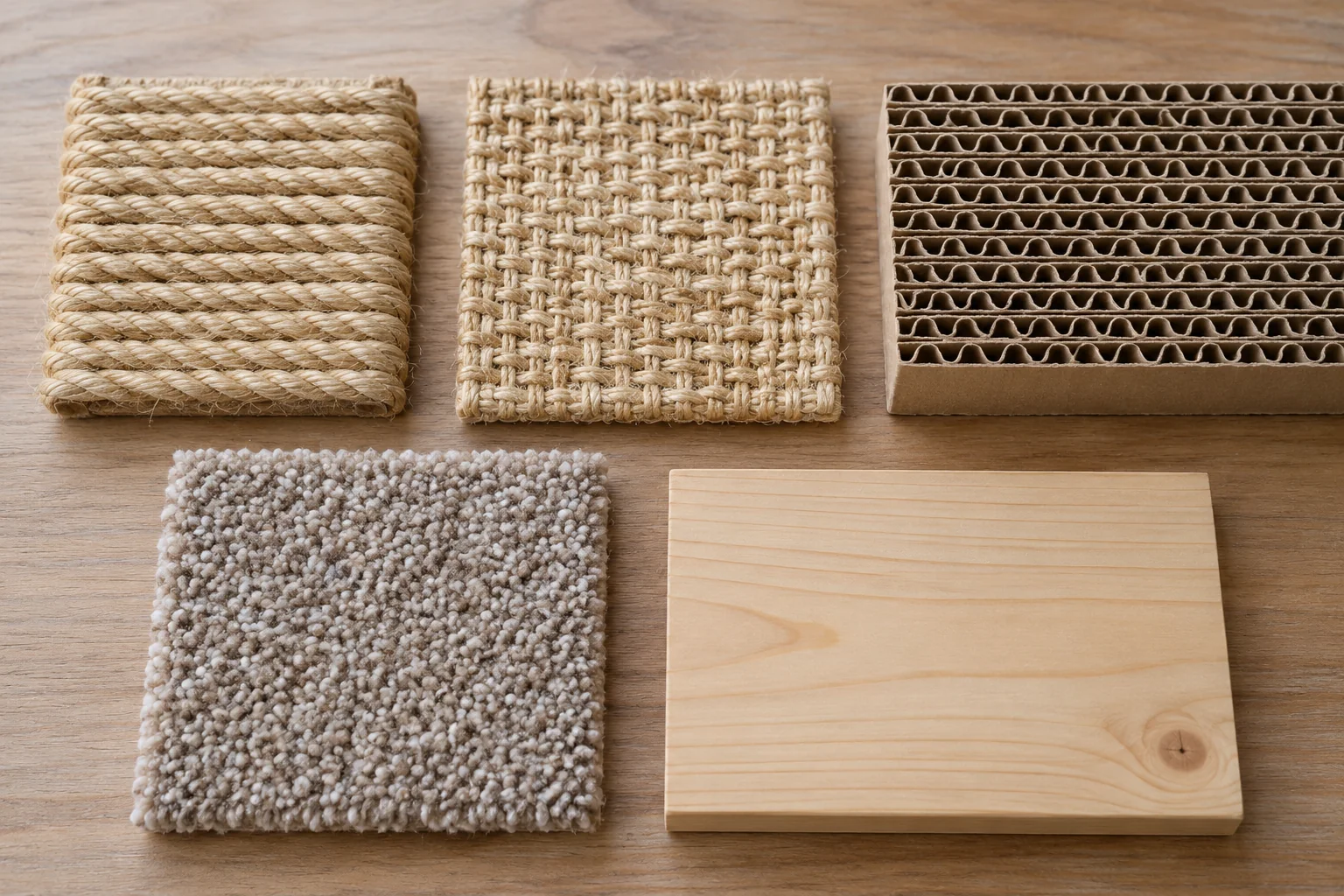
The table gives you a way to compare samples. It does not rank safety, predict lifespan, or identify a material that every cat will use.
| Material | What the surface looks like | Formats to look for | What to check on the actual product |
|---|---|---|---|
| Sisal rope | Twisted cord wound in adjacent rows | Wrapped posts and cat-tree columns | Loose turns, exposed ends, gaps, and how the covering meets the post edges |
| Woven sisal | A continuous sheet with a visible weave | Panels, mats, and wrapped surfaces | Weave, backing, seams, and whether the sheet stays attached |
| Corrugated cardboard | Cut edges of layered corrugated paper | Floor pads, shaped scratchers, and refillable frames | Loose paper, worn areas, insert fit, and the maker’s replacement instructions |
| Carpet | Yarn pile or a textile covering | Covered posts, panels, and cat furniture | Loops that may catch claws, loose yarn, backing, and cleaning instructions |
| Wood or bark | Grain or a bark-covered surface | Purpose-made wooden scratchers | Splinters, loose bark, damage, finish information, and product instructions |
A scratcher may combine materials without making them interchangeable. A carpet-covered resting platform and a sisal-covered column serve different parts of the same product. In cat tree and scratching-post projects, specify which areas are intended for scratching instead of describing the whole item as a single material.
Sisal Rope vs. Sisal Woven Fabric
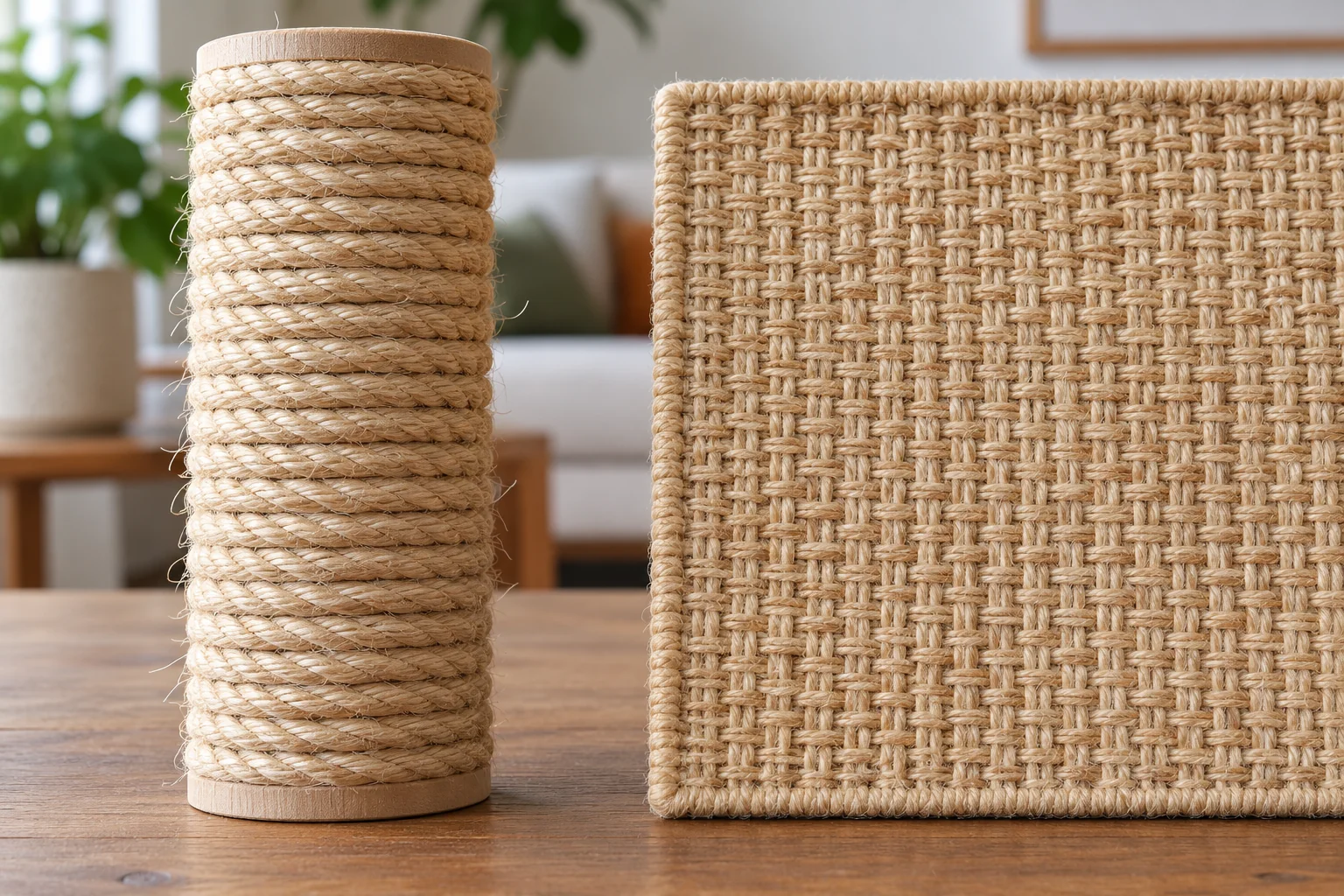
Sisal rope and woven sisal differ first in physical form: one is cord wrapped around a surface, while the other is a textile sheet. Choose between the actual samples based on texture, fit, and your cat’s response. Neither form establishes a universal preference or a guaranteed service life.
What a rope covering changes
On a rope-wrapped post, you can see separate turns of cord. Check whether they sit together, whether the ends are contained, and whether any area has come loose. A rope sample also lets you see the cord thickness and twist, although those details alone do not prove durability.
Compare equivalent products when possible. A small wrapped column and a broad sisal panel differ in available space as well as covering. If the cat uses one and ignores the other, you have not isolated material as the cause.
What a woven covering changes
A woven sheet presents a continuous textile surface with edges or seams. Inspect the whole panel, including its backing and attachment points. A photograph of the front cannot show whether the edge lifts or the backing separates.
For custom pet accessory planning, ask for the actual woven sample and its intended application. Record the material description, backing, finished dimensions, and replacement format. A description such as “sisal fabric” is a starting point for a specification, not a complete product approval.
Corrugated Cardboard: Surface, Wear, and Refill Formats
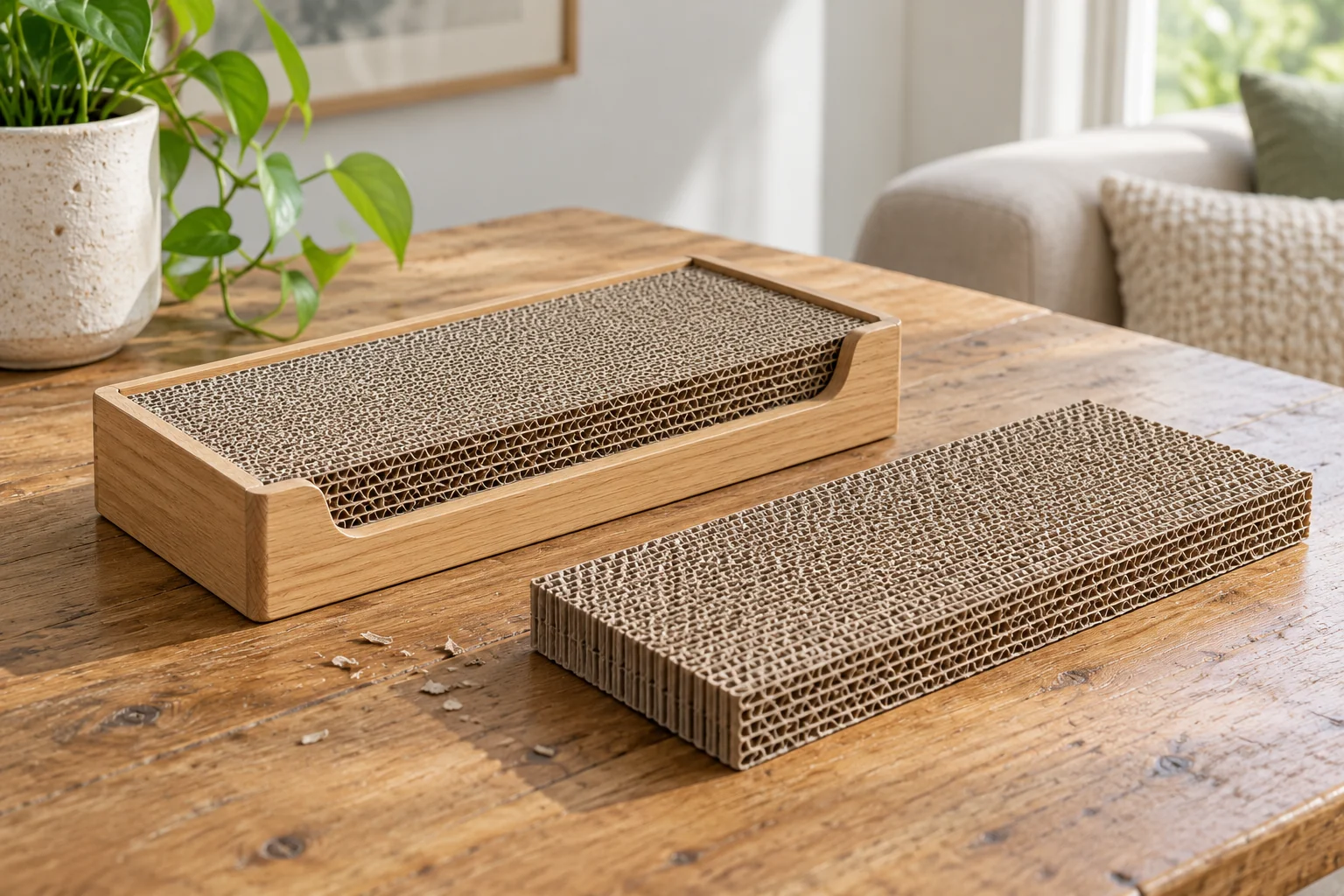
Corrugated cardboard offers a paper scratching surface and is commonly sold in floor pads and shaped scratchers. It can shed pieces as it is used. Before buying, check the exposed paper surface, the space around the pad, and whether the product has an available refill.
Inspect the complete pad
Look at the scratching face, edges, and supporting frame. The pad should fit its intended holder according to the product instructions. If it slides out or the holder is damaged, a fresh paper insert alone will not resolve the whole problem.
Do not assume that all cardboard scratchers use the same paper, construction, or adhesives. Words such as “dense” and “premium” need a product-specific explanation if they affect your purchasing decision. Request a sample rather than inferring performance from the size of the visible corrugations.
Confirm refill and turning options
Some cardboard scratchers use replaceable inserts. Others are sold as complete units. A pad may be designed for use on both sides, but confirm this before turning it over; a backing, frame, or shaped surface may limit how it can be used.
Keep the replacement dimensions and product reference. Two pads that look alike in a listing may not fit the same frame. Availability matters too: a refillable design is easier to plan around when the matching insert can actually be ordered.
Clean loose paper according to the maker’s instructions, and inspect the remaining surface. Replace a damaged insert as directed rather than treating a stated number of months as a universal schedule.
Carpet on Scratching Posts: Check the Pile and Loops
Carpet needs closer description than “soft” or “durable.” Some carpet loops can catch claws and discourage a cat from using the surface. Examine the pile and any loose yarn, and consider a different texture if your cat catches its claws or avoids the covering.
Cut-pile carpet has cut yarn ends instead of an intact looped surface. That description does not guarantee that the entire finished scratcher is free of snagging points. Seams, torn areas, and loose threads still need inspection. Stop using a damaged covering and follow the product’s repair or replacement guidance.
Carpet also needs cleaning appropriate to its construction. Check whether the maker permits vacuuming, spot cleaning, or removal of the covering. Avoid assuming that a household carpet cleaner is suitable for every scratcher backing or finish.
If your cat already scratches a carpeted area, you can observe whether it uses a designated scratcher with a similar or different texture. Offering an alternative is a practical comparison; it does not guarantee that the cat will stop scratching the floor.
Natural Wood and Bark Surfaces
Wood is a distinct scratching option, but the condition of the finished surface matters more than a wood-name ranking. Inspect purpose-made wooden scratchers for cracks, splinters, loose bark, and damage. Ask for finish and care information when it is missing.
Treat the scratching face separately from any concealed wooden core. A wood core covered in rope is not the same product as an exposed wood scratcher. Likewise, a wooden base tells you little about the texture the cat touches.
Do not infer chemical suitability from “natural,” “solid wood,” or the absence of a noticeable smell. Use the product documentation, and contact the maker if the intended use or finish is unclear. Avoid substituting an unidentified outdoor branch or treated building timber based only on its appearance.
Match the Surface to Scratching Direction
Observe whether your cat scratches upward, along the floor, or on an angled surface. Texture and direction are separate choices. If you change both at once, it can be hard to tell which change the cat responded to.
For an upward scratcher, compare suitable vertical surfaces. For a cat that uses rugs, consider a floor pad or mat. Some cats use more than one direction, so providing different options can help you learn their preferences.
Keep this comparison focused on the surface. Finished-post height, base stability, and mounting are separate selection checks, and no material label resolves them. A sheet of woven sisal fitted to a poor support does not become a suitable scratcher simply because the covering is familiar.
In a multi-cat home, record which cat uses which surface instead of assuming that the most-used scratcher suits every animal. A brief observation note can distinguish a texture preference from the preferences of another cat sharing the space.
Evaluate Wear, Cleaning, and Replacement
Inspect the surface you own rather than relying on a general durability ranking. Useful observations include loose cord, detached fabric edges, worn paper, loose carpet yarn, and damaged wood. The product’s condition and instructions should guide your next step.
Compare use under similar conditions
If you are comparing samples, record the format, location, cleaning routine, and visible changes. A post used by several cats and a pad that is rarely touched do not provide an equivalent wear comparison. Photographs taken from the same angle can help you track changes without inventing a lifespan estimate.
Cleaning convenience also depends on the whole design. Check access around the base, whether a covering is removable, and where loose debris collects. Keep material names separate from claims such as “washable”; the backing, support, and attachment may have different care limits.
Record a usable material specification
For a buyer working on pet product manufacturing, a useful sample record includes:
- The intended scratching area and format.
- The supplier’s material description and any backing or finish.
- Finished dimensions, seams, edges, and attachment details to confirm.
- Cleaning instructions and the matching replacement part, if available.
- Observed wear and questions that remain unresolved.
Keep this as an inquiry and inspection record. It does not substitute for product-specific safety evidence, verified performance data, or appropriate testing.
FAQ
What is the best overall material for cat scratching?
Start with the texture and direction your cat already uses. Sisal, cardboard, carpet, and wood are options to compare, but there is no single choice that establishes every cat’s preference. If possible, try a different surface while keeping a familiar scratching direction.
Which should I choose, jute or sisal?
Compare the actual cord or textile samples and confirm their intended use. The fiber name alone does not establish the finished covering’s wear, attachment quality, or your cat’s preference. Avoid treating a decorative cord as an approved replacement simply because it resembles the original.
Why are carpet loops a concern?
Claws can catch in carpet loops, which may discourage use. Check the surface for loops and loose yarn rather than relying on a generic carpet description. If your cat catches its claws, stop using that surface and choose another suitable option.
Is there a carpet that cats will never scratch?
Do not buy carpet on the assumption that a particular fiber or texture will prevent scratching. Observe your cat’s behavior and provide suitable designated surfaces. A material label is not a furniture-protection guarantee.
How long should a scratching surface last?
There is no reliable replacement interval for every material and household. Usage, construction, cleaning, and the number of cats differ. Inspect the actual product and follow its replacement guidance when the covering is damaged or detached.
Conclusion
Choose a surface to try, keep its format appropriate to your cat’s habits, and record what you observe. Before buying again, check the condition of the covering and whether the same replacement format remains available.
For a scratching-product project, prepare a sample description, intended format, and care or replacement questions. You can contact us to discuss those project requirements.