The best cat scratching post fits your cat’s scratching direction, offers enough usable space for its reach, stays sturdy during use, and has a surface the cat will use. Start with those checks before comparing appearance or price. A brand ranking cannot tell you whether a particular post fits your cat, your floor, or the place where it will stand.
A short post beside a sofa may look convenient, yet offer little space for an upward scratch. A tall post tucked away from the cat’s usual resting area may also go unused. Compare the complete product and its location rather than treating height or material as the deciding feature.
Core Criteria for Selecting the Best Cat Scratching Post
Choose a post by matching your cat’s habits to the usable scratching area, assembled stability, surface, and room placement. Check the product instructions and dimensions together. The criteria below help you compare actual products without turning one model’s specifications into a universal standard.
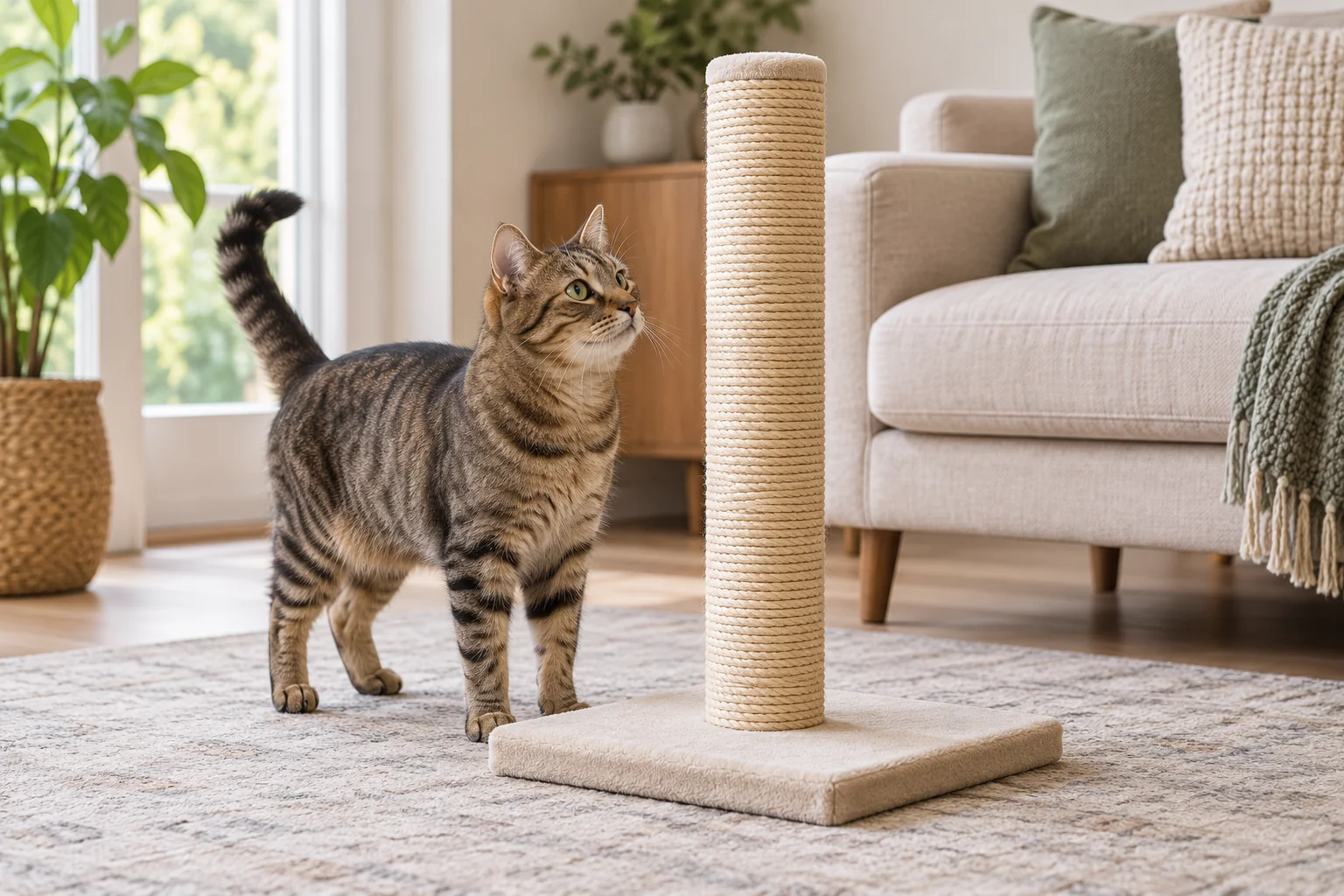
| Selection check | What to look at | Question to ask before buying |
|---|---|---|
| Scratching direction | Vertical, horizontal, or angled use | Does this format match the surfaces my cat already uses? |
| Usable reach | Exposed scratching surface, including any interruptions | Is there enough room for my cat’s normal stretch? |
| Stability | Assembled post, base, floor contact, and mounting | Can I follow the installation instructions in this room? |
| Surface | Actual covering, edges, and seams | Is the texture familiar, or can I offer it as another option? |
| Placement | Space around the base and access to the surface | Can the post stand where my cat is likely to encounter it? |
| Ongoing care | Inspection, cleaning, and replacement information | Are instructions and matching parts available? |
If you are developing a range of cat trees and scratching posts, use these checks to describe intended use. They are inquiry points for a product specification, rather than claims that a particular design has passed testing.
Height and Usable Scratching Reach
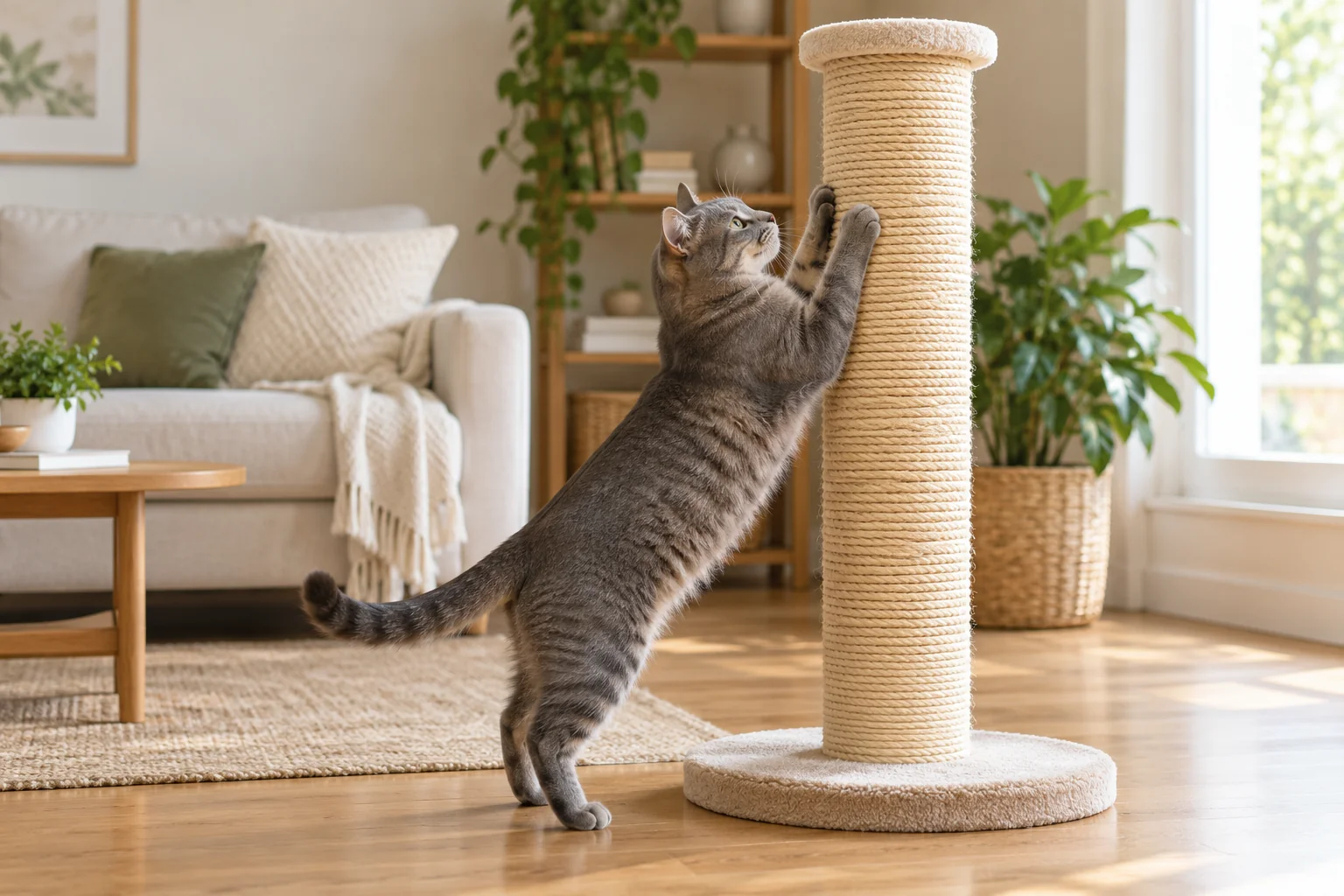
A vertical scratching post should offer enough usable surface for the cat to stretch its body. Compare that space with your own cat’s reach instead of relying on one fixed height for every adult cat. Total product height can include a cap, perch, or other part that is not a scratching surface.
Look at the exposed surface
Observe a voluntary upward stretch at a surface your cat already uses. Note where its front paws reach and whether it continues scratching comfortably. Then compare the candidate post’s exposed covering and any interruptions along it. Do not force the cat into a measuring pose.
A product listing may show the assembled height without stating the covered height. Ask for that distinction if the picture is unclear. Decorative tops, shelves, or short covered sections can change how much space is available, even when two products have the same overall height.
Compare the cat and the room
A larger cat may need a different usable area from a smaller one, but breed names are not a substitute for observing the individual animal. Also check that the proposed post fits its intended location with space for the cat to approach and scratch.
For several cats, compare their habits separately. A single post may not be the preferred option for all of them. You can offer additional suitable surfaces without assuming that a taller product will resolve every difference in preference.
Base Stability and Assembled Connections
Check the complete assembled post on the type of floor where it will be used. A base dimension or product weight alone does not prove that a post will remain sturdy. Assembly, connections, floor contact, and any required mounting all belong in the comparison.
Inspect assembly and floor contact
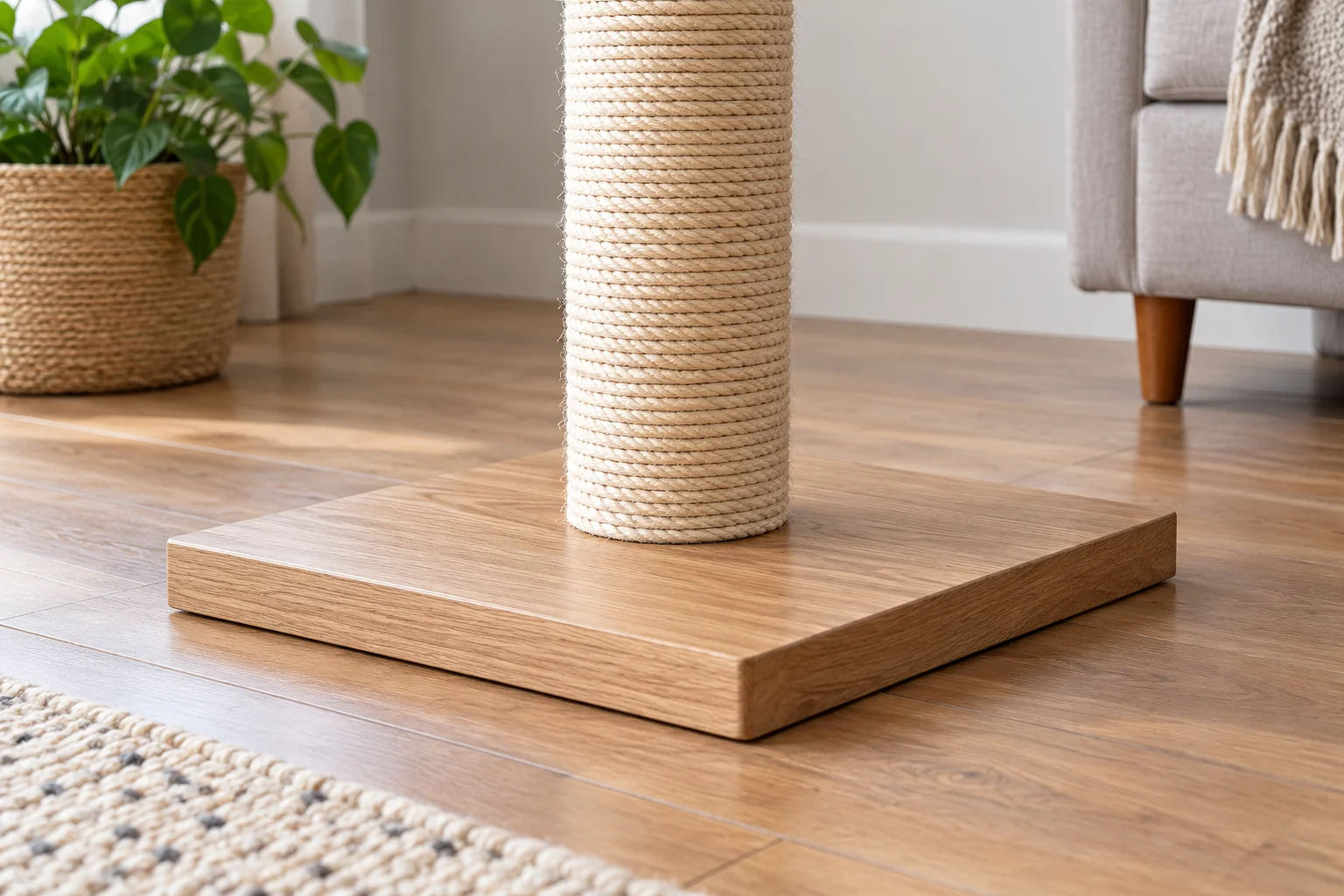
Follow the maker’s instructions, including any specified tools or anchoring. Check that the base sits properly on the floor and that parts are fitted as directed. If the product rocks, slides, or has a loose connection, stop and resolve the issue before allowing use.
Check the underside as well as the visible top of the base. A photograph cannot tell you whether a part has been assembled incorrectly or whether the floor is uneven. Do not improvise extra ballast, substitute hardware, or treat a larger base as a guaranteed repair for a loose joint.
Ask how stability is evaluated
For purchasing teams, request product-specific evidence for stability claims. Record the assembled dimensions, intended mounting, instructions, and the conditions of any evaluation supplied. Compare the delivered sample with that information.
Avoid approving a model because it uses a particular bolt label or a heavy-sounding material. Those descriptions leave the complete design and installation unresolved. The same applies to phrases such as “anti-tip” or “heavy duty”: ask what the maker means and what supports the claim.
Post Shape, Surface Area, and Covering
Compare how much of the surface is accessible and how your cat approaches it. Round posts, square columns, and flat panels present different shapes. There is no reason to infer a universal preference or lifespan from column width alone.
Look at seams, corners, top and bottom edges, and any area the cat cannot reach. A larger covered area may give you more space to offer, but only observation shows which part the cat actually uses. A climbing or resting feature also needs its own intended-use information; a scratching post is not automatically a perch.
Keep the material comparison brief when selecting a finished post. Sisal rope, woven sisal, cardboard, and carpet are surface options, while the support and installation are separate checks. Inspect carpet for loops or loose yarn that may catch claws. A familiar material on a poorly fitted product does not settle the buying decision.
If you are comparing custom pet accessory options, request a covering sample and an assembled product. A swatch shows texture; the complete item shows where that texture is placed and how the edges are finished.
Choose the Right Format and Orientation
Observe the direction your cat already scratches before choosing a format. Some cats use upright surfaces, some scratch along the floor, and some use both. Offer appropriate options and watch what happens rather than assigning a preference by age or breed.
Vertical posts
A freestanding post provides an upright scratching area and needs suitable reach, a sturdy assembled support, and room around the base. Compare the exposed covering with the cat’s stretch. Check any installation or anchoring requirement before purchase.
Horizontal pads and mats
A floor scratcher gives a different direction to try if your cat scratches rugs or similar surfaces. Check how it sits on your floor and whether it moves during use. A low format does not remove every possibility of sliding or other product damage.
Angled and mounted surfaces
An angled scratcher is another option to observe, rather than a proven treatment for mobility problems. A wall-mounted panel needs the mounting method and suitable supporting surface specified by the maker. Confirm that you can install it as directed; mounting to a wall does not automatically establish stability.
Placement and Helping Your Cat Explore
Place a suitable scratcher where your cat is likely to use it, such as near a resting area or an existing scratching spot. Keep access clear. A useful surface hidden in an inconvenient location gives the cat less opportunity to encounter it.
If the cat already scratches a sofa corner, you can try a suitable post nearby while leaving enough space to approach it. Observe use before relocating the post. There is no universal distance or weekly moving schedule that fits every room and cat.
Spend time near the scratcher and reward voluntary use. Avoid taking the cat’s paws and rubbing them on the surface. Giving it an opportunity to explore is different from forcing a scratching action.
If a new post is ignored, check direction, texture, usable area, stability, and location separately. Change one practical factor at a time when possible. Keep expectations modest: buying a post does not guarantee that all furniture scratching will stop.
Product Sample Checks for Buyers and Brands
Use an assembled sample to review the proposed product and its instructions. For a pet product manufacturing project, a clear record helps separate observed construction from unverified marketing language.
Check the following before agreeing to a specification:
- Confirm assembled dimensions and the actual scratching area.
- Record the covering, edges, seams, and matching replacement parts.
- Review assembly and mounting instructions with the supplied hardware.
- Identify the intended floor or supporting surface and any restrictions.
- Request evidence for specific stability, wear, or load claims.
- Inspect packaging and instructions for the version you plan to supply.
Record discrepancies with photographs and specific questions. For example, a sample can have a different covering from the listing, or an instruction sheet can refer to hardware that is missing. These are concrete points to resolve with the supplier.
Do not convert this inspection list into a claim that the sample is certified or universally suitable. A hand check is not a substitute for a relevant product evaluation, and a successful assembly does not prove a service life.
FAQ
What is the ideal height for a cat scratching post?
Choose enough usable height for your cat’s voluntary stretch. Check the covered surface rather than only the assembled product height. A measurement taken from one recommended model should not become a minimum for every cat and design.
What makes a good-quality scratching post?
A useful product has clear dimensions, assembly and care instructions, and a suitable surface and support for its intended use. Check the delivered item against that information. Price, decorative features, and a “heavy duty” label alone do not establish quality.
Do cats prefer vertical posts or horizontal pads?
Preferences vary. Watch whether your cat reaches upward or scratches along the floor, and consider offering both formats. In a shared home, the preferences of one cat may differ from those of another.
How do I choose a scratching post for a large cat?
Compare the individual cat’s reach and the product’s usable area, assembled support, and stated intended use. Ask the maker for missing fit or stability information. A “large cat” label or breed photograph alone does not establish suitability.
Is a scratching post better than a scratching pad?
Choose the direction your cat is likely to use. A post offers an upright surface, while a pad offers a floor-level one. They can be complementary options rather than competing products with a single winner.
Conclusion
Shortlist a format that matches your cat’s habits, then check usable reach, assembly, and where it will stand. After installation, observe use and inspect the product regularly according to its instructions.
For a product range, prepare the intended format, assembled dimensions, covering sample, and unanswered evaluation questions. You can contact us to discuss the project requirements.