Do dog dental toys clean teeth in normal use? Only where chewing creates useful contact. Some specific products can reduce plaque or tartar accumulation when used as tested, and that result belongs to the product and conditions studied. A “dental” label, toothbrush shape, ridge pattern or rubber material alone offers no proof that a toy cleans teeth.
Chewing can create contact between a product and part of a tooth surface. That contact rarely reaches every tooth and says nothing about cleaning below the gumline, removing existing disease or replacing daily brushing and veterinary dental care. The practical question is therefore not whether dental toys work as a category. It is whether one product has credible evidence for a defined claim and can be used without creating a poor fit or tooth-damage problem for the individual dog.
Mechanical Cleaning Only Happens Where the Toy Makes Contact
A dental toy relies mainly on mechanical action: the dog’s teeth press against and move over the product while chewing. The contact may disturb material on the surfaces being worked. A ridge or flexible projection can change that contact, but appearance alone cannot show how deeply it reaches, how long the dog engages with it or which teeth receive useful friction.
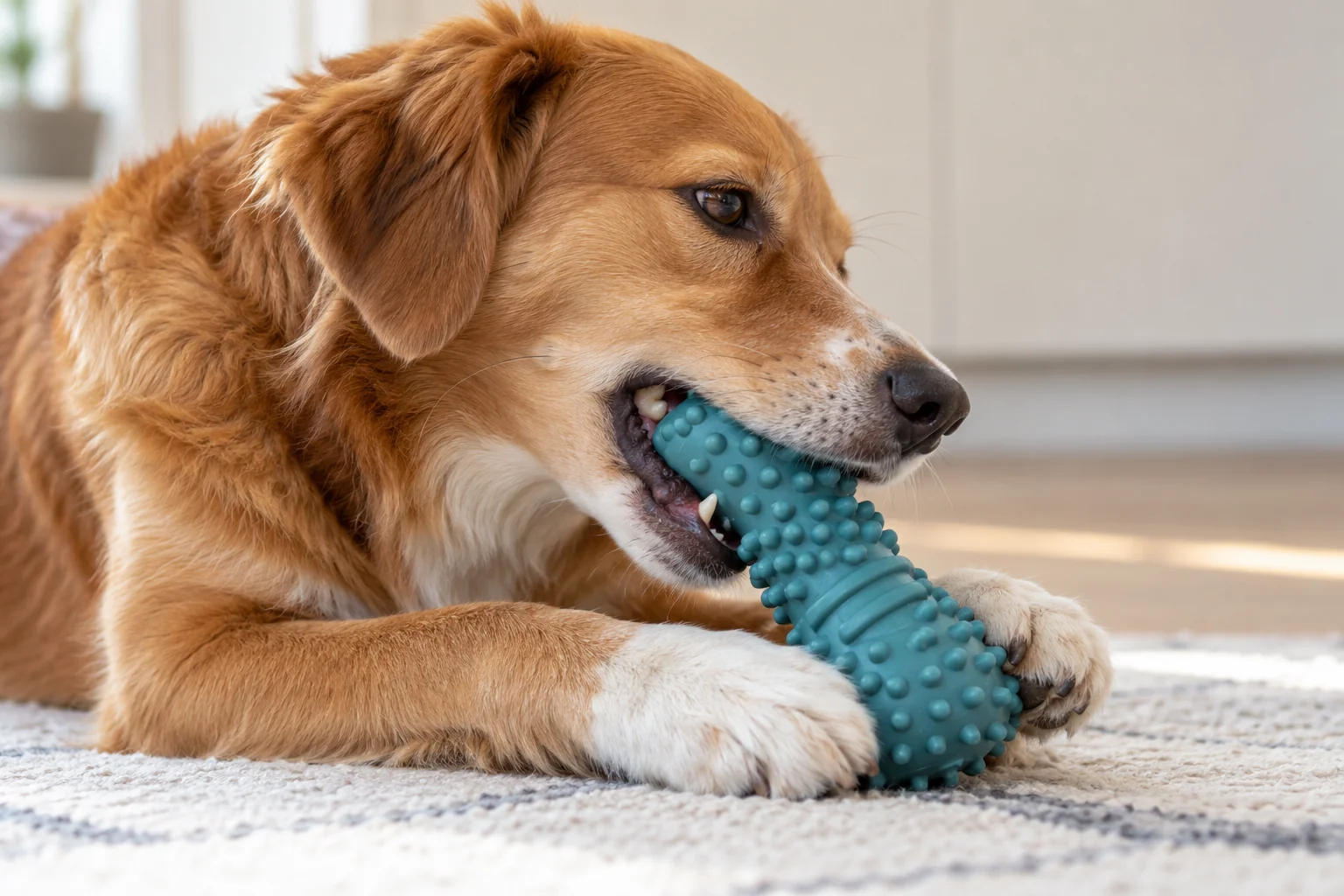
When comparing rubber dental-toy shapes and textured formats, treat each ridge, groove and flexible projection as a contact variable, not proof of plaque control.
Two dental terms are enough to understand the claim:
- Plaque is the soft biofilm that forms on teeth. Home care aims to disrupt it regularly.
- Tartar, or calculus, is mineralized deposit. A claim about slowing tartar accumulation is different from claiming that a toy removes established calculus.
Chewing patterns make coverage uneven. A dog may hold a toy on one side, work it mostly with the premolars and molars, or lick filling from a groove without chewing the textured area at all. Front teeth and the gumline may receive little contact. A product can therefore show a useful effect on measured surfaces without acting like a full-mouth toothbrush.
Watch the dog use the toy once before judging its dental role. If the intended cleaning area never contacts the teeth, the design is not performing its proposed mechanical task for that dog.
Evidence for One Dental Product Does Not Prove the Whole Category
The stronger published evidence is product-specific. Controlled studies have tested particular edible dental chews under defined routines, often after a professional cleaning and with one chew given daily. Those results support the products and conditions studied, leaving reusable toys with nubs, bristles or a dental name to establish their own evidence.
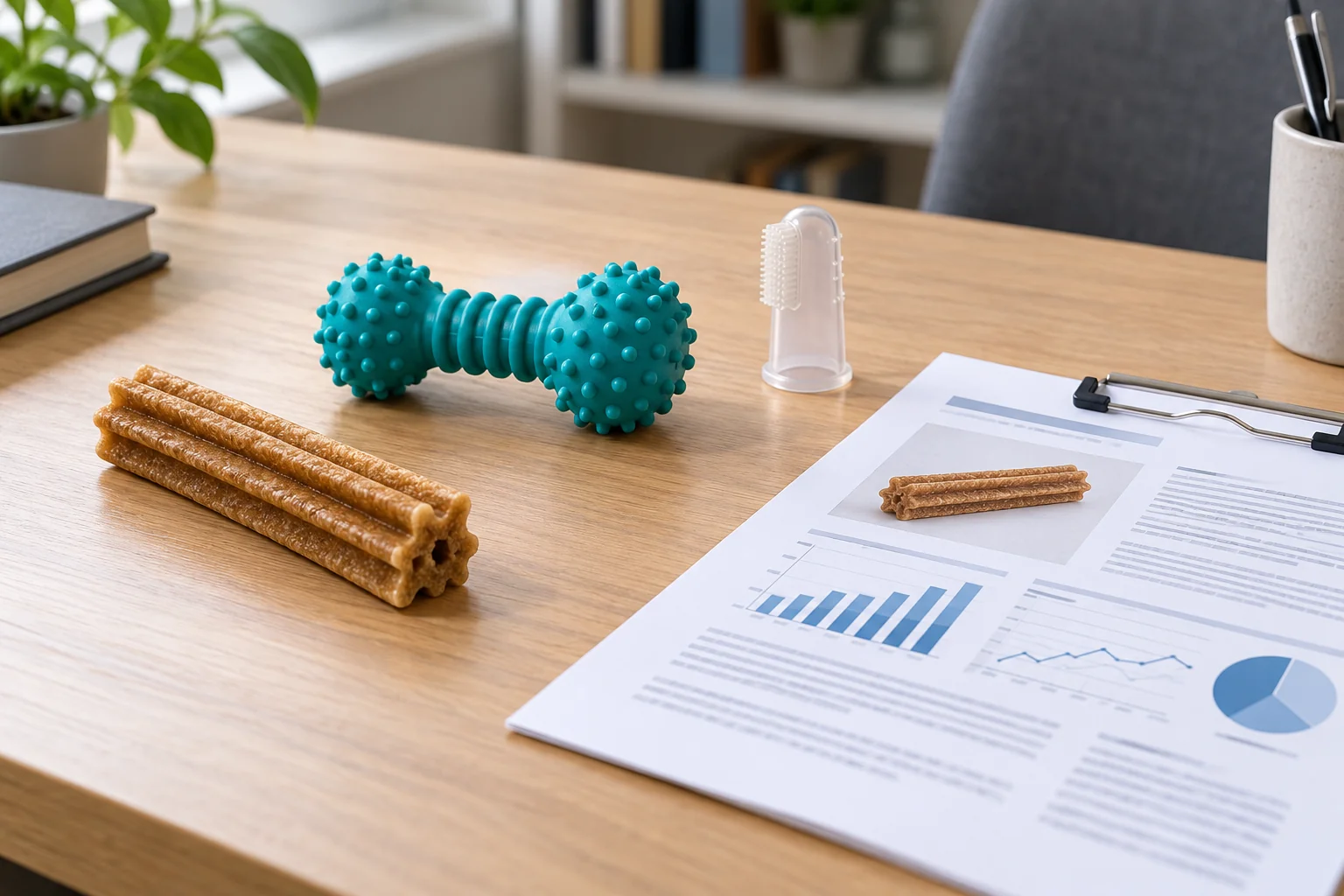
This distinction matters because dental products differ in formulation, size, shape, density, abrasiveness and hardness. Dogs also differ in mouth size, chewing surfaces used, behavior and time spent chewing. Similar textures are not a basis for transferring a study to another construction.
One 28-day study used twelve adult female beagles and compared three specific dental chews with a dry-diet control. Outcomes differed among the chews: two reduced measured plaque coverage and thickness relative to the control, while another showed a narrower effect on calculus coverage. Gingivitis did not differ among the groups in that study. A later 28-day study of another specific chew found lower calculus measures and gingivitis scores but no significant difference in plaque scores. These are useful findings precisely because they show that outcomes are not interchangeable.
The studies also describe daily use, controlled feeding, healthy trial dogs and professional scoring. Occasional play, treatment of periodontal disease and use in a painful mouth all fall outside those conditions.
Frequency is part of the evidence, too. Results from daily use say little about occasional use, and a toy used differently from its directions has left the tested conditions. Record how the product is actually offered before deciding that it has failed or succeeded.
Read the Claim, Test Method and Product Identity Together
Start with the exact outcome named on the product. “Supports oral care” is broad; “helps control plaque” and “helps control tartar” are separate, testable statements. Then look for evidence tied to the same product, size or product line you intend to use.
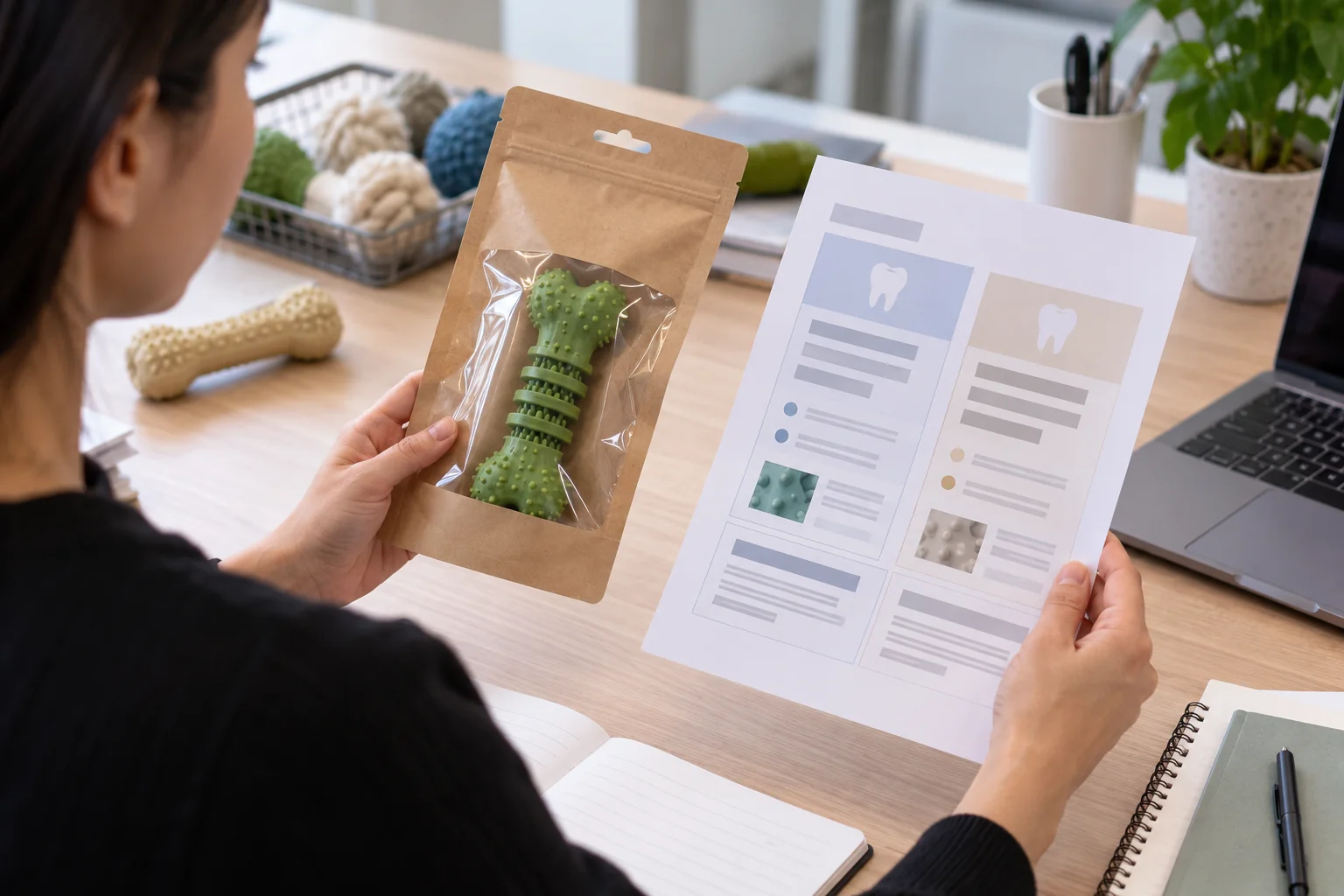
| What you see | What to verify | What it does not establish |
|---|---|---|
| Dental, toothbrush or cleaning in the name | A defined plaque or tartar claim and product-specific support | Full-mouth cleaning or treatment of dental disease |
| Ridges, grooves or bristles | Evidence that the used surfaces contact teeth as intended | That every dog chews the same area or with the same duration |
| A study result | Exact tested product, comparison group, frequency, duration and measured outcome | Equal results for a different toy, material or size |
| A VOHC seal | The exact accepted product and whether the listed claim is plaque, tartar or both | Approval of an entire material class or every product from the company |
| Before-and-after photos or reviews | At most, a reason to investigate the formal evidence | A controlled measurement of efficacy or safety |
The Veterinary Oral Health Council lists accepted products with their individual plaque or tartar claims and publishes trial requirements. Its protocol for mechanically effective chews compares a test group with a control and requires measured reductions across trials. That makes the seal useful when it matches the exact product. It is not a general certification for dental toys as a category.
Keep the product type aligned as well. Evidence for an edible chew may involve formulation and ingestion alongside mechanical contact, so it cannot be reassigned to a reusable toy with a similar shape.
Reusable rubber dental toys often fall outside the edible-chew evidence people cite. Their geometry remains a design feature to assess, not proof of plaque control. Ask for evidence tied to the finished product if a dental outcome will be claimed.
Hardness and Fit Can Cancel a Possible Dental Benefit
A dental feature is irrelevant if the object creates an unsuitable chewing load or can be swallowed. Veterinary guidance warns against hard toys and chews that can damage teeth. There is no universal home test that proves a product safe for every mouth, and a dog with existing dental problems needs an individual veterinary assessment rather than a softer-looking product chosen by guesswork.
Size affects both use and contact. The toy should be too large to fit entirely in the mouth but manageable enough for the dog to hold the intended working area. If the dog only gnaws a thin end, that point receives the force while the wider textured body may never touch the teeth.
Inspect the finished item and its actual use for:
- rigid sections that do not yield during the dog’s chewing action;
- narrow tips or raised features that concentrate force;
- cracks, sharp wear, detached pieces or thinning walls;
- openings or handles that do not fit the dog’s mouth geometry;
- a size that lets the dog gulp the item or break off a large section;
- a chew pattern that avoids the proposed cleaning surface.
Stop using a damaged product. A worn ridge shows where the toy changed, not whether teeth were cleaned.
Use Dental Toys as One Part of Home Care
Daily toothbrushing remains the strongest at-home method for plaque control. Dental chews or toys can be an adjunct when they have a supported claim and the dog uses them as intended. Veterinary oral examinations and professional treatment remain part of care when indicated.
A simple routine keeps each tool in its proper role:
- Follow the veterinarian’s dental plan for the individual dog.
- Brush with dog-appropriate products at the recommended frequency.
- Add a dental chew or toy only after checking its specific claim, directions, size and condition.
- Observe which teeth contact the product rather than assuming the shape cleans the whole mouth.
- Reinspect it before reuse and retire it when damage changes the fit or surface.
Home tartar scraping and attempts to push through pain, bleeding or resistance have moved beyond product selection. Stop and involve the veterinary team.
Build Dental Claims Around the Finished Product
For a retailer or product developer, a molded texture is a starting design choice. It is not substantiation. Keep the claim narrow until evidence for the finished product supports more.
A defensible product file should identify:
| Record | Why it matters |
|---|---|
| Exact product and version | Keeps evidence tied to the same formula, geometry, size and manufacturing revision |
| Intended user and exclusions | Defines dog size, chewing behavior and any dental-status limits |
| Mechanical pathway | States which surface is intended to contact which area of the mouth |
| Outcome claimed | Separates plaque, tartar, breath or general play language |
| Test design and result | Shows frequency, duration, comparator, subjects, scoring and limitations |
| Use and retirement directions | Covers fit, supervision, cleaning, damage and stop-use conditions |
Changing hardness, dimensions, texture depth or material can change contact and chewing behavior. Recheck whether the original evidence still applies before carrying the claim to the revised version.
Stop Product Testing When the Mouth Needs Assessment
A dog with loose or broken teeth, obvious pain, bleeding, inflamed gums or recent dental treatment should not be used to trial a dental toy at home. Stop the product and contact the veterinarian or veterinary dental professional who knows the dog’s case.
The same boundary applies if chewing suddenly changes, the dog drops the toy, avoids one side of the mouth or the product shows blood. Diagnosis and a recovery timeline require the veterinary team. This is the point where product comparison ends.
FAQ
Do dog toothbrush toys work?
The shape alone proves nothing. A toothbrush-style toy may create contact on some tooth surfaces, but look for evidence tied to the exact product and observe whether the dog actually chews the intended area.
Can a dental toy remove tartar from a dog’s teeth?
Treat established calculus as a veterinary issue. Product evidence usually concerns reducing accumulation under defined use, while existing deposits and dental disease require assessment.
Does a VOHC seal mean every product from that brand works?
No. The accepted-products list ties the seal to a named product and a plaque, tartar or combined claim. Check the exact item rather than extending the result to a brand, material or toy category.
Are hard dental toys bad for dogs’ teeth?
Hard objects can damage teeth, particularly when a dog chews forcefully. A dental label cannot cancel that risk. If a product is rigid or the dog has a dental history, ask the veterinarian to assess the choice.
What dental toy is suitable for a dog with bad or sensitive teeth?
That question needs professional assessment of the dog’s mouth. A soft-looking toy may still be unsuitable for loose teeth, pain, bleeding or recent dental work.
Conclusion
Take one dental toy you are considering and check the exact claim against the exact product evidence. If all you have is a dental name and a textured shape, treat it as an ordinary toy rather than a proven cleaning device. If the dog has pain, bleeding, damaged teeth or recent dental treatment, set the toy aside and ask the veterinary team to assess the mouth first.