Choosing safe chew toys for dogs starts with the finished product, the dog’s mouth, its chewing behavior and the intended activity. The toy then has to remain intact during actual use. A toy that is too small, sheds pieces or develops sharp damage should leave the rotation even if its label says durable, natural or non-toxic.
Treat the first chewing session as part of selection. Watch what the dog does with the finished toy: carries it, compresses it, scrapes it with the back teeth, worries at one edge, strips fibers or tries to swallow it. That behavior tells you more than a broad breed or “power chewer” label.
Start With the Dog’s Actual Chewing Pattern
Choose for the behavior in front of you. A small dog can methodically destroy a seam, while a larger dog may only carry and mouth the same construction. Body size helps with fit; actual use reveals the chewing pattern.

| What the dog does | What the toy must manage | A reason to choose something else |
|---|---|---|
| Carries and mouths | Comfortable grip with no easy-to-reach small attachment | The whole item slides far into the mouth |
| Holds and gnaws one area | Enough usable surface that wear is not concentrated on a thin tip | One edge quickly becomes rough, sharp or deeply cut |
| Compresses repeatedly | Finished shape recovers without cracking or opening a join | Splits appear, or a hollow wall starts tearing |
| Picks at fibers, seams or raised details | Construction keeps those details attached during that dog’s use | Threads, layers or decorative parts begin to lift |
| Bites off and swallows pieces | A different format that does not reward piece removal | Any fragment is detached or missing |
The last pattern needs the clearest boundary. Supervision may let you interrupt the session; a toy the dog can rapidly dismantle remains a poor match.
Chewing behavior can also change. Recheck the choice when a dog becomes more persistent, learns to attack a weak point or moves from carrying a toy to trying to consume it.
Keep toys assigned to different jobs when the dog’s behavior supports that distinction. A rope that remains intact during a short game of tug may not belong in the dog’s crate as a chew, and a treat holder may work only while the dog licks rather than tears at its opening.
Judge the Finished Toy, Not the Material Label
Material is one part of the decision. Wall thickness, geometry, seams, molded transitions, attached rope, flavor layers and surface finish determine what the dog can reach. Two toys described as rubber or nylon may behave very differently because their constructions are different.
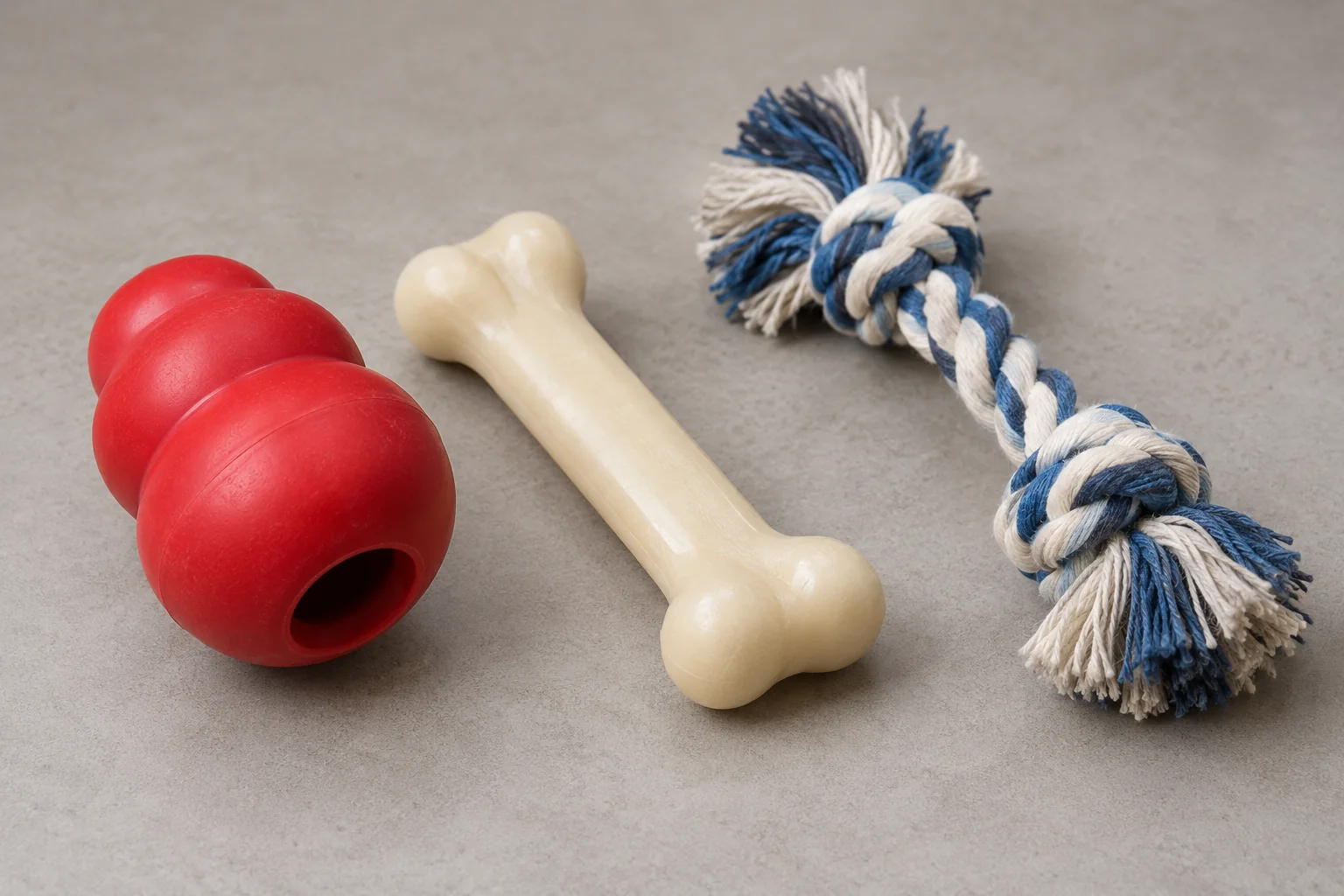
Before use, look for enough product information to identify the material and intended use. Then inspect the actual unit for cuts, exposed reinforcement, flash or sharp edges, open joins, loose attachments and areas that are much thinner than the rest. “Non-toxic” on a label leaves size, detachable parts and the dog’s chewing pattern unanswered.
Rubber chew toys
Rubber can be molded into solid, hollow, treat-holding, ring and textured forms. Flexibility may make a rubber form more forgiving than a rigid object, but the material name leaves the finished toy’s hardness, tear resistance and formula unresolved. A dog that cuts through a hollow wall or peels material from an edge needs a different construction.
For a practical view of the forms available, compare rubber dog toy shapes and formats by intended use, geometry and size. That category shows product directions without certifying every rubber toy for every dog.
Nylon and other rigid chews
Rigid chews can last longer for some dogs, yet hardness creates a separate concern for teeth. Veterinary guidance warns that hard toys and chews can damage teeth. Slow visible wear offers no assurance that the chewing load suits the dog’s teeth.
The surface matters as the toy ages. Raised rough areas, sharp wear, cracks or a missing chunk are stop conditions. There is no single material-wide answer for “are nylon chew toys safe?” because construction and chewing force differ, and a label cannot resolve an individual dog’s dental condition.
Rope and fiber constructions
Rope can work well for an interactive tug session when the dog grips rather than eats it. It is a poor chew choice for a dog that separates strands and swallows them. Retire a rope when strands loosen, a knot opens or an attached component becomes accessible.
Claims that rope fibers clean teeth or pass harmlessly if swallowed require their own evidence. They fall outside a basic toy-safety decision and cannot be applied across rope constructions.
Fit Size and Shape to the Whole Mouth
A chew toy should be too large to fit entirely inside the dog’s mouth, while still allowing a stable grip on the intended chewing area. That principle is more useful than a breed-only chart. Dogs of the same weight can have different head shapes, grip styles and determination to work an object backward in the mouth.

For a small dog, “small” should mean manageable, not swallowable. The toy needs enough length or width to remain visible outside the mouth during normal use. At the same time, an oversized, heavy object that the dog cannot control may not serve its intended activity.
Look at the geometry from the dog’s point of view:
- Can the dog get the entire object behind the front teeth?
- Is there a narrow tip that invites all chewing force into one small area?
- Does an opening or handle distort when gripped, changing the intended fit?
- Are raised details large and integrated, or small enough to be worked loose?
- Does an attached rope, cap, squeaker or plug become the easiest part to remove?
Packaging size guidance is a starting point. If the observed fit conflicts with the label, use what you can see in the dog’s mouth rather than forcing the advertised size to work.
Use the First Session to Test the Match
Stay close enough to see the contact point, not merely whether the dog remains in the room. The useful question is where the first meaningful damage appears.
Begin with the toy as supplied and follow its use and care directions. Watch whether the dog settles into chewing the intended area or immediately finds a seam, vent, thin edge or attachment. Pause the session to inspect the wet toy under good light; saliva can hide shallow cuts and lifted material.
The result should lead to a decision:
- Little change and controlled chewing: continue supervised use and inspect again before the next session.
- Concentrated tooth marks without a break: shorten access and decide whether a thicker or differently shaped version gives the dog a broader working area.
- A split, lifted layer, loose strand, exposed interior or missing piece: remove the toy rather than waiting to see how long it lasts.
- The dog tries to gulp the toy or detached material: stop using that format for chewing.
This observation is product-specific. A successful session applies only to that size and construction, not every product made from the same broad material.
Replace a Chew Before Damage Becomes the Activity
Chew toys change with use, so the original purchase decision has an expiration point. Inspect the toy before each return to the dog and compare high-contact areas with the less-used surface.
Replace the toy when you find:
- a crack that opens when the toy bends;
- a piece, plug or attachment that is loose or missing;
- a hollow wall that has become thin or torn;
- sharp or heavily raised wear on a rigid surface;
- rope strands that separate from the main body;
- exposed stuffing, reinforcement or internal hardware;
- a size or shape change that lets the toy travel farther into the mouth.
Cleaning cannot repair structural damage. A clean split toy is still split, and trimming a frayed rope can expose a new end the dog can unravel.
If part of a toy may have been swallowed, remove the remaining material and keep the product information. Contact a veterinarian for advice based on the dog and the item involved. Advice about inducing vomiting, pulling swallowed string or waiting a fixed number of hours belongs with a veterinary professional, not a toy-selection guide.
Specify Safety-Relevant Details for a Product Line
For a buyer, “rubber chew toy” or “nylon bone” is not a complete specification. Record the intended activity, target size range and observed chewing pattern before comparing samples. The finished sample then needs its own review.
A useful sample record includes:
| Field | What to record |
|---|---|
| Finished dimensions and weight | Actual unit, not only catalog size name |
| Construction | Solid or hollow body, wall transitions, seams, inserts and attachments |
| Material identification | Supplier’s exact material description for each accessible component |
| Intended use and limits | Chew, tug, fetch or treat holding; supervised-use language and exclusions |
| First-use observations | Contact area, deformation, cuts, strand movement and part removal |
| Care and retirement instructions | Cleaning method and visible stop-use conditions |
| Version identity | Sample date, size, color/formula variant and revision so results stay tied to the tested unit |
This record does not create a safety certification. It prevents a result from one sample, size or construction from being silently applied to a different finished toy.
FAQ
What is the safest thing to give a dog to chew on?
There is no universal safest chew. Choose a finished toy that is too large to swallow whole, suits the dog’s observed chewing pattern, has no accessible loose parts and remains intact during supervised use.
Are rubber chew toys safe for dogs?
Some rubber toys can be suitable, but “rubber” alone is not an approval. Compare the finished toy’s size, flexibility, wall thickness, joins and actual tear pattern. Remove it if the dog cuts off or swallows pieces.
Are nylon chew toys safe for dogs?
They are not suitable for every dog. Rigid chews can place high loads on teeth, and worn surfaces or detached pieces create additional reasons to stop. Dental history and chewing intensity matter more than the material name.
Are rope toys safe for dogs to chew?
Rope is better treated as an interactive format when a dog grips it without consuming fibers. If the dog separates strands, opens knots or swallows material, retire the toy and choose a different construction.
How do I choose a safe chew toy for a small dog?
Select a toy the dog can hold but cannot fit entirely in its mouth. Inspect small raised parts and thin ends closely, then watch the first session to see whether the dog carries the toy, gnaws one area or dismantles it.
Conclusion
Pick up the chew toy you are considering and resolve its biggest unknown before the next session. If size, an attachment or the intended use is unclear, get the exact product information or choose another toy. If the unit is already split, frayed, sharply worn or easy for the dog to swallow, retire it now.