To choose safe toys for dogs, start with the intended activity, then examine the size and accessible parts of the complete toy. A plush toy needs a different review from a fetch toy or puzzle. Consider where your dog will grip, pull or work at that particular object.
Use the same starting questions for every toy, then focus on the parts that belong to its type.
Start With What the Toy Will Do
Choose the activity before choosing a toy category. Carrying a soft toy, retrieving an object, pulling against a handle and working a puzzle involve different parts of a product. That gives you a specific place to begin the inspection.
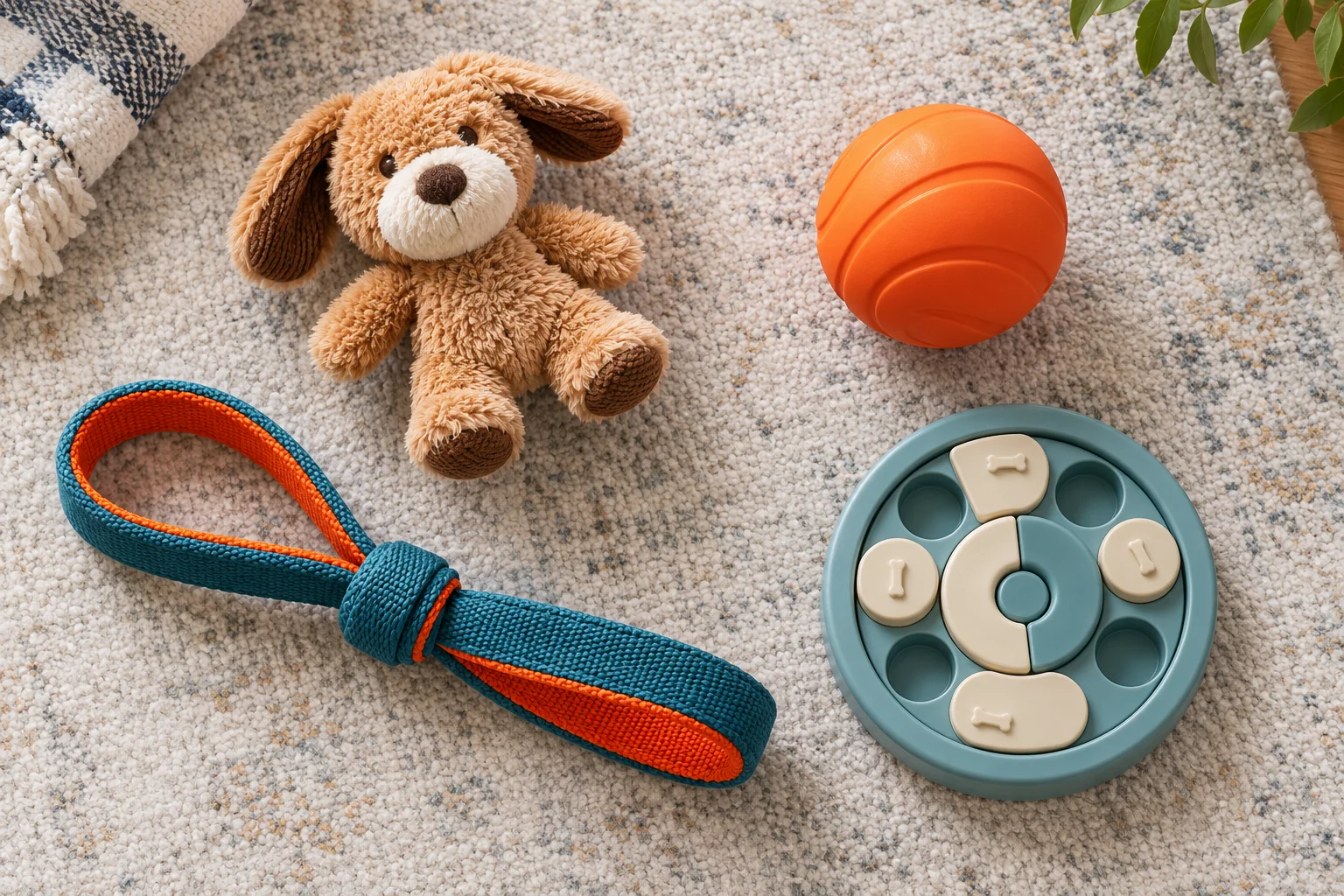
For example, a dog that usually carries a plush toy may work at the sound component of a new squeaky one. With the second toy, watch what happens around the insert and the shell that holds it.
Use the toy’s intended function to focus the comparison.
| Intended activity | Parts to examine | A useful first question |
|---|---|---|
| Carrying or gentle plush play | Shell, seams, ears, tails and fill containment | Does the dog carry the body or try to remove a part? |
| Fetch | Complete body, surface, covering and any attached sound part | Is the object suited to this dog’s retrieval use and the product directions? |
| Shared tug | Grip areas, handles, knots, stitching and joins | Where will each participant hold the toy? |
| Puzzle play | Openings, moving pieces, closures and removable parts | Which parts are meant to move or come out? |
| Chewing | Intended use, sizing guidance and changing condition | Does the product match the dog’s actual chewing behavior? |
The dog toy types and construction options show how rope, plush and molded designs differ as complete products. Use the category distinctions to identify the form you need, rather than treating all the options as interchangeable.
Judge Size and Parts on the Finished Toy
Consider the complete toy and the pieces a dog can reach, not just the size of the main body. A large plush body can have a small attached eye; a large handled toy can have a narrow connection. The overall dimension does not describe those details.
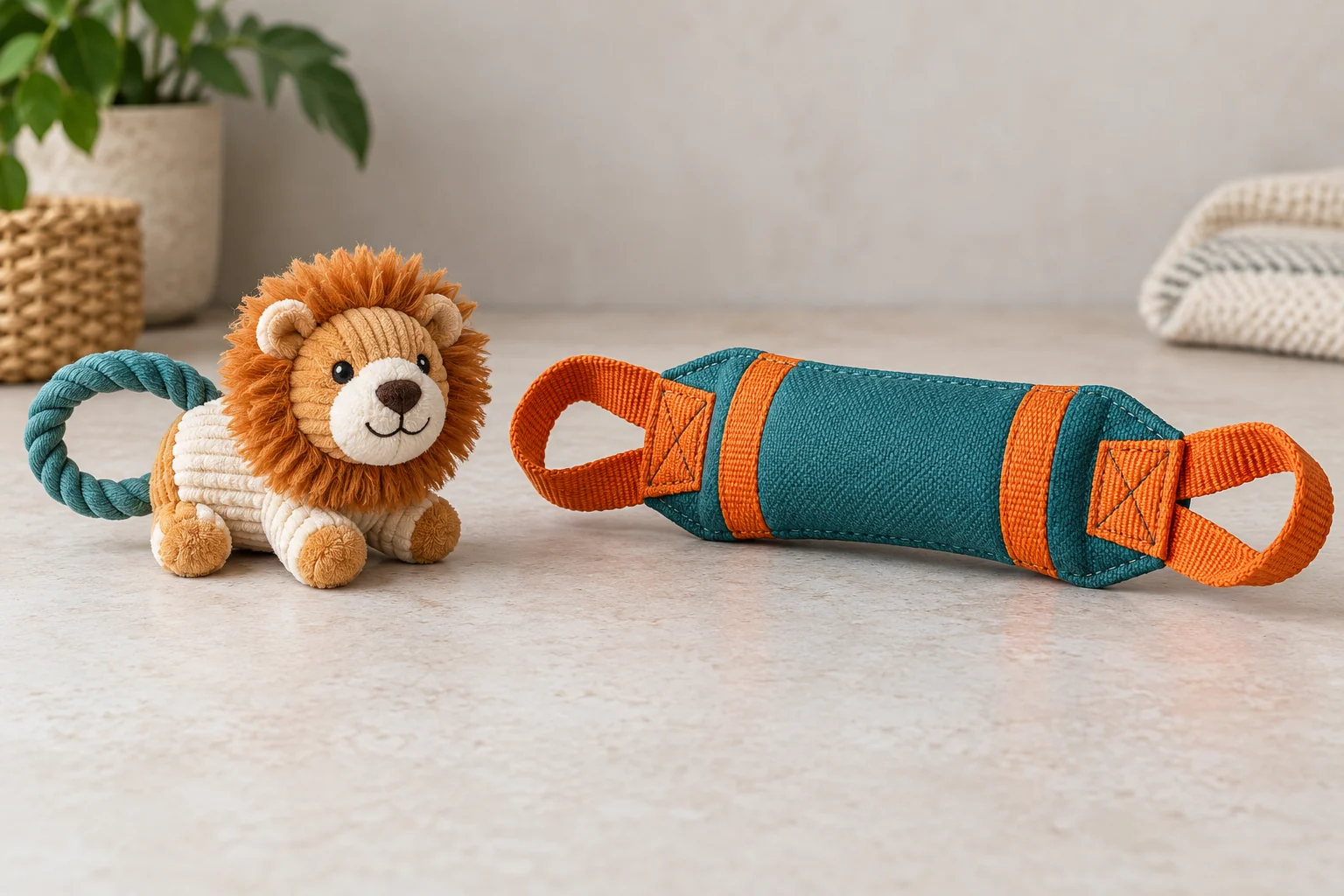
Avoid toys small enough to be swallowed. Then use the product’s guidance for the dog’s size and behavior. A small, medium or large label is a product-specific starting point, not a common measurement shared by every manufacturer.
For small dogs, size also has a handling side: look at the weight, shape and accessible gripping areas. Choosing a toy that the dog can carry does not mean simply buying the smallest version in a collection. Compare the actual dimensions and components of the options.
Read material descriptions at the component level. “Nylon” might describe a woven shell or a solid part. “Rubber” might identify a body without saying anything about its fabric cover or sound insert. The dog toy materials and components guide separates those terms when a listing leaves the construction unclear.
Use the material description to identify components. Leave broader claims such as “non-toxic” or “reinforced” separate until there is applicable information about the substance or construction being described.
Plush and Squeaky Toys: Keep the Inside Contained
On a plush toy, the shell needs to contain the filling and any internal sound parts. Open seams, holes or exposed filling are reasons to remove it from use. Include the less visible underside and the bases of attached limbs when you examine the shell.
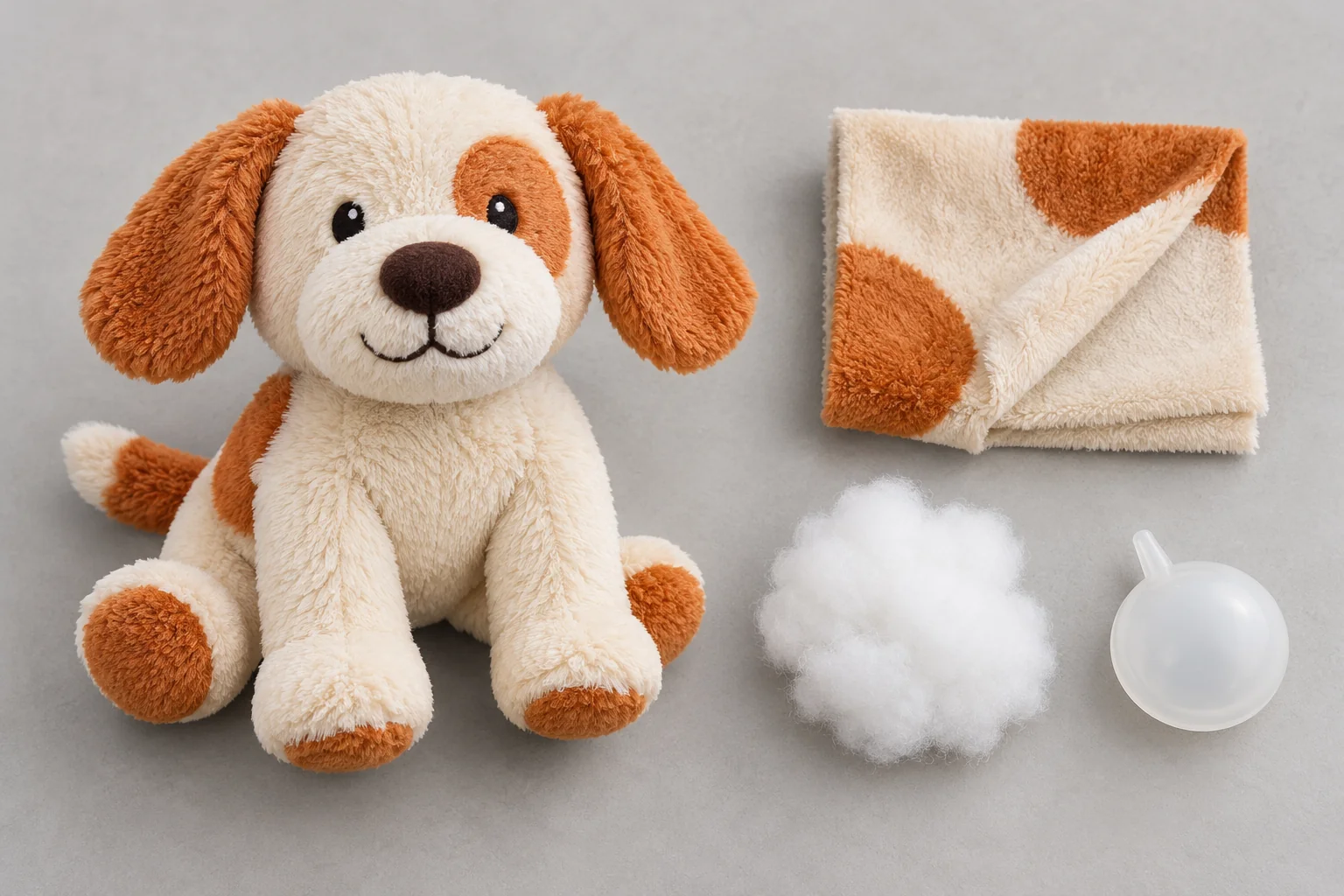
Look at narrow limbs, corners and stitched-on details as well as the center of the body. An ear can have a different attachment from the main seam. Decorative eyes, ribbons and other removable details deserve attention because a dog can detach and swallow small parts.
A stuffing-free toy can still contain rope, a squeaker or attached decorations. Include those parts in the review even when there is no loose fill to consider.
A squeaky toy adds a sound component to the same review. Its noise does not tell you where the insert sits or how it is contained. On a soft toy, look at the shell around it; on a molded toy, examine the body, openings and any separate sound fitting.
If that component becomes loose or accessible through damage, take the toy away, including any part that has separated.
Notice where your dog focuses. Carrying the toy by its middle is different from pulling at a stitched detail or working at the squeaker’s location. That observation can rule out a format even when another toy made from a similar fabric has worked differently in your home.
Fetch and Tug Toys Have Different Wear Points
For fetch, examine the object’s body, surface and covering. For tug, examine the holding areas and the connections between them. For either type, compare its present condition with its intact form.
A fetch toy can be a single molded object or an assembly with a fabric cover, rope or sound part. Look at the object you will throw and the way the dog will carry it back. Retire a toy with broken pieces, an opening cover or a separating surface.
Prepare the play area for the intended game and follow any setting restrictions in the product’s instructions. After retrieval, put the fetch toy away if its directions do not support chewing on it.
For shared tug, identify the intended dog-grip section and handhold. On a fabric handle, the stitching is part of that layout. On a rope section, the ends and knots are part of it. On a combined toy, follow each connection into the next component.
A separating handle, opening seam or fraying rope ends that tug session. Remove the damaged toy from play rather than moving the handhold to another part of it.
Puzzle Toys Need Their Own Setup and Care
For a puzzle, establish which parts are intended to move, lift out or stay attached. A removable piece can be part of the design, while a newly loosened piece can be damage. The product’s assembly instructions distinguish the two.
Lay out the puzzle before introducing it. Identify the intended openings, closures and separate components. This gives you a reference for noticing a missing piece or changed fit after use, without guessing whether a gap was part of the original design.
During the first use, watch whether the dog interacts with the intended openings or starts pulling at a part that should stay attached. Set the puzzle aside if the dog begins taking it apart. The setup diagram gives you a reference for describing which component has changed.
Care belongs to the whole assembly. The body, moving parts and any inserts may have different cleaning or reassembly directions. Use the product’s instructions instead of inferring a washing method from one material name. After cleaning, return the correct parts to their intended positions before the next use.
If a component no longer fits as designed, keep the puzzle out of use until the manufacturer’s guidance resolves that change. Keep its separate pieces together so that reassembly uses the parts intended for that product.
Make the First Play Session a Useful Trial
Introduce a new toy while you can observe the way your dog uses it. Start with the activity in its directions, and keep the parts you identified earlier in view.
Describe what you see: the dog carries the body, targets an attachment, works a seam, pulls out a puzzle part or removes a piece. These descriptions tell you more than “likes it” or “plays hard.” Use what you see to decide whether to continue that intended activity or remove the object.
Keep the general routine simple. Follow the product’s use and care directions, examine the relevant parts before returning it to play, and remove items with loose components, exposed interiors or broken pieces. Being present helps you respond to a change; it does not make an unsuitable or damaged object appropriate.
If you think the dog has swallowed toy material, stop access and promptly contact your veterinarian. Keep known product information and remaining parts available. Follow the veterinarian’s guidance for the next step.
For a buying project, record the same observations against a specific finished sample: intended activity, dimensions, component identities, joins, accessible parts and care directions. A plush sample needs its shell and interior described; a tug sample needs its grip layout and connections described. This provides useful questions for a supplier without turning one sample into proof about an entire range.
FAQ
What is the safest toy for a dog?
There is no universal recommendation for every dog and activity. Start with a specific product’s intended use, size and complete construction, then observe how your dog uses it. Choose from that information rather than a category’s reputation.
Are plush toys safe for dogs?
A dog carrying a plush toy and a dog dismantling it present different uses. Follow that product’s directions, and remove it if its shell opens or the interior becomes accessible. A softer replacement still needs the same containment review.
Are squeaky toys safe for dogs?
Review how the sound component is contained in the particular toy. Take it away if the body breaks, the insert loosens or the dog gains access to it. The presence or absence of a squeak alone cannot answer the safety question.
What toys can I leave my dog alone with?
Follow the particular product’s restrictions and consider your dog’s observed behavior with it. This general guide cannot establish that a toy is suitable for unattended use. If your dog removes or swallows material, ask your veterinarian about appropriate toy choices.
Conclusion
At the next play session, introduce one toy intended for that activity and watch the part your dog works on first. If the dog starts opening a seam or loosening a piece, remove it from play. Use that observed behavior to guide the replacement choice.