The best dog rope toy is one that fits the game you intend to play, gives you and your dog usable gripping space, and has a clearly described construction. Compare the whole toy: its fiber, rope diameter, knots, finished ends and attached parts. A thick rope or a “heavy chewer” label alone does not settle the choice.
Start with the way your dog uses toys. Carrying a knotted rope back to you, pulling against a hand-held loop and picking individual strands apart are different activities. Choose a form for the game you want to share.
Choose the Game Before the Rope
For shared tug, look first at the areas each of you will hold. For carrying and retrieving, consider the complete object’s shape and weight. A toy intended for one activity should not acquire a different use just because it has a rope attached.
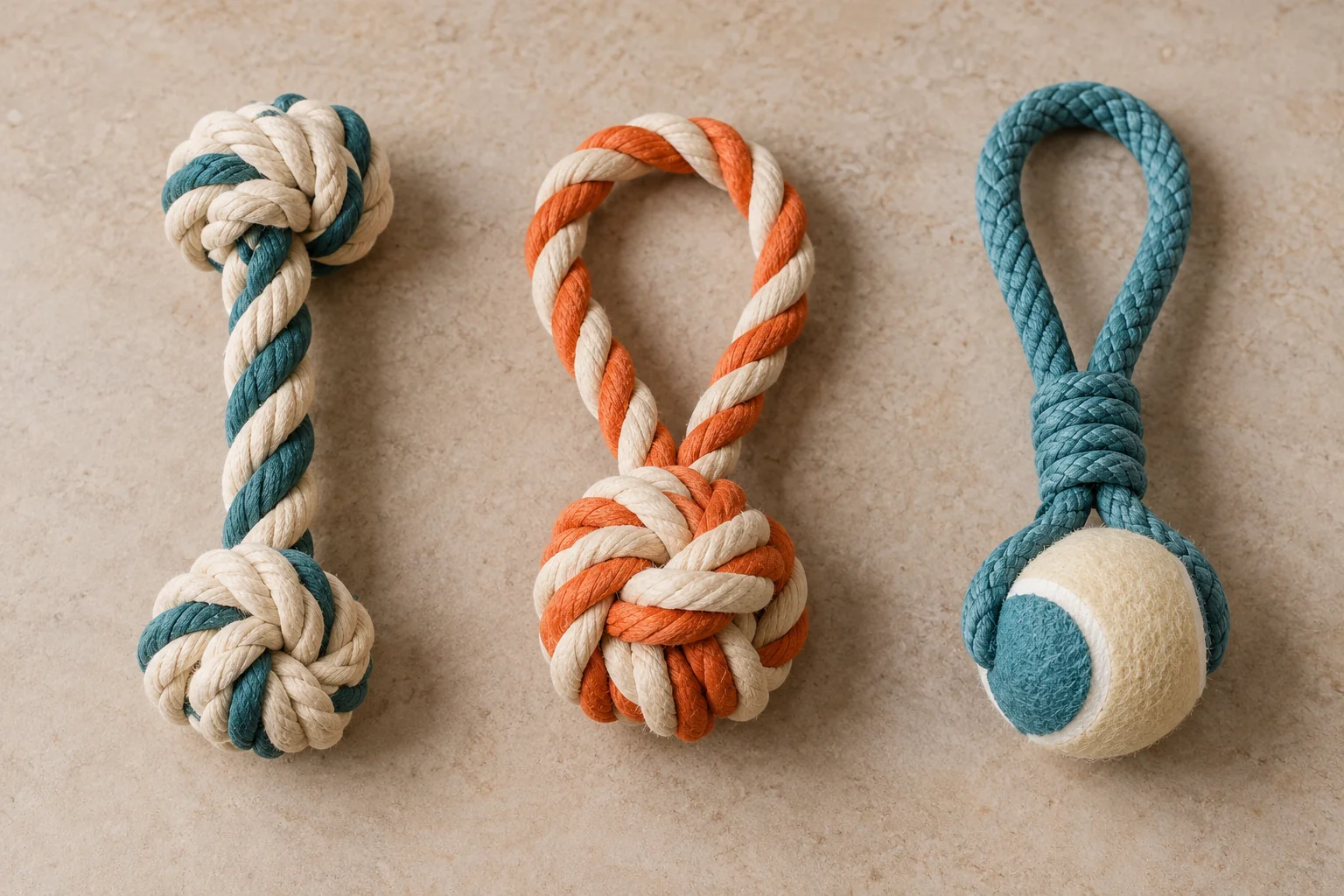
A straight rope with knots gives you several possible holding positions. A loop has a defined handle opening. A rope-and-ball toy adds a separate body and a connection that belong in the comparison. Each layout changes where you can grip the toy and which connections you need to see.
Picture a simple choice between a short two-knot rope and a longer handled version. The longer toy may offer more hand space while adding a handle, a join and more bulk. A clear view of the whole toy shows whether that extra space is useful to you.
The rope-toy formats include knotted, looped and combined-component designs. Use those forms to narrow the design you want before comparing fiber descriptions or colors.
Use the particular product according to its directions and observe how your dog plays with it. A toy described for shared tug should stay in that role unless its instructions also support the other use you have in mind.
Read Fiber and Construction Together
Cotton, polyester and blends describe the fibers in a rope. Pair that information with its construction, knot positions, finished ends and attachments to describe the toy you are buying.
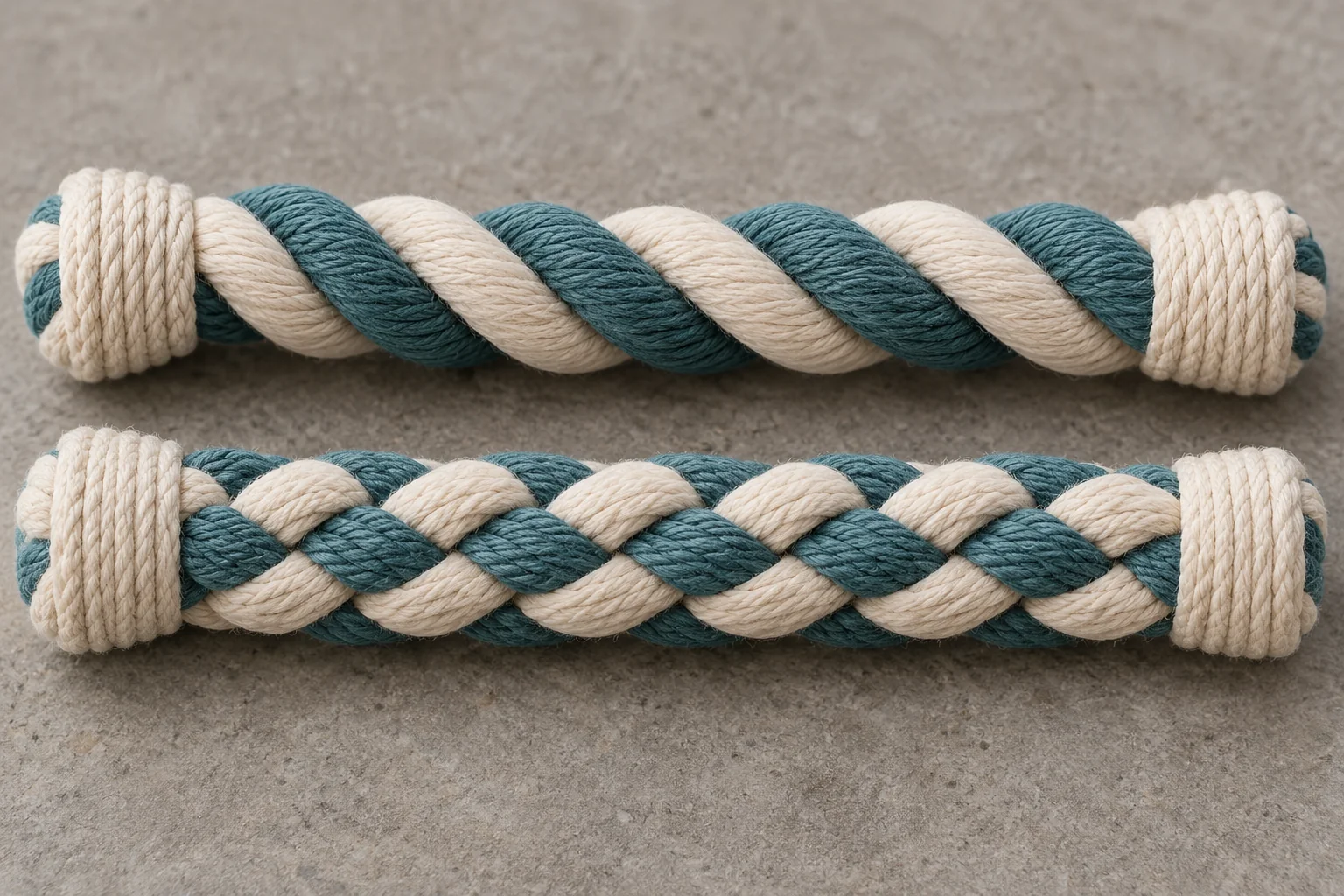
Twisted rope has groups of strands wound around one another; braided rope has strands interlaced. Use those terms to distinguish the samples or listings in front of you.
Two similarly colored ropes could have different fiber specifications. Conversely, two ropes with the same fiber description could differ in diameter, construction, knot placement and added parts. A photograph shows the visible arrangement but cannot identify an exact fiber blend.
For a toy made from several materials, the dog toy materials and components guide explains the difference between a rope section, textile shell, molded body and internal fill. Those distinctions are useful when “cotton toy” describes only one part of the assembly.
For a cotton rope with a fabric handle, read the handle description separately. If the listing says only “natural rope,” the fiber identity is still missing. A matching color in a photograph cannot supply that information.
Compare Usable Length, Diameter and Weight
Overall length is not the same as available grip space. Knots, loops, tails and attached bodies occupy part of the toy, so compare where the measurement begins and ends as well as the number on the listing.
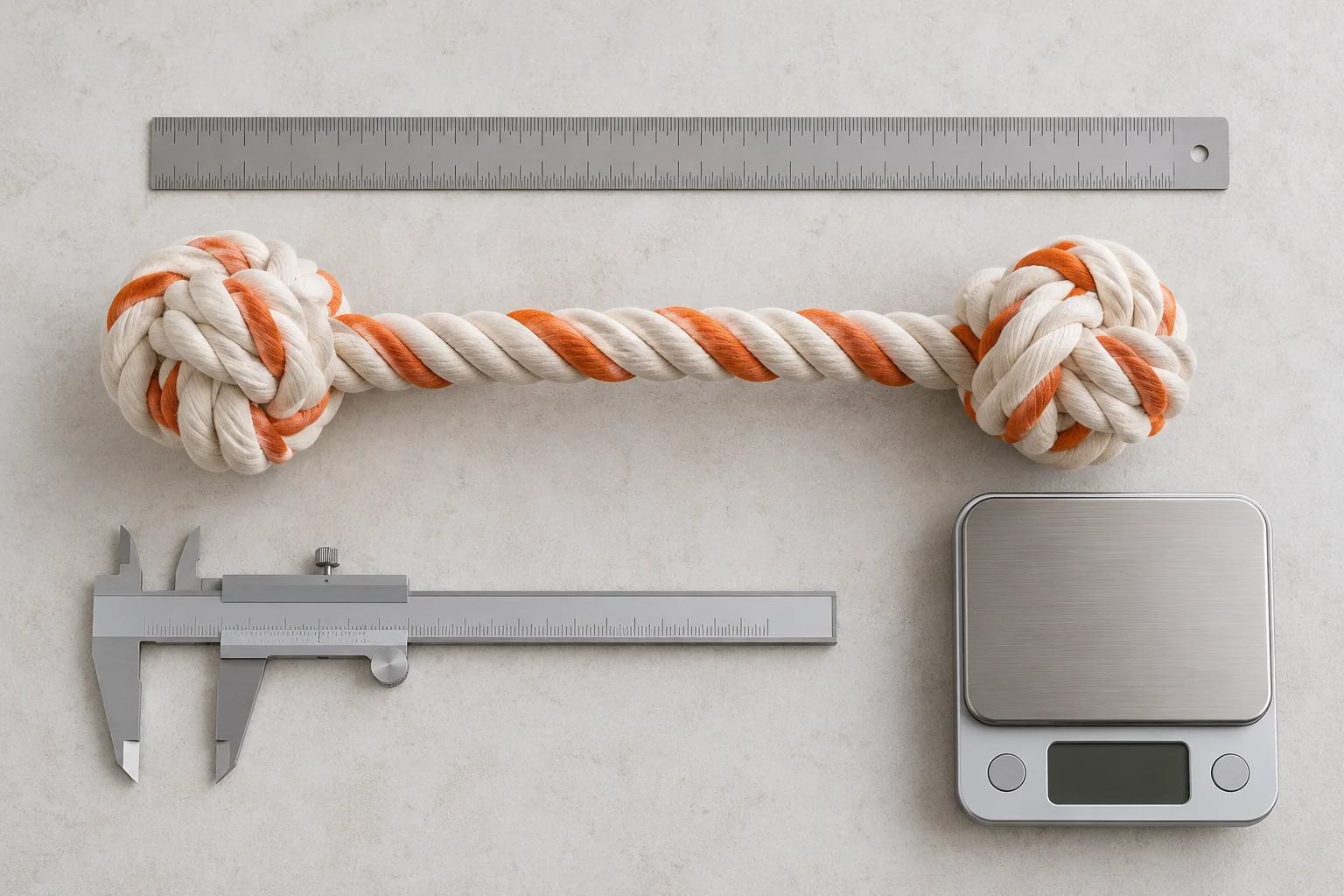
Imagine two ropes with the same overall length. One has large end knots and short exposed sections. The other has smaller knots spaced farther apart. They can offer different holding areas even though the stated length matches. A dimensioned product drawing or a complete sample makes that difference easier to see.
Diameter describes the thickness of a rope section, not the size of its largest knot or attached ball. For a looped design, the handle opening is another dimension. Treat these as separate measurements rather than trying to describe the whole toy with a single size label.
For a large dog, “large” on the packaging is only a starting point for the product’s own sizing guidance. It does not supply a universal rope diameter, pulling-force rating or knot size. For a smaller dog, an oversized knot or heavy attachment can also make the form awkward to carry. Include the complete toy’s weight in the comparison.
Avoid a toy small enough to be swallowed, and use the manufacturer’s guidance for the dog’s size and chewing habits. The useful measurements belong to that finished product; no single rope diameter is specified here for a breed or weight range.
When deciding between sizes, ask what changes in the actual design. A larger option might change only the rope length, or it might also change the knots, handle and attached body. Compare those details before assuming the options are scaled copies of one another.
Look at Knots and Added Parts
Knot position changes the holding area. Compare a knot near the end of a rope with one in the middle: the same number of knots can leave quite different exposed sections.
On a plain knotted rope, note how much rope sits between knots and how the ends finish beyond them. On a loop, look at how the loop closes. On a mixed-material toy, follow the connection from the rope into the other component: through an opening, into a stitched section or around a separate fitting.
A decorative tail may occupy the area you expected to hold. A ball may hide the rope connection in a photograph. Look for a view that shows those features together, including the section the dog will grip.
Compare a complete toy when attachments matter. A loose rope sample cannot show how a handle, fabric body or ball joins the finished product. If you cannot see or identify a connection that is central to your intended use, that is a specific information gap worth resolving before choosing it.
Know When a Rope Has Reached the End
Fraying or loose strands are reasons to remove a rope toy from use. Pay attention to a changed knot, a separating handle or an opening join as well as the rope’s middle section. The condition of the whole assembly determines whether it is still the toy you selected.
This is especially relevant when searching for rope toys for aggressive chewers. If your dog picks apart fibers or removes pieces, that behavior changes the decision. Moving to a thicker rope or a larger knot does not demonstrate that the problem has been solved.
Describe the change you see: the dog carries the body, opens a knot or pulls at a rope end. That observation gives you a more useful basis for the next choice than calling the dog a light or heavy chewer.
Use condition and the product’s replacement guidance to decide when it comes out of play. There is no replacement calendar supplied here. Keep the instructions with the toy so that care and wear guidance remain available after the packaging is gone.
Put Two Shortlisted Toys Side by Side
Choose between two candidates by comparing the details that affect your intended game. Missing information should stay visible in the comparison instead of being filled with assumptions about a brand or material.
| Comparison point | What to record for each toy | How it helps the decision |
|---|---|---|
| Intended activity | The product’s stated use and any restrictions | Separates an interactive tug from a different toy format |
| Holding layout | Exposed rope, knots, loop and attached body | Shows where the hand and dog will engage with the toy |
| Dimensions | Overall measurement, rope diameter and relevant openings | Reveals whether two size descriptions refer to the same features |
| Complete weight | Weight of the assembly, including added parts | Adds context for carrying or retrieving |
| Construction | Fiber description, twist or braid, ends and connections | Makes differences between similar-looking designs explicit |
| Care and wear guidance | Product-specific instructions and replacement criteria | Gives you a basis for use after purchase |
For your own dog, this can be a short note beside two listings. You do not need a technical file to notice that one listing gives an overall length but never shows the handle, while another shows the full layout and explains its intended activity.
For a wholesale or custom project, use the same fields in a sample record. Tie the agreed fiber description, dimensions, knot layout and attachment details to one sample reference. If a supplier proposes a different handle or end finish, record the change on that reference rather than letting matching colors stand in for matching construction.
Put broad claims in a separate column from the observable details. “Heavy duty,” “natural” or “reinforced” needs a product-specific explanation before it can help you choose. Fiber composition identifies material; an applicable assembly test would answer a different question about a defined product. One cannot stand in for the other.
For care, use instructions for the complete assembly. A washable rope section does not establish the same cleaning method for an attached fabric handle, ball or sound component.
FAQ
Should dogs chew on rope toys?
Use the particular toy according to its directions and your dog’s observed behavior. A rope meant for shared tug is not automatically a prolonged chewing toy. If the dog frays it or removes strands, take it away rather than relying on a “chewer” label.
What should I do if my dog eats part of a rope toy?
Stop access to the toy and promptly contact your veterinarian. Swallowed rope or string needs professional assessment; do not assume it will pass. Keep the product information and any remaining pieces available to help explain what may be missing. Follow the veterinarian’s guidance for what to do next.
What is the best type of rope for dog toys?
A fiber name alone cannot settle the choice. Narrow it to finished toys intended for your game, then compare their construction. This guide does not rank cotton above polyester, or the reverse, without applicable product evidence.
Conclusion
For the rope toy on your shortlist, find a view that shows the dog’s gripping section and its connection to the rest of the toy. If the ball or handle hides that connection, request a complete view before choosing. Decide on the finished assembly you can identify, rather than the section of rope you can see.