Dog toy materials include rubber-like compounds, solid and woven nylon, textile shells, rope fibers, stuffing, squeakers, and crinkle inserts. The right choice depends on the whole toy: its size, geometry, seams, attachments, intended play, and the way a particular dog uses it. A material name alone cannot tell you how a finished toy will perform.
You might find two toys labeled “rubber” that feel quite different, or a supplier quotation that says “nylon” without explaining which part it describes. Comparing the components first helps you see what you are buying—and what still needs clarification.
Start With the Toy’s Job
Begin with the type of play the toy must support. A hollow enrichment toy, a fetch ball, a tug toy, and a plush comfort toy place different demands on their materials and joints.
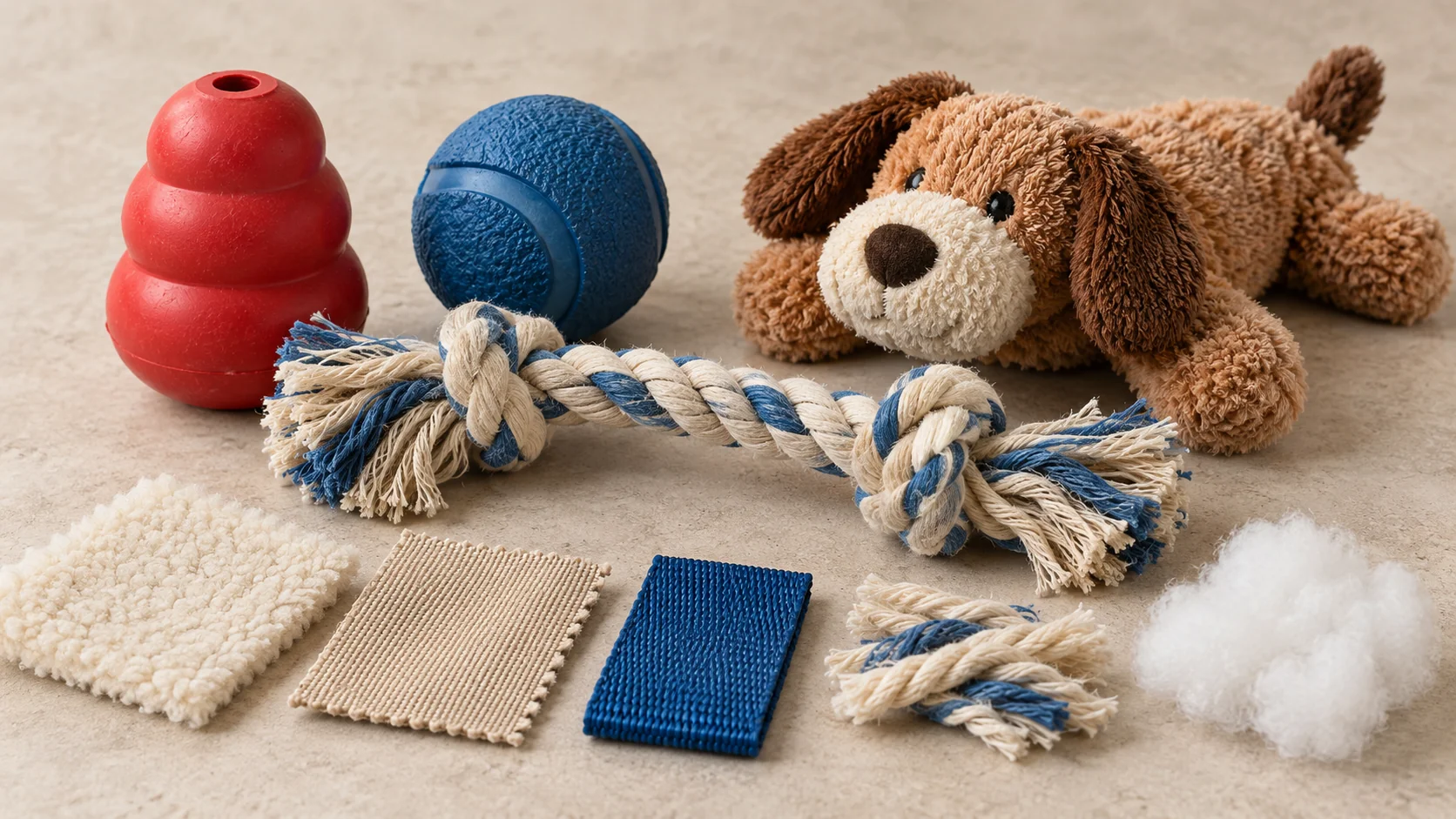
For a chew or enrichment toy, look at the body’s flexibility, wall thickness, openings, and edges. For fetch, consider shape, rebound, visibility, and surface condition after use. Tug toys need a review of the rope, fabric, stitching, knots, and handles together. With plush toys, check how the shell contains the fill and sound components.
Dog size and behavior change the decision. Follow the product’s sizing and use guidance. A dog that targets seams or removes pieces uses a toy differently from a dog that mainly carries it. Watch how your dog plays with a new toy rather than relying only on its material label.
For buyers developing a range, describe that use before selecting a material. “A soft toy for carrying” gives a supplier a clearer starting point than “a durable dog toy.” It also helps you decide which parts of a sample deserve closer inspection.
Compare Rubber-Like Materials by Construction
Natural rubber, thermoplastic rubber (TPR), and thermoplastic elastomer (TPE) are broad labels used for molded dog toys. Formulation, geometry, thickness, and manufacturing can vary within those categories, so compare finished samples instead of assuming that every rubber-like toy feels or behaves the same.
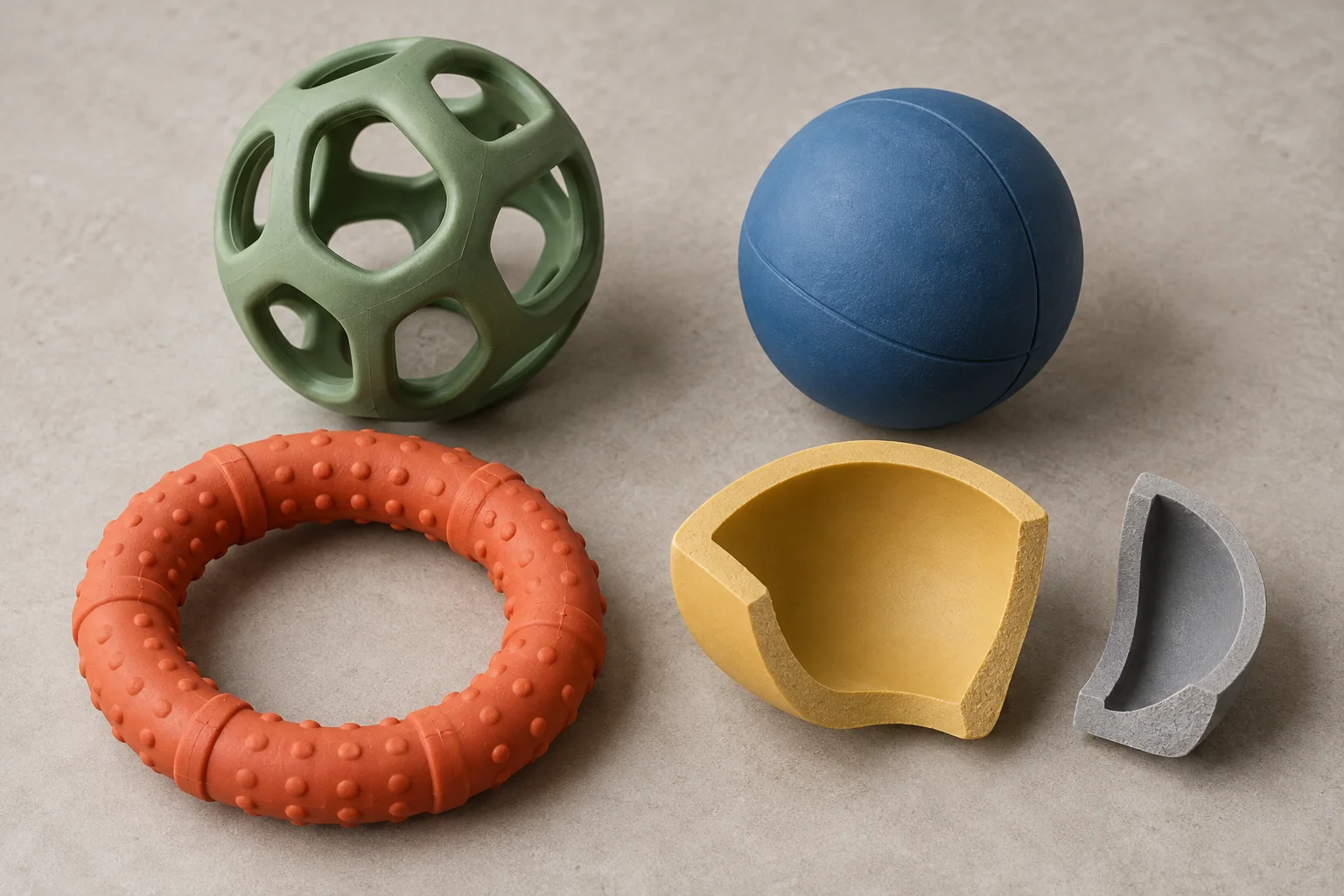
If you are choosing a toy for your dog, handle the finished product. Check its size, flexible areas, openings, joins, and any detachable parts against the intended use and care instructions. A flexible surface does not, by itself, establish that the complete toy suits every dog.
For product development, record more than “rubber” on the specification. Identify the supplied material family, solid or hollow construction, dimensions, target weight, surface texture, openings, joins, color requirements, and intended use. If hardness matters to your design, agree on how it will be measured and reported for that product. Do not treat one hardness number as a universal suitability rule.
When comparing wholesale rubber dog toys, use the same checklist for each sample. A difference in feel is a reason to clarify the specification, not enough evidence to label one material universally better.
Separate Solid Nylon From Woven Nylon
Solid nylon chews and woven nylon shells are different constructions. A molded nylon part is a rigid three-dimensional component. Nylon fabric is made from fibers and needs a separate description of its weave, coating, seams, thread, and attachments.
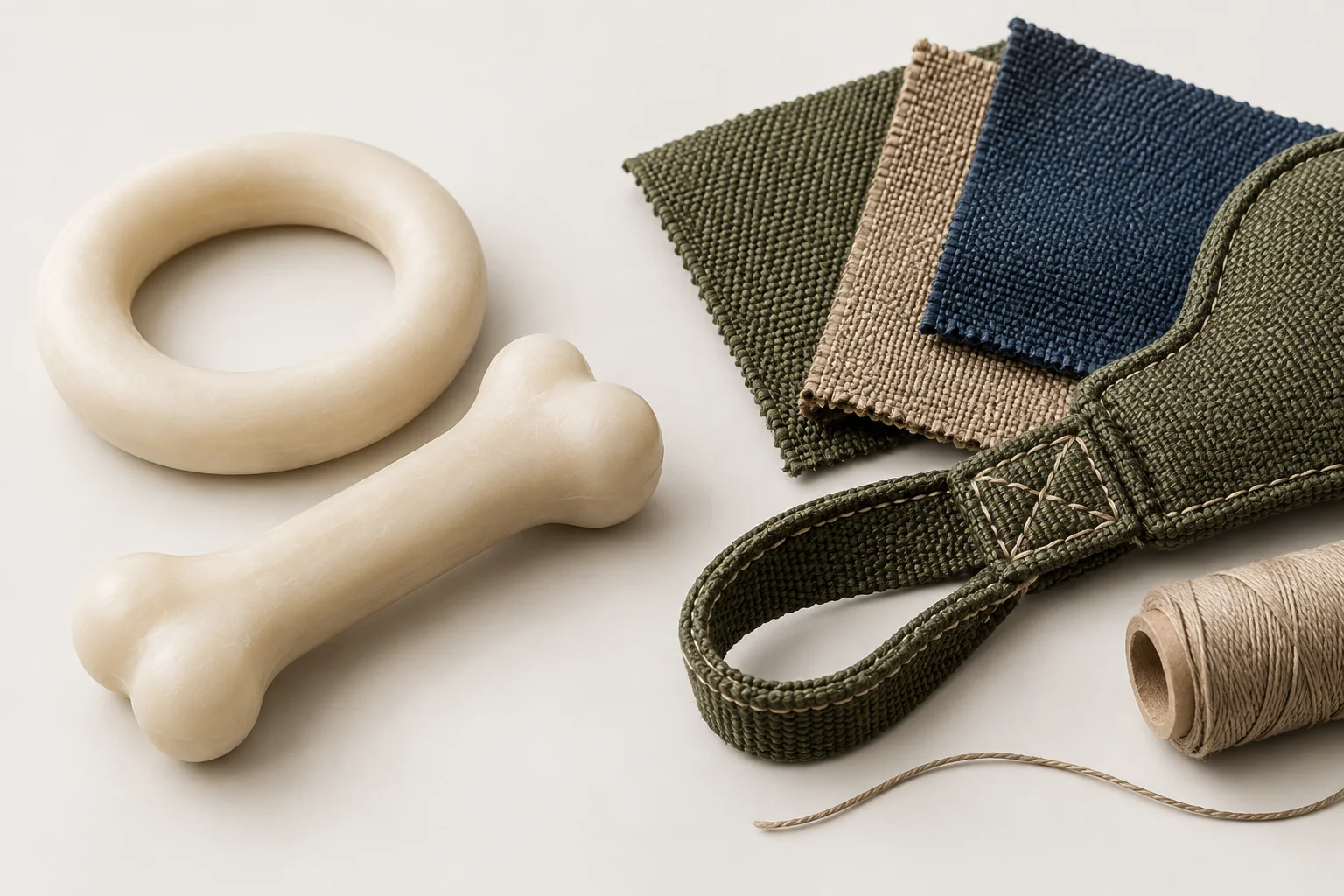
That distinction matters when you compare supplier descriptions. “Nylon dog toy” is incomplete unless it identifies whether nylon forms a solid component, a textile shell, a webbing element, or another part. Ask for a component description and a finished sample before treating two nylon products as equivalent.
On a solid component, inspect the shape, openings, surface, and edges. On a textile component, inspect the fabric layers, seam placement, stitching, and connection to the rest of the toy. Those are different review tasks even though the material name overlaps.
Neither the word “nylon” nor a sample’s appearance establishes how a toy will perform in use. For a purchase decision, combine the component description with the product’s intended use, sizing, care instructions, and sample observations. Stop using a toy if parts loosen or damaged surfaces develop.
Break Plush and Squeaky Toys Into Components
A plush or squeaky toy is an assembly, not a single fabric. Review its shell, backing layers, seams, attachments, fill, squeaker, and any crinkle insert separately.
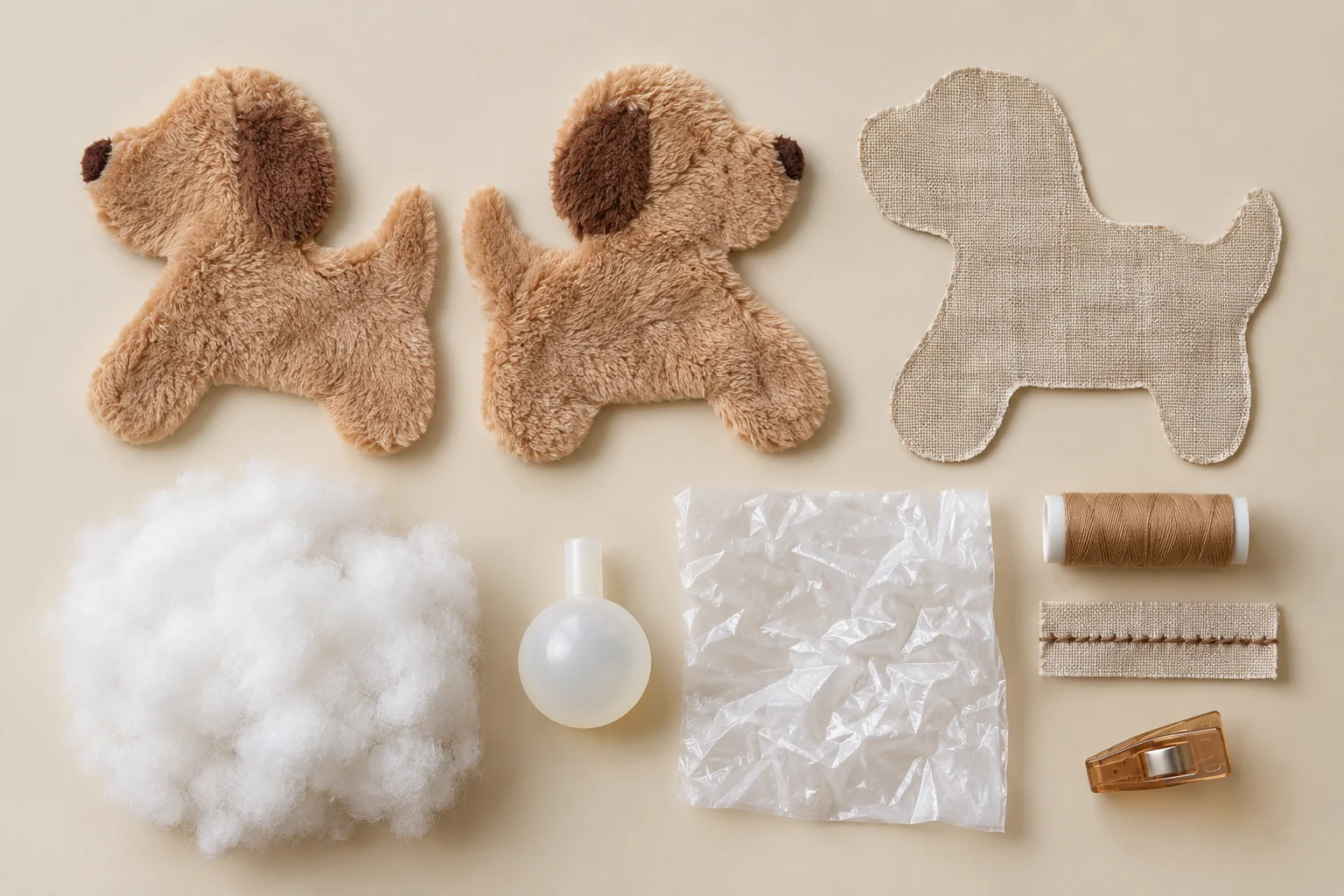
Shell, seams, and attachments
Common shell descriptions include fleece, plush polyester, canvas, denim, and woven nylon. Those names do not state fabric weight, backing, layer count, or seam construction. A useful specification identifies the textile and explains how the body, ears, limbs, handles, and decorative parts are joined.
For a sample review, look beyond how the fabric feels in your hand. Check corners, narrow limbs, stitched-on details, and changes between materials. These are useful places to compare construction and record differences between samples.
Fill and sound components
Fill should be identified separately from the shell. If a supplier describes “fiberfill,” ask for its material identity, intended amount, distribution, and how it is contained. Do not assume that every toy uses the same fill just because the outside looks similar.
Crinkle toys add a rustling insert, often described as a plastic film. That description does not identify a universal polymer, thickness, or care limit. Ask what the actual insert is, where it sits, and how the shell keeps it contained. Treat a squeaker as another component with its own placement and containment requirements.
When reviewing wholesale dog squeaky toys, check the sound component, fill, shell, and seams together. If the shell opens or an internal part becomes accessible during use, stop using the toy rather than treating the remaining fabric as an intact product.
Specify Rope Fiber and Rope Construction
Rope toys may use cotton, polyester, or blended fibers, but fiber name alone does not define the product. Rope diameter, strand structure, twist or braid, knot shape, attachments, and end finishing also need attention.
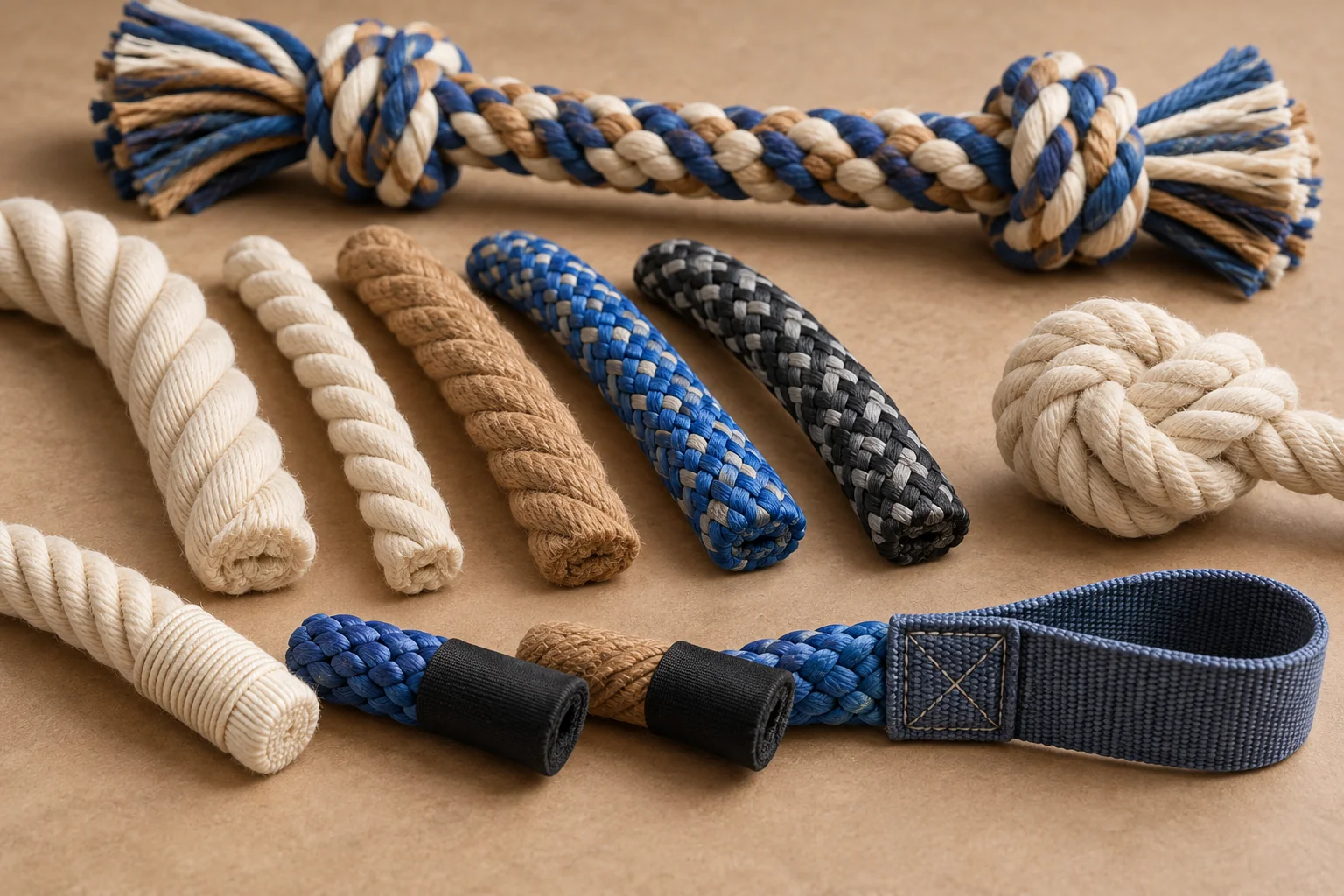
For buyers, inspect how the rope connects to the rest of the toy. Tugging on a rope segment also pulls on its knots, stitching, fabric junctions, and handles. Review the full assembly rather than comparing only loose lengths of rope.
Ask the supplier to describe the fiber or blend and show how the ends are finished. A photo may show the color and knot layout, but it cannot confirm the exact fiber composition. Record the agreed material description alongside the sample reference so that appearance does not become the only acceptance criterion.
If you are choosing a rope toy for your dog, monitor the ends, knots, and strands during play. Remove it when it unravels or pieces come free, and follow the product’s use guidance. “Natural fiber” is not a reason to ignore visible damage.
Compare wholesale dog rope toys by fiber and assembly together. A change in a handle or attachment can matter to your design even when the rope itself stays the same.
Use a Component Comparison, Not a Material Ranking
Compare dog toy materials by the job each component performs and the construction you can inspect. There is no single material ranking that can replace a review of the complete toy.
| Component or material family | Common role in a toy | Questions to put in the specification | Visible reasons to stop use |
|---|---|---|---|
| Rubber-like molded body | Chew, fetch, or enrichment body | Material family, solid or hollow geometry, dimensions, openings, surface, relevant measured attributes | Cracks, missing pieces, deep damage, or a changed surface |
| Solid nylon component | Rigid component | Exact material, dimensions, geometry, edge condition, intended use | Sharp or rough worn edges, splits, or pieces coming free |
| Woven textile shell | Plush, tug, or reinforced outer layer | Fiber, fabric construction, backing, layers, seams, thread | Open seams, holes, thinning, or exposed internal parts |
| Rope assembly | Tug segment, handle, or mixed-material component | Fiber, diameter, strand construction, knots, attachments, end finishing | Fraying, loose strands, opening knots, or detached sections |
| Fiberfill or other fill | Shape and softness inside a shell | Fill type, amount, distribution, containment, intended care | Exposed fill or an opened shell |
| Squeaker or crinkle insert | Internal sound component | Identity, size, placement, containment, care expectation | Exposed, detached, punctured, or accessible component |
Use the table to spot missing information, not to assign safety or durability scores. If a quotation identifies the shell but says nothing about fill or attachments, you have a specific follow-up question before you compare prices.
Inspect the Finished Toy Regularly
Inspect the complete toy before use and as it wears. Check the places where components meet, and stop using it if damage opens the shell, loosens parts, or changes the surface.
Look for cracks, deep gouges, or missing pieces on molded bodies. Feel rigid components for newly sharp or rough edges. On fabric toys, check for thinning, holes, open seams, and visible fill or inserts. On rope toys, check strands, knots, ends, and handles.
Care instructions should follow the finished product, not a generic material assumption. A washable textile does not establish that its fill, coating, adhesive, sound component, and assembled seams have the same care limits. Use the manufacturer’s instructions and inspect the toy again after cleaning.
For a buying project, record the inspection points you expect on the finished sample. A short checklist is easier to compare across suppliers than a general request for “good quality.” Keep photos and notes tied to the specific sample, rather than treating one sample as evidence about every product in a material category.
Lock the Material System Before Ordering
Before ordering, put the components, construction, and review criteria into one specification. That gives each supplier the same product to quote and gives you a clearer basis for sample approval.
- Define the product’s job. State whether it is intended for fetch, tug, carrying, enrichment, gentle plush play, or another use. Avoid undefined claims such as “indestructible.”
- List every component. Include the molded body, shell, rope, fill, squeaker, crinkle insert, thread, coatings, adhesives, and attachments that apply.
- Describe construction. Add dimensions, layers or wall arrangement, seams, stitch locations, knots, joins, openings, and attachment points.
- Choose relevant measurements. Request product-specific fields for weight, hardness, fabric construction, fill amount, or other attributes only when they help define the agreed product.
- State documentation needs. Identify the destination market and ask which material declarations and product-specific documents are available. Have applicable market requirements checked by a qualified specialist rather than accepting a broad “compliant” label.
- Review representative samples. Compare the agreed materials, dimensions, joins, seams, surfaces, accessible parts, and care instructions.
- Record acceptance criteria. Write down what will be checked and what counts as a defect before approving production.
Use the dog toy manufacturers page when moving from material research to a wholesale or custom project. Keep your specification and sample reference with the inquiry so that the discussion concerns a defined product, not only a material name.
FAQ
These questions address material choices you may need to clarify when buying a toy or reviewing a supplier’s sample.
What’s the best fabric to specify for a dog toy?
There is no single best fabric for every design. For a useful comparison, request samples made with the intended shell, backing, seams, and attachments—not just fabric swatches. You can then compare the surface feel and finished construction for the play style you have in mind, without assuming that a fabric name guarantees durability.
What type of rope should I ask a supplier to use?
Specify the fiber or blend together with the rope construction. Ask the supplier to identify both, then compare samples with the intended knots and attachments. If an alternative is proposed, have the supplier describe the change before you approve it; matching color and diameter alone does not show that the material specification is unchanged.
How do I know what the crinkle insert is made of?
Ask for the actual insert’s material description, not just “crinkle paper.” The rustling sound does not identify the polymer or its care limits. For a supplier sample, request the insert specification and check its placement and containment in the finished toy. Do not substitute packaging film simply because it makes a similar sound.
Can I compare two products described as “nylon dog toys”?
Only after you establish which component the word “nylon” describes. A molded part, woven shell, and webbing attachment are not equivalent items to quote. Ask each supplier to describe the nylon component in the same format, then compare the full construction and sample—not the shared label alone.
Conclusion
Choose dog toy materials as part of a finished design, not as a promise on a label. For your own dog, the next step is to check the toy’s intended use, size, condition, and care instructions. For a buying project, it is to turn the design into a component specification that suppliers can quote consistently.
If you are preparing a wholesale or custom inquiry, contact us with your product reference, intended use, material preferences, and destination market. Use those details to start a product-specific discussion rather than a request for the “best” material without a defined toy.