The best pooper scooper for a lawn may be an awkward choice for a gravel run or a daily walk. Start with the surface where you pick up most often, then compare how the tool collects, carries and releases waste. Handle reach and storage matter, but they cannot compensate for a head that does not suit the job.
Rake-and-tray sets, spades, closing jaws and bag-supported tools offer different ways to collect waste. This guide compares those formats without declaring a tested winner or assuming that every model within a category performs alike. It also separates a yard tool from a portable setup, so you can decide whether one purchase can cover both.
How Rake, Spade, Jaw and Bag Scoopers Work
A rake moves waste toward a tray or pan. A spade uses a solid leading edge. A jaw closes around the pickup area, while a bag-supported tool holds a bag in position during collection. Some products combine these features, so look at the actual head and release mechanism rather than relying on the category name.
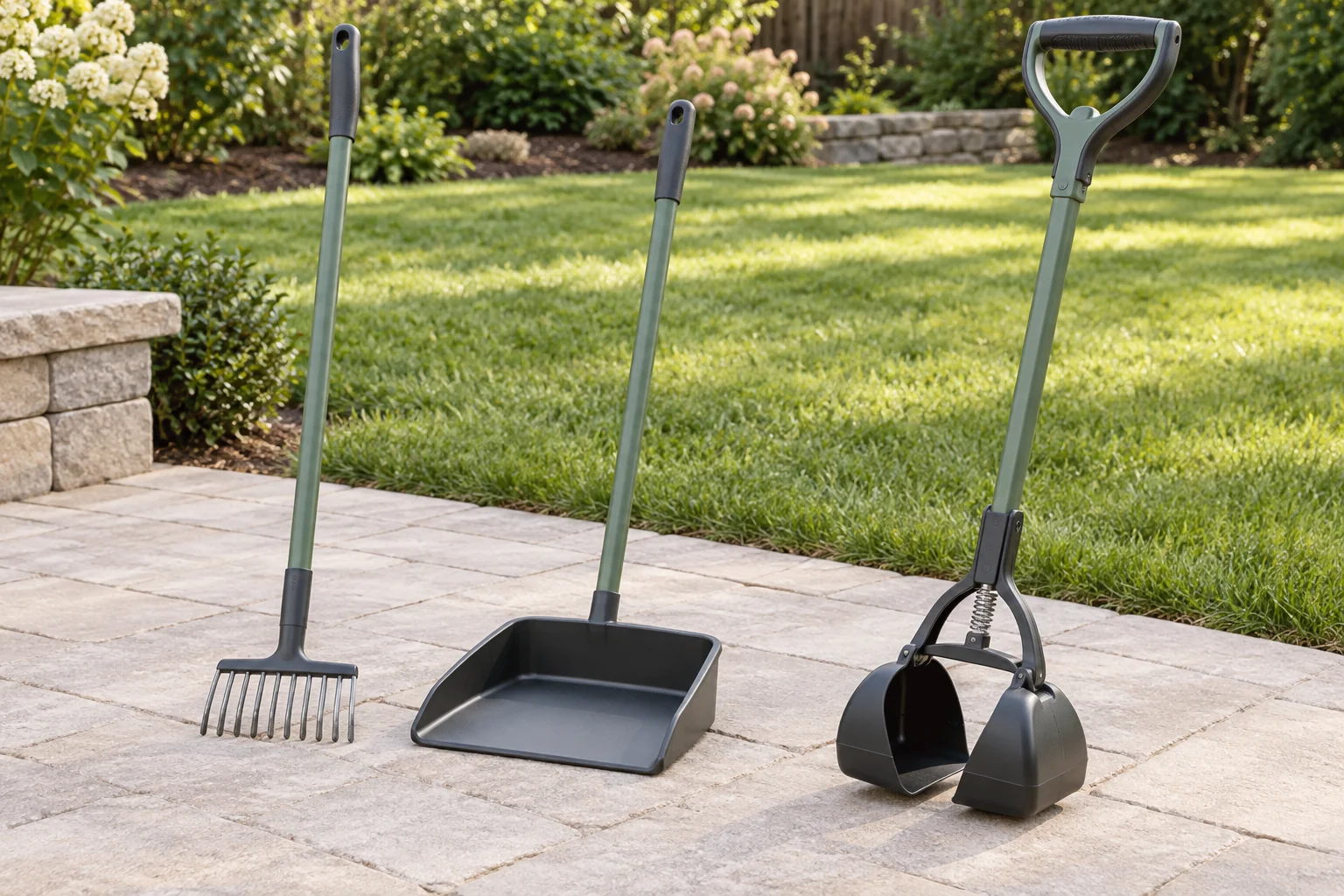
| Format | What to compare | Practical tradeoff |
|---|---|---|
| Rake and tray | Tine spacing, rake width and tray edge | Separate collection and carrying pieces, with two items to store |
| Spade and tray | Solid edge, pan shape and handle arrangement | A scraping edge to consider for firm surfaces, with a separate receiving container |
| Closing jaw or claw | Opening width, trigger and closure | Collection in one tool, with capacity and release dependent on its design |
| Bag-supported tool | Bag attachment, supported bag sizes and release | Waste held in a bag, with compatible bags needed for continued use |
For a retail assortment, the manual care and waste-tool range provides a place to organize scoop shape, openings, handle dimensions and accessories in a product brief. Its category scope does not establish that a particular rake, jaw or bag mechanism is available. Name the required format explicitly when comparing a proposed item.
The Best Setup for Grass
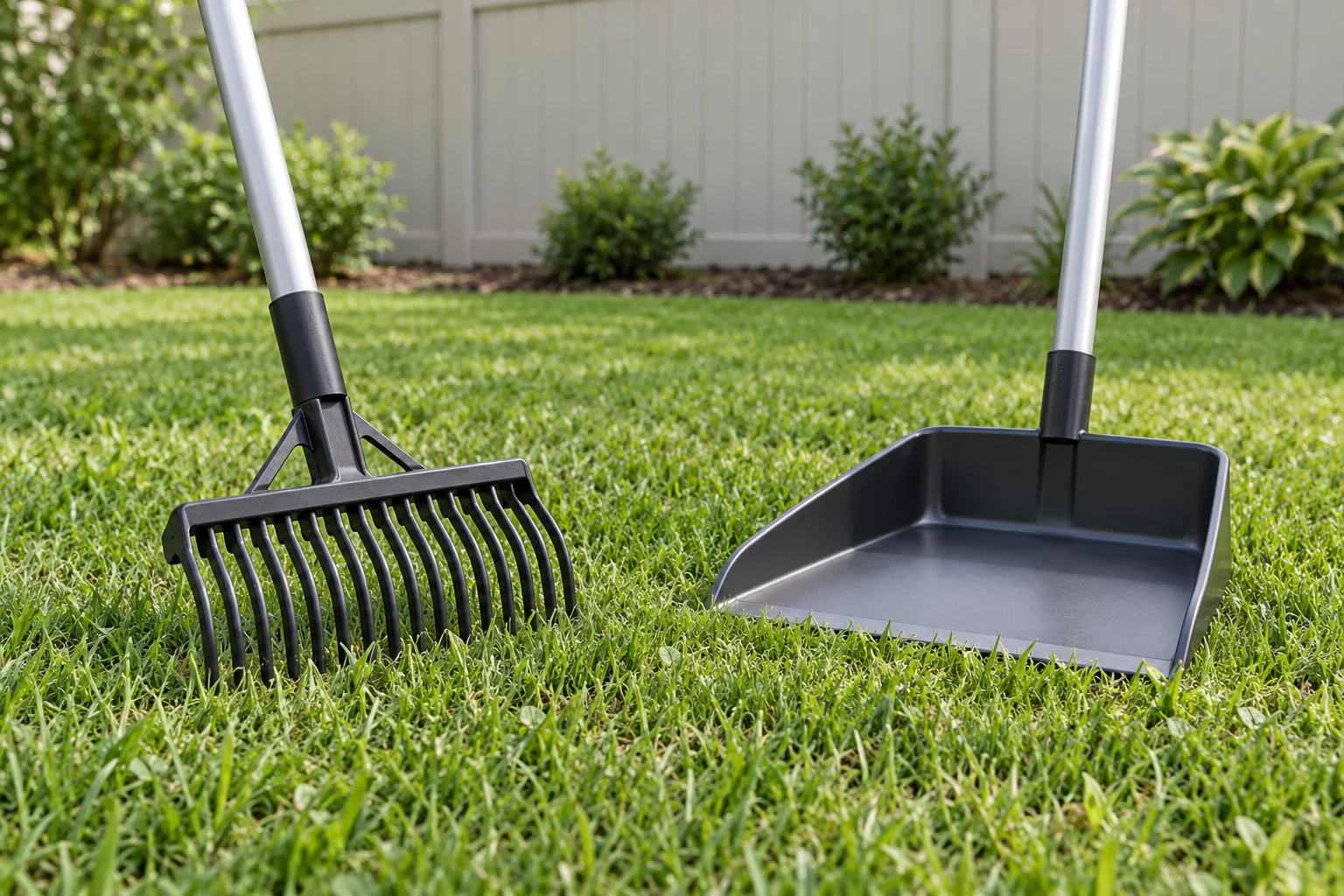
On a lawn, consider how the working edge will move among the grass blades. A rake-and-tray set is one format to compare because its separated tines and receiving pan let you evaluate those two jobs individually. The tine spacing, leading edge and pan height are more useful details than a broad “for lawns” claim.
A jaw tool raises a different question: can you place and close its head where you need to pick up? Head width and opening clearance matter when the pickup area is close to a fence, border or other obstruction. A large head may offer more collection space, but it also needs room to operate.
The condition of the waste affects the task as well. A product shown lifting a firm pile has not thereby demonstrated how it handles soft waste among grass. Look for an explanation or a relevant demonstration of the use you need, rather than treating a single tidy product photograph as a performance test.
Artificial grass deserves its own review. Use the surface supplier’s care instructions when deciding which edges and cleaning methods are appropriate. A tool advertised for lawns does not automatically cover every artificial surface or backing construction.
Gravel, Rocks and Other Loose Surfaces
On gravel, the collection problem includes material you want to leave behind. Rake openings and pan edges affect how the tool interacts with stones, but the name “gravel scooper” does not tell you the size of those openings or whether they suit your particular ground.
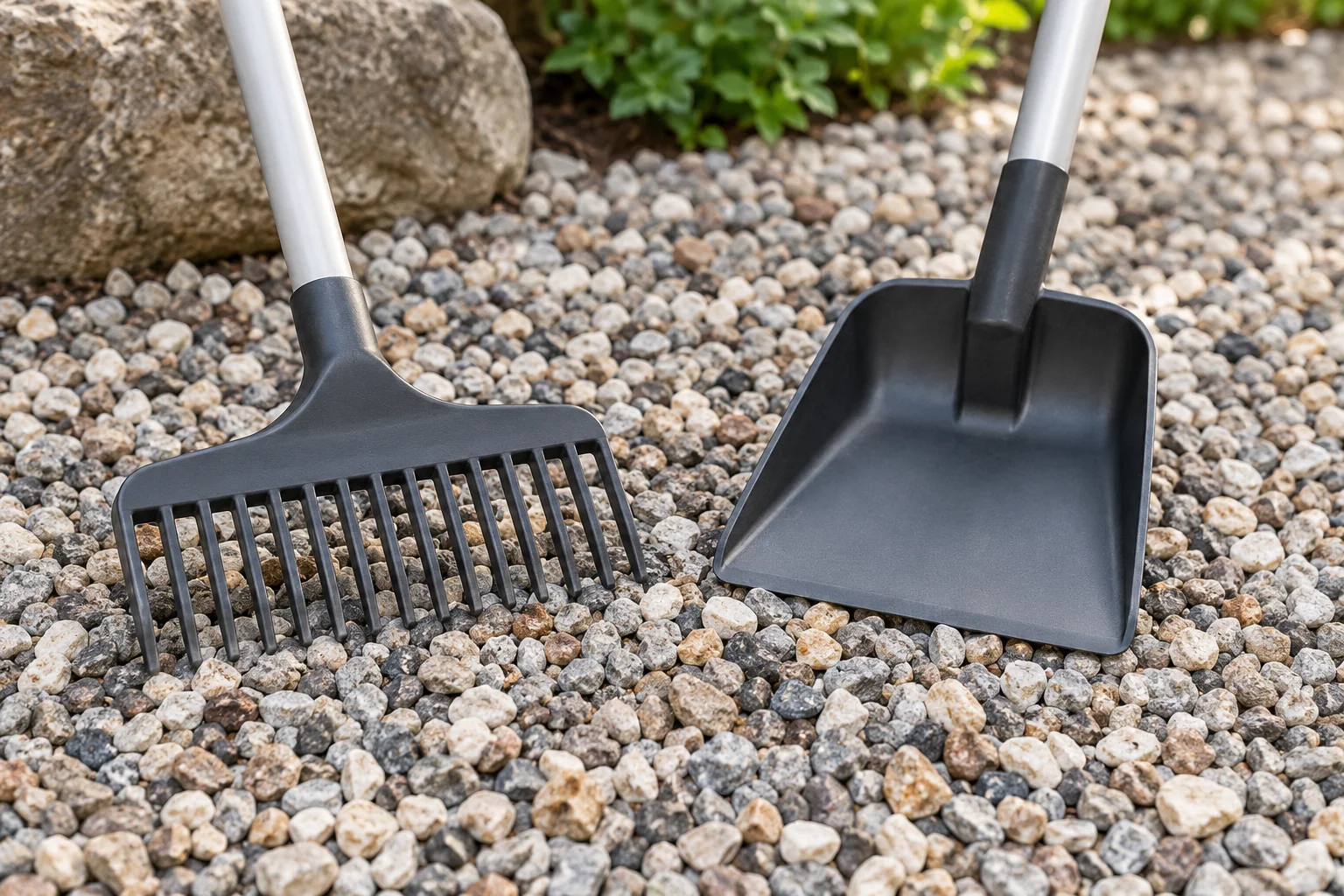
Compare the actual head dimensions with the surface. A solid spade offers no openings through which loose material can fall. A rake has gaps, though their presence alone does not prove clean separation of stones and waste. The useful question is how that model is intended to collect the waste without taking an unacceptable amount of the surrounding material.
A closing jaw is another option to examine where stones or uneven ground may obstruct its edges. Its ability to close in a product photo says little about closure at your pickup spot. If relevant evidence is unavailable, leave gravel performance as an open question instead of inferring it from a sturdy-looking handle.
Concrete, Paving and Other Hard Ground
A solid-edged tool is worth comparing for firm ground because you can assess how its edge meets the surface. Consider the pan’s receiving edge as well: moving waste toward a tray is a separate action from getting it over the tray lip.
Paving joints, rough texture and changes in level can interrupt an otherwise flat pickup area. Where your yard has those features, look beyond demonstrations on smooth concrete. The same applies to a jaw: its closing edges may meet differently on level paving and across a joint.
Collection and washing are separate decisions. A tool’s claimed pickup function does not establish that it will leave every surface free of residue, and rinsing it does not demonstrate disinfection. Follow the tool and surface care instructions for any cleaning that remains after collection. Avoid adding a chemical treatment solely because a scooper listing calls the product easy to clean.
Choosing a Scooper for Walks
For walks, decide how you will carry the tool before and after use. A long yard handle can be inconvenient to carry with a leash, while a compact head may need an additional bag holder or another way to contain the collected waste. Compare the whole arrangement rather than the tool’s folded appearance alone.
Bag-supported designs need particular attention to attachment and release. Find out which bags fit, how the bag is held open and how you remove and close it. A general claim of bag compatibility is less useful than supported dimensions or a clear fitting demonstration. Bag capacity and the tool’s capacity are also different things.
Consider the occupied hand as well. A trigger that is comfortable to operate on its own may be awkward with the leash arrangement you use. If the product needs two hands to fit or remove a bag, include that step in your decision. There is no need to assume that every jaw tool or bag attachment can be operated one-handed throughout the pickup.
Handle Reach, Capacity and Storage
Handle length changes the position from which you operate the head. Compare the assembled length with your intended pickup location, including corners and narrow runs. A longer handle may suit a particular reach; it does not establish relief from back pain or eliminate every need to bend during bagging, emptying and cleaning.
For a yard with several pickup spots, look at what happens between collection and disposal. A tray’s carrying capacity, a jaw’s retention and a bag tool’s closure are different design questions. A wide head does not by itself tell you how much waste the assembled tool will hold or how easily it will release it.
Storage can decide between otherwise workable options. Measure the available space against the assembled tool, or the stated folded dimensions if it folds. Include a tray, holder or detachable handle where supplied. A wall hook is useful only if there is an appropriate place for the complete setup.
Materials, Cleaning and Replacement Parts
Material names are a starting point for identifying the parts, not a ranking of service life. A tool may combine a metal shaft, plastic head, fasteners and a moving trigger. Record those components separately rather than describing the entire product with the material of its handle.
Follow the model’s cleaning and storage instructions, including any limits for moving joints or removable parts. Wash your hands after handling dog waste, even when you have used a bag. A bag attachment changes how waste is collected; it does not remove that hygiene step.
For a wholesale range, specify head width, opening dimensions, handle length, connections and included accessories. If a holder or tray is pictured, establish whether it is part of the quoted pack. Ask separately about replacement components and any proposed load or repeated-use testing. A sample’s appearance cannot substantiate those performance claims.
FAQ
What type of pooper scooper is best for grass?
A rake-and-tray set is one format to compare, alongside closing jaws and bag-supported tools. Look at how the head works among grass, the receiving edge and the available operating space. Treat “for grass” as a use claim to examine, not proof that all such models collect equally well.
Can the same scooper work on gravel and concrete?
Possibly, if its design suits both areas. Gravel raises a separation problem, while concrete raises edge-contact and residue questions. Review evidence for each surface rather than extending a demonstration on one to the other.
Is a rake or a claw scooper better?
A rake-and-tray set separates collection from carrying; a claw closes around the pickup area. Compare operating space, handling and release for your yard. Neither format label alone establishes cleaner pickup or easier operation for every user.
Are bag-attached scoopers useful for walks?
They can be worth considering when their size and handling fit your walk. Include bag fitting, removal and carrying after pickup in the comparison. The attachment must support the bags you plan to use; not every ordinary bag is automatically compatible.
What should I look for in a scooper for frequent use?
Look at the complete pickup-to-disposal sequence, cleaning access, handle connections and replaceable parts. For a business purchase, turn those requirements into a written specification. A professional label or a claim about what other operators use is less informative than those details.
Conclusion
Choose the surface that accounts for most of your cleanup and compare two tool formats against it. Then work through carrying and disposal, including any bag change. If the yard setup is awkward to take on a walk, keep that as a separate portability requirement rather than compromising the main yard tool.