The dog nail grinder vs clippers choice comes down to two different actions: a grinder files with a rotating abrasive head; clippers cut with a blade mechanism. Compare the sound, handling and upkeep of those actions with your dog’s needs and your own experience. Gradual removal does not make a grinder automatically safer or remove the need to know when to stop.
Both tool categories can be used for nail care. The useful question is which specific tool you can operate appropriately, with guidance where needed. This comparison covers the equipment choice rather than teaching nail trimming, prescribing a stopping point or declaring a winner for every dog.
How Each Tool Actually Works
Manual clippers use a cutting mechanism. Scissor- or plier-style models bring cutting edges together; guillotine-style models move a blade across an opening. A grinder uses a powered abrasive head instead. Those mechanisms create different handling and maintenance requirements, even before you compare individual sizes.
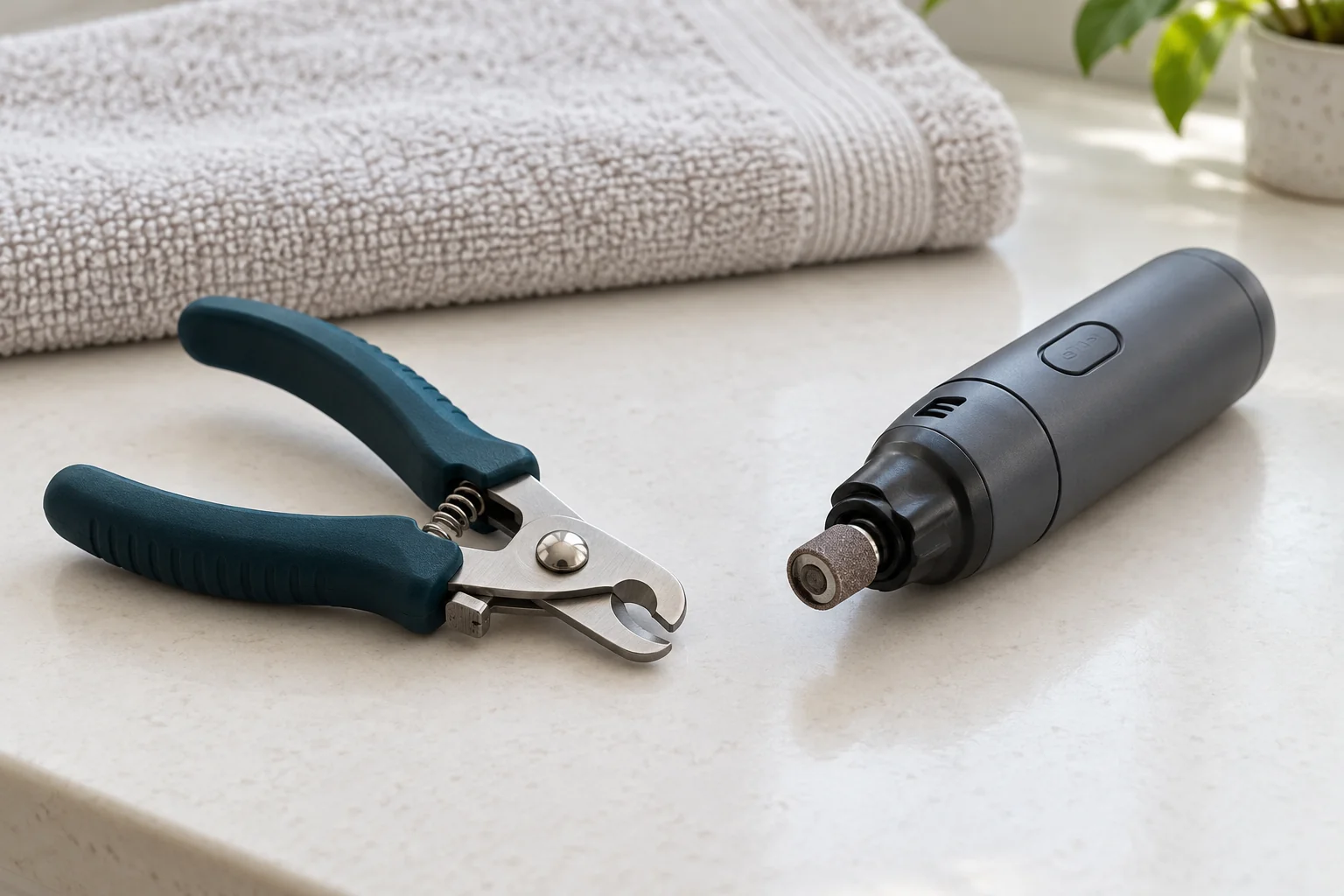
For the manual side of a retail range, the manual nail-clipper specifications cover dimensions, handle arrangement, opening mechanism and requested springs, locks or guards. That is a useful specification starting point. The confirmed range excludes electric grinders; the powered category discussed here is a separate product comparison.
| Question | Manual clippers | Nail grinder |
|---|---|---|
| What does the work? | Cutting edges or a sliding blade | Rotating abrasive head |
| What powers the action? | Hand-operated handles | The model’s specified power supply |
| What do you operate? | Handle movement and cutting mechanism | Switch, grip and approach to the working head |
| What needs upkeep? | Working edges, connections and moving parts | Abrasive parts, power equipment and collected dust |
| Which details vary? | Opening size, handle shape, spring, lock and guard | Head, cover, controls and charging or battery arrangements |
Use the final row to build a shortlist of individual models. Record which features each one actually includes. For a guard, identify its stated function in the instructions; the handler still needs to know the appropriate amount of nail to remove.
Noise, Vibration and How Dogs Respond
A grinder adds motor sound and vibration to the handling involved in nail care. Manual clippers have no motor, although their action is not necessarily silent. Your dog’s response to either tool needs more attention than a simple quiet-versus-noisy label.
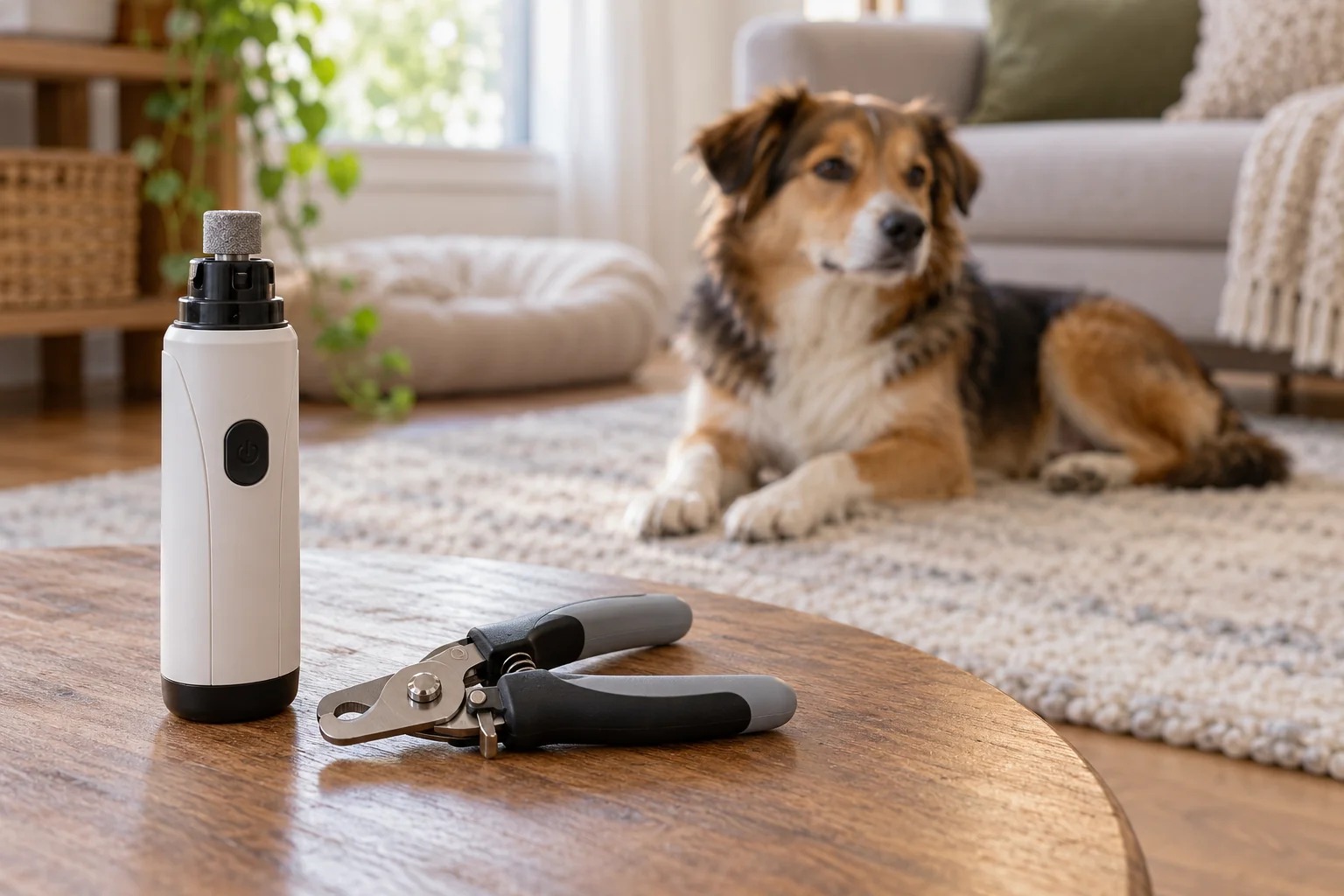
Separate difficulty with paw handling from a reaction to equipment. A dog that pulls away before the tool is introduced has not demonstrated a preference for clippers or a grinder. Equally, accepting the sound of a motor at a distance does not establish comfort with a working head near the paw.
Introduce nail-care equipment gradually with appropriate guidance. If your dog becomes concerned, stop and return to an easier stage rather than pressing on to finish. A brief trial with an unrelated power tool is not a substitute for that introduction, and a difficult session is not a reason to switch immediately to another unfamiliar device.
For a purchase, a sound demonstration gives you information about the device. Keep that separate from what you know about your dog’s response. If handling is already difficult, ask a veterinarian or suitably experienced groomer for help before choosing equipment around an assumed solution.
Nail Color, Visibility and Judgment
The sensitive tissue within a nail is called the quick. It is often easier to see through a light nail than a dark one. That difference affects visibility, but nail color alone does not select the tool or tell an inexperienced handler where to stop.
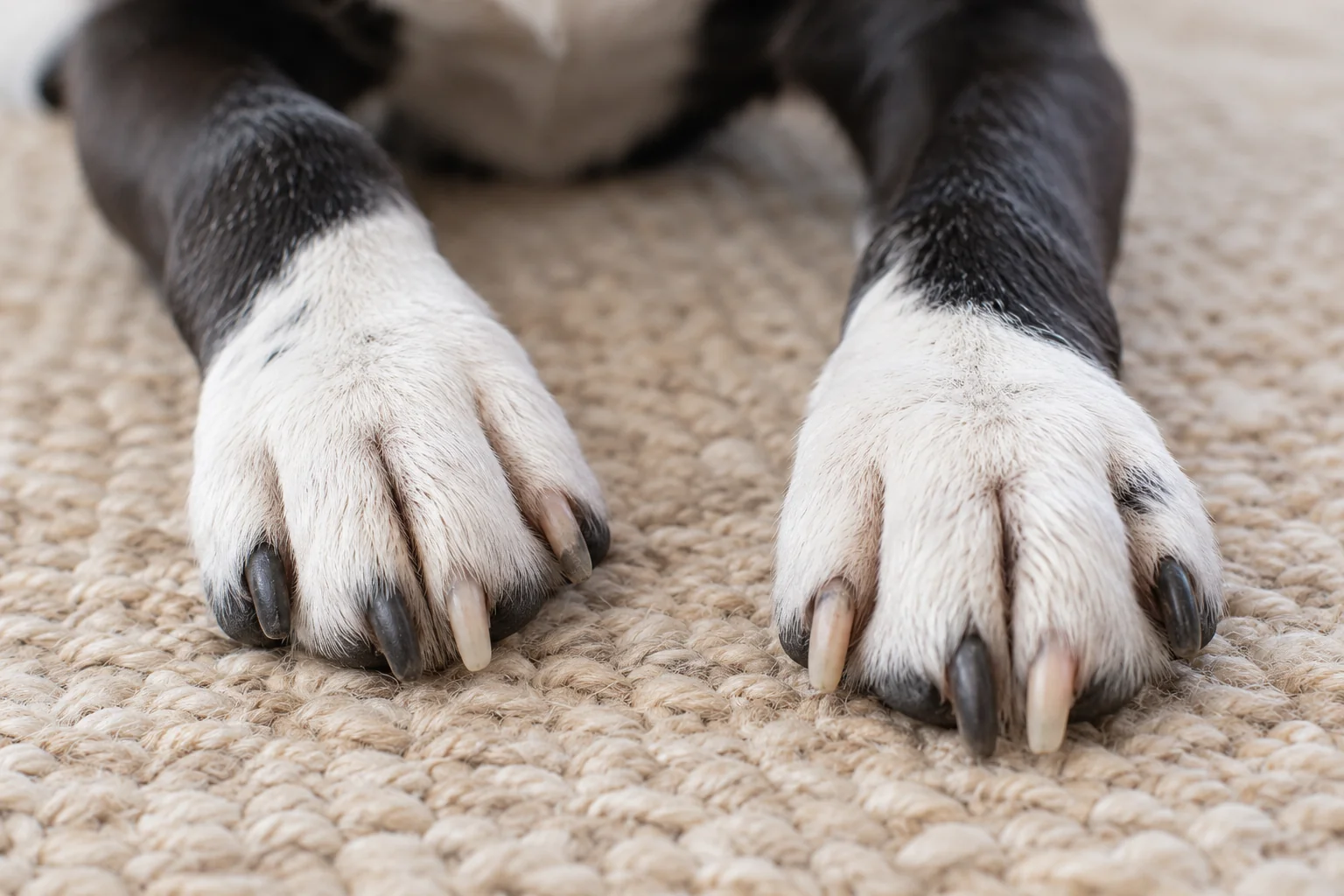
A grinder removes material gradually. It can still remove too much, and dark nails do not become safe to work on simply because you choose abrasion over a blade. Claims that a grinder is forgiving of mistakes or automatically best for black nails skip the judgment that both methods require.
Lighting and your view of the working area are practical equipment considerations. Compare how the tool sits in your hand and what the instructions show about access to the nail. For a model with a light or cover, include its position and operating arrangement in that comparison.
If you cannot identify an appropriate stopping point, obtain hands-on guidance rather than choosing a tool that promises to remove that uncertainty. Tool selection is a different task from learning to trim a particular dog’s nails. This is also why a general product comparison cannot supply a safe cutting depth for your dog.
Control, Speed and the Learning Curve
With clippers, the amount removed depends on positioning before the cutting action. With a grinder, material is removed while the abrasive head is in contact. These are different control tasks. It is more useful to ask which action you can manage than to rank one category as precise and the other as crude.
The time needed for a session depends on more than the working mechanism. Tool condition, the nail-care task and the dog’s cooperation all belong in the comparison. A claim that clipping is always quick or grinding is always easy cannot describe every combination. Avoid choosing a device on an unverified promise to finish all the nails within a fixed time.
Grinding also introduces contact-related risks: a rotating head can catch hair or contact skin, and friction creates heat. Follow the specific tool’s instructions and appropriate professional guidance. Small increments do not cancel those risks. This is a reason to understand the equipment, not a reason to improvise a trimming technique from a shopping guide.
Some routines use both tools for different parts of the task, but owning both is not a requirement or proof of a professional method. Each tool still needs its own handling and care knowledge. If a second tool does not address an identified need, it adds equipment to maintain without resolving the original difficulty.
Maintenance: Blades, Abrasives and Power
Manual clippers need attention to their working edges, alignment and moving parts. The maker’s care information should explain the relevant cleaning and replacement steps, including whether servicing or sharpening is offered. Keep that information with the tool so a future maintenance decision has a more useful basis than its original material label.
For a grinder, identify the fitted abrasive and the compatible replacements. Sanding bands and other heads have model-specific fitting and care requirements. A listing that says spare heads are available is less useful than an identifiable part and an explanation of how it is fitted. Availability today is information to record, not a promise of indefinite supply.
The power arrangement adds another maintenance task. Establish whether the tool uses replaceable batteries, a charger or another supply, and what comes in the box. Keep the power equipment with the correct device and follow its charging and storage instructions. A powered body also needs its own cleaning method.
Compare the continuing requirements alongside the purchase: the parts you may need, the storage space and the instructions you will keep. Without model-specific evidence, neither an expensive head material nor a high initial price establishes a longer service life or a quieter tool.
Sizing the Choice for Your Dog and Your Range
For a household purchase, begin with the part of nail care you need help with. A handle that is awkward for you calls for a grip comparison. Difficulty knowing where to stop calls for instruction. A reaction to equipment calls for an appropriate introduction plan. Buying a different mechanism does not necessarily solve the other two problems.
Compare the actual tool dimensions and opening arrangement with the intended dog and the task. A size label is a starting point; photos and measurements can clarify the working head and handle. This gives you a specific model to discuss if you need help choosing equipment for the dog.
For a manual-clipper assortment, document the handle, opening, connection and requested moving parts. Give any guard or lock a defined function in the specification. Review the sample against that description, keeping appearance checks separate from any proposed functional test. Do not describe a guard as preventing all over-trimming.
If your assortment also includes a powered category from another source, keep its specifications distinct. Power supply, replacement abrasives and operating instructions cannot be inferred from an otherwise similar manual-tool brief. This keeps the pack contents and claimed functions clear without treating two categories as interchangeable products.
FAQ
Is it better to clip or grind a dog’s nails?
The category alone does not decide. Compare the dog’s response, your handling ability and the specific tool’s care requirements. If the main uncertainty is how much nail to remove, get appropriate guidance before using either method.
Can I use a nail grinder instead of clippers on my dog?
A dog nail grinder is an alternative tool for nail care. Its suitability depends on the particular dog, equipment and handling. It still requires a gradual introduction and knowledge of when to stop; owning a grinder does not make those steps optional.
Is a rotary grinder better than clippers for dark nails?
Dark nails can make the quick harder to see, but that does not establish a universal grinder advantage. Abrasion can also remove too much. Resolve uncertainty about the dog’s nails with professional guidance rather than relying on a black-nail marketing claim.
What do professional groomers use to trim dog nails?
Manual clippers and grinders are both nail-care tools; the word professional does not specify one required choice. For help with your own dog, ask the groomer which tool and handling approach they recommend for that animal, rather than copying a general preference from a product listing.
Do dog nail grinders actually work?
They remove nail material using a rotating abrasive head. The remaining questions are whether the model suits the task and whether it can be used appropriately with your dog. A working motor or a smooth-looking result does not establish a risk-free process.
Conclusion
Name the obstacle in your current nail-care routine before choosing another tool. If it is grip or upkeep, compare that feature on specific models. If it is knowing where to stop or helping your dog accept handling, arrange guidance first; a switch from blades to an abrasive head will not answer that question for you.