Read a dog bed size chart by comparing your dog’s resting footprint with the bed’s usable sleeping area, then check that its outer dimensions fit the intended space. Measure your own dog and read the product’s measuring instructions. A size label, breed example, or weight range is a starting point for comparison, rather than a substitute for those checks.
The important distinction is between space for the dog and space for the bed. Raised sides, curved edges, and a thick entry can change how a bed fits without changing the size printed on its label.
What a Dog Bed Size Chart Can Tell You
A useful chart tells you what has been measured and how the seller expects you to use that measurement. Before comparing sizes, identify whether the listing describes the outer bed, its sleeping cushion, or a removable component.
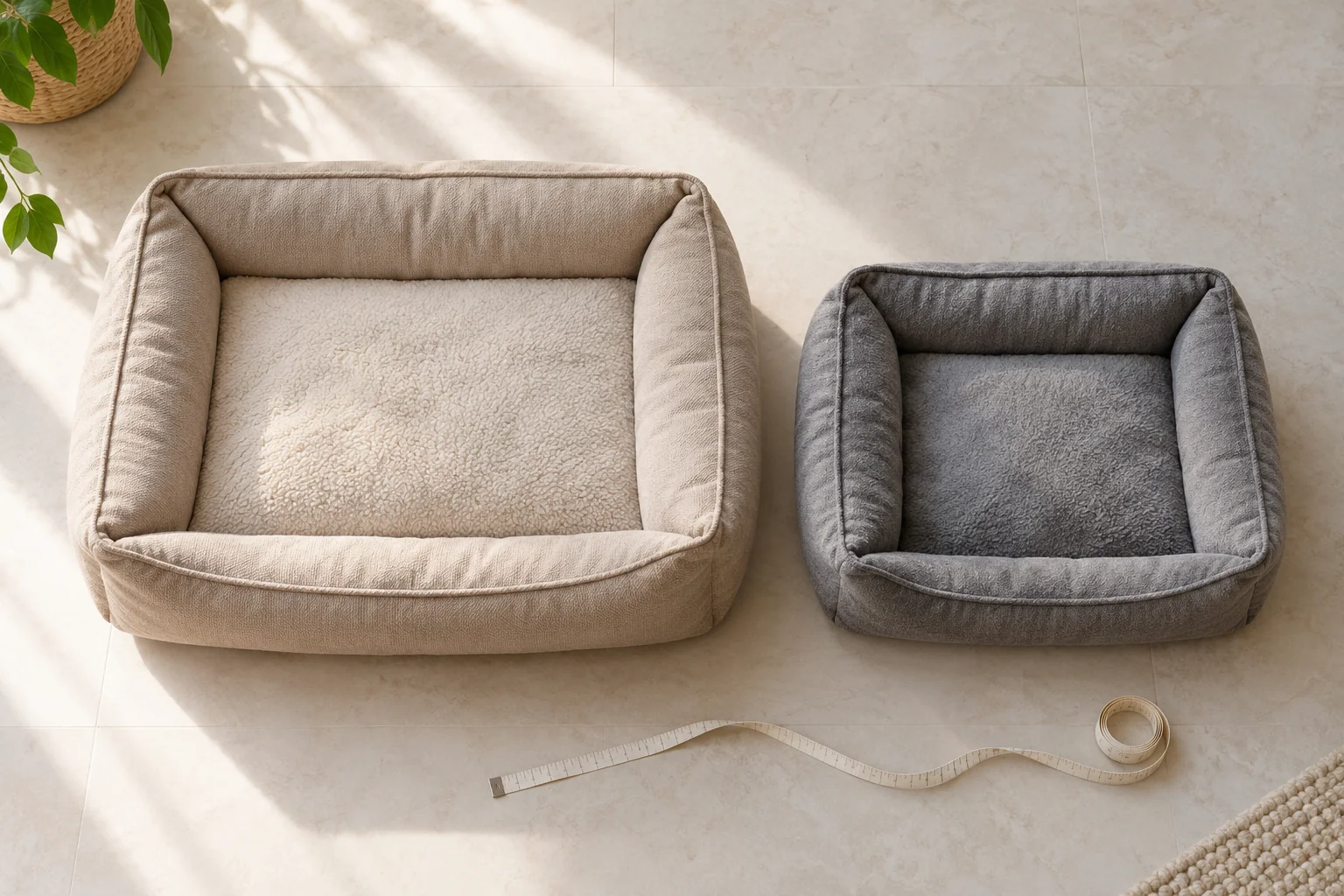
Do not assume that Small, Medium, Large, or XL means the same dimensions across products. Read each product’s length and width, and check whether a round bed is listed by outer diameter or usable inner diameter.
Weight and breed suggestions can help you find candidates, but they cannot describe your dog’s resting position. A dog that stretches out may occupy a different shape from one that curls up. Even dogs of the same breed need individual measurement.
Use this interpretation chart to decide which measurements to compare.
| What you are choosing | Record or request | Compare with |
|---|---|---|
| An open rectangular cushion | Usable sleeping length and width | Your dog’s natural resting footprint |
| A bed with raised sides | Clear sleeping area between the sides | Space for your dog to settle and change position |
| A round or oval bed | Usable inner dimensions, not just the outer rim | Curled and stretched resting positions |
| A bed for a particular room | Finished outer length, width, and height | Floor space, doors, furniture, and walking routes |
| Bedding for a crate | Actual available base space and product fit instructions | The fitted pad and remaining space for the dog |
If a listing supplies only outside measurements, ask for the sleeping-area dimensions before treating it as a match. A photo can show the shape but does not establish the scale.
How to Measure Your Dog for a Bed
Measure your dog in a natural resting position and note the space they actually occupy. If the product guide asks for a particular body measurement, follow that method too, and keep it distinct from the resting footprint.
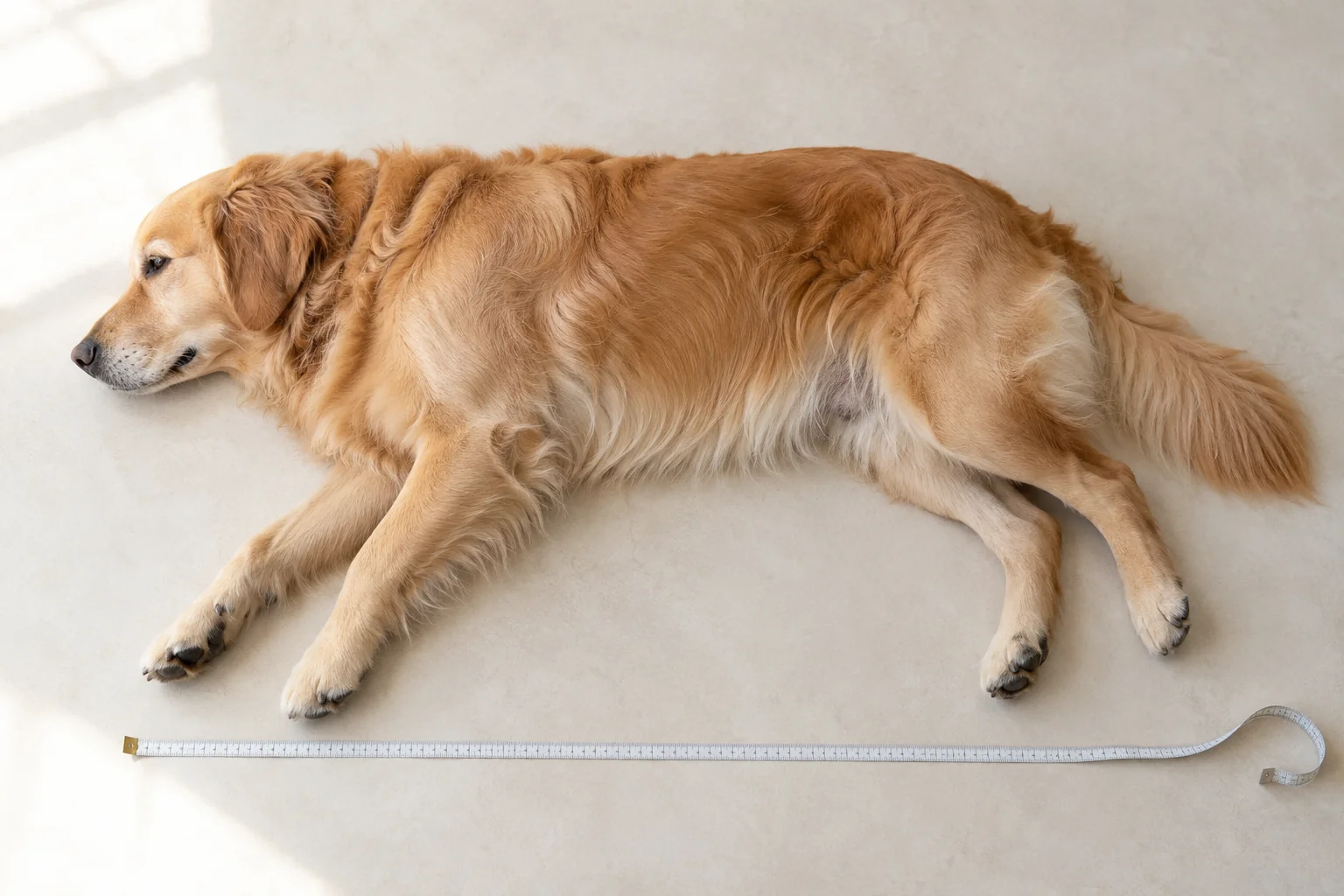
Observe the positions your dog uses
Look at where your dog settles when given a choice. Note whether they curl up, lie on their side with legs extended, or change between those positions. Choose a candidate that accommodates the positions you observe rather than a shape suggested solely by breed.
You do not need to force your dog into a pose. Wait for a normal rest, note the occupied length and width, and check another position if your dog commonly uses it. A curled measurement alone may miss the space needed for stretching.
Record length and width
Use a measuring tape beside the resting dog to record the footprint. Keep the units consistent with the product chart and write down how you took the measurements so you can compare them later.
Some product guides ask for a nose-to-tail-base measurement; other guides use a different reference or an allowance specific to their beds. Follow the instructions for the product you are considering. Do not combine the starting point from one guide with the allowance from another.
The goal is enough usable space for your dog to rest and change position comfortably. There is no need to turn a retailer’s suggested allowance into a universal rule for every cushion, bolster bed, and crate pad.
Compare the dog with the usable area
Place the measurements alongside the candidate bed’s sleeping dimensions. Check both length and width. A long, narrow surface may meet one measurement while failing the other.
If possible, mark the proposed sleeping area on the floor to understand its scale. This is a way to visualize the dimensions, not a test that proves the dog will like the finished bed. Still consider its shape, entry, and product-specific instructions.
Sleeping Area and Outer Footprint Are Different Measurements
For a bed with raised edges, the outer dimensions include space that may not form part of the flat sleeping surface. Compare the inner cushion first, then use the outer footprint to plan placement.
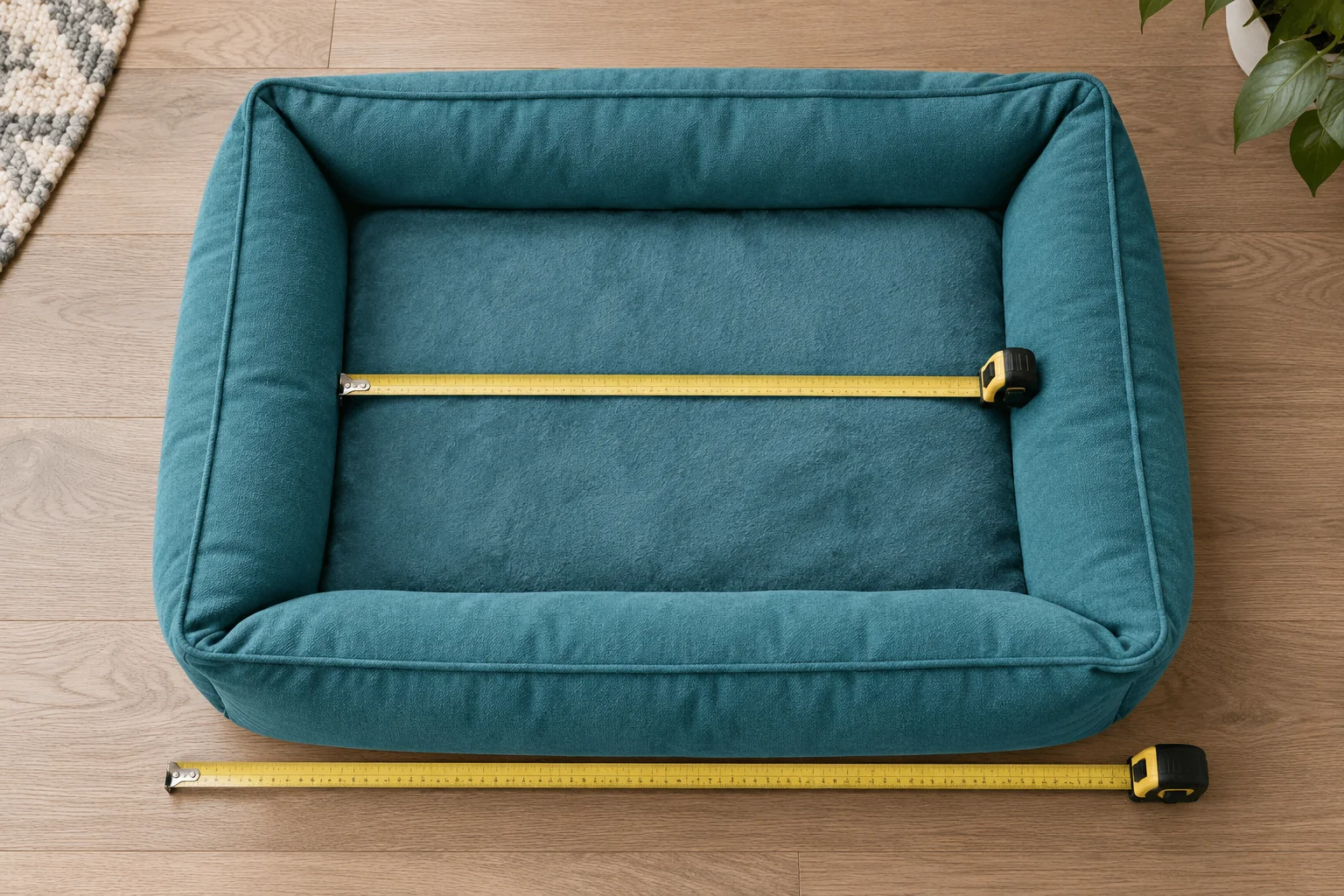
Raised sides and bolsters
Ask for the clear length and width between the raised sides. Also check where those measurements are taken: a soft or sloping border may make a single dimension difficult to interpret.
For a simple rectangular outline, the clear length can be estimated by subtracting the borders at both ends from the outer length. The same approach applies across the width. Treat that calculation as a geometric estimate, then confirm the actual sleeping surface with the seller or sample.
Do not assume that every bolster has the same thickness. Avoid using a fixed deduction across unrelated products. An advertised outside size can remain the same while a change in the border alters the available interior.
When comparing soft pet bed constructions, keep the outer dimensions and usable cushion dimensions together. That makes it easier to distinguish a placement problem from a sleeping-space problem.
Round and oval beds
A round dog bed size chart may list the whole bed’s diameter. Find out how much of that width belongs to the inner sleeping area and how much belongs to the rim.
An oval bed needs both inner length and width. A single diameter or a photograph can hide that distinction. Check the dog in more than a curled position if stretching is part of their normal rest.
Round and rectangular beds distribute their space differently, so equal-looking size labels do not make them interchangeable. Compare the actual surface with the dog’s resting footprint instead of choosing by the label alone.
Entry height and overall height
Height is worth checking separately from length and width. Note the sleeping surface’s height, any raised border, and the entry your dog will use.
Check whether the dog can get on and off and change position comfortably. A size chart does not determine an individual dog’s medical needs. If pain or mobility difficulties affect the choice, ask a veterinarian about appropriate bedding rather than relying on a general foam-thickness rule.
Using Weight and Breed Information Without Guessing
A dog bed size chart by weight can narrow your search, but the next step is measurement. The same applies when looking for a bed for a Labrador, German Shepherd, Corgi, or another named breed.
Read a weight recommendation together with the manufacturer’s usage information. It does not automatically tell you the sleeping length, foam thickness, or preferred shape. If your dog’s measurement falls close to the limits of a listed sleeping area, compare the next option and the actual available floor space.
For a long-bodied dog, pay attention to the resting length. For a dog that stretches its legs, check the width as well. These are individual fit questions, not reasons to assign every dog of that breed a particular size.
Before ordering, resolve missing measurements. A seller who provides outside dimensions but no sleeping-area information has left an important comparison unfinished, even if the weight range looks suitable.
Fitting a Bed in a Room or Crate
After checking space for the dog, measure space for the complete bed. A suitable sleeping area is only useful if the assembled product works in its intended location.
Room placement
Measure the proposed floor area and compare it with the outside dimensions. Check doors, furniture, and walking routes rather than assuming that a bed will fit because it looks small in a product photo.
Allow the dog to approach and leave the bed comfortably. Choose a place where resting will not be repeatedly interrupted, and reconsider placement if the bed blocks a frequently used route. The required clearance depends on the actual room; there is no single perimeter distance to apply everywhere.
For a round nest or a bed with a plush border, remember that the rim still occupies floor space. When comparing plush and fleece products, confirm the proposed bed’s outer footprint and inner sleeping dimensions separately.
Crates and divided spaces
Measure the available interior base, including any divider. Check the crate and bedding instructions for the specific products instead of assuming that a nominal crate length describes its usable tray.
Put the bedding in place and confirm that it sits as intended. Check the door operation and that the dog still has suitable room to stand, turn, and rest. A bulky cushion can take up space that a flat pad does not, so assess the assembled setup.
Do not force an oversized cushion into a crate or assume that every pad must match the tray with no clearance at all. Different products have different fit requirements. For a lower-profile format, compare the proposed pet mat with the available space and its own instructions.
Oversized and human-size loungers
A human-size dog bed needs the same measurement discipline as a smaller bed. Check the outside footprint, usable center, and placement area before comparing features or appearance.
If it is intended for shared use, verify the product’s stated use and requirements rather than assuming that a dog-bed label includes use by people. Large dimensions alone do not establish support, comfort, or suitability for everyone who may use it.
Choosing a Size for a Growing Puppy
Measure a puppy again as it grows rather than treating one purchase as a permanent fit. Whether you choose a temporary bed or a larger bed for later use depends on the placement, care needs, and the puppy’s behavior.
For a crate, match the bedding decision to the currently available space and the crate instructions. The crate and any divider determine that space; the bed’s dimensions do not establish a complete house-training method.
For an open room, compare the puppy’s current resting footprint with the usable area and entry. Consider how conveniently the cover can be cared for and the bed replaced if needed. Avoid assigning a universal month of maturity or purchase timetable to every puppy.
Size Specifications for B2B Buyers
For a bedding range, define the measurements customers need as well as the measurements used for production. An approved sample and a clear measurement method are more useful than an unsupported industry-wide tolerance.
Distinguish the finished outer size, usable sleeping area, entry height, and removable component dimensions. Agree whether the bed is measured filled, unpacked, or in another stated condition, and record the units and measuring points.
For each proposed size, confirm:
- The intended bed format and use.
- Finished outside dimensions and usable sleeping dimensions.
- Which dimensions appear on the retail chart.
- Measuring condition, method, and agreed tolerance.
- Fit of the cover and removable inserts.
- Packed dimensions and the product-specific unpacking instructions.
- The approved sample used as the reference.
Use the same definitions when discussing pet product manufacturing and preparing retail descriptions. A change to a bolster or insert should prompt a fresh check of the sleeping dimensions, not just the outside size label.
Calculate logistics from the actual packing proposal, shipment, and carrier quote. Do not assume a universal compression saving or unpacking time. Keep those decisions tied to the proposed product and sample.
FAQ
What size bed does a 70-pound dog need?
Weight alone does not establish a bed size. Measure the dog’s resting length and width, compare them with the usable sleeping area, and follow the candidate product’s use and measuring instructions.
What is the standard size of a dog bed?
Treat Small, Medium, Large, and XL as labels belonging to the particular product range. If the chart does not define its measurements, request the usable inner dimensions before ordering.
Are round or rectangular beds better for stretching out?
Compare the usable space in the actual beds. An open rectangular surface may be a convenient option to assess for a dog that stretches, while a round bed needs a check of its inner diameter and rim. The shape label alone does not settle the fit.
How do I read a dog bed size chart in centimeters?
Record your measurements in the same units as the chart. If the seller provides both inches and centimeters, check that they refer to the same outside or inside dimensions. Ask for clarification when unit labels or measurement definitions are missing.
Should I buy a larger bed for my puppy now?
You can compare a larger bed for open-room use, but still check the entry, placement, and care requirements. For a crate, use the current available space and the specific product instructions. Remeasure as your puppy grows.
Conclusion
Before ordering, put the dog’s resting measurements, the bed’s usable sleeping dimensions, and its outer footprint side by side. Resolve any missing dimensions and check the proposed placement. For a sourcing project, share the bed format, measurement definitions, and sample requirements when you contact us.