When choosing a durable snuffle mat for dogs, compare the fabric attachments, base, food pockets, and documented care method. Then consider how your dog uses fabric items. A mat intended for supervised food searching is not a chew toy, and neither a material name nor a “heavy duty” label guarantees durability.
A snuffle mat hides food among fabric folds or pockets for the dog to find. The purchase decision is about that whole assembly: the working surface, its connection to the base, the underside, and the parts you must clean.
What “Durable” Means for a Fabric Foraging Mat
Treat durability as a product-specific claim that needs a defined use and supporting information. A description should explain the construction and care limits, rather than asking you to infer performance from the fabric name.
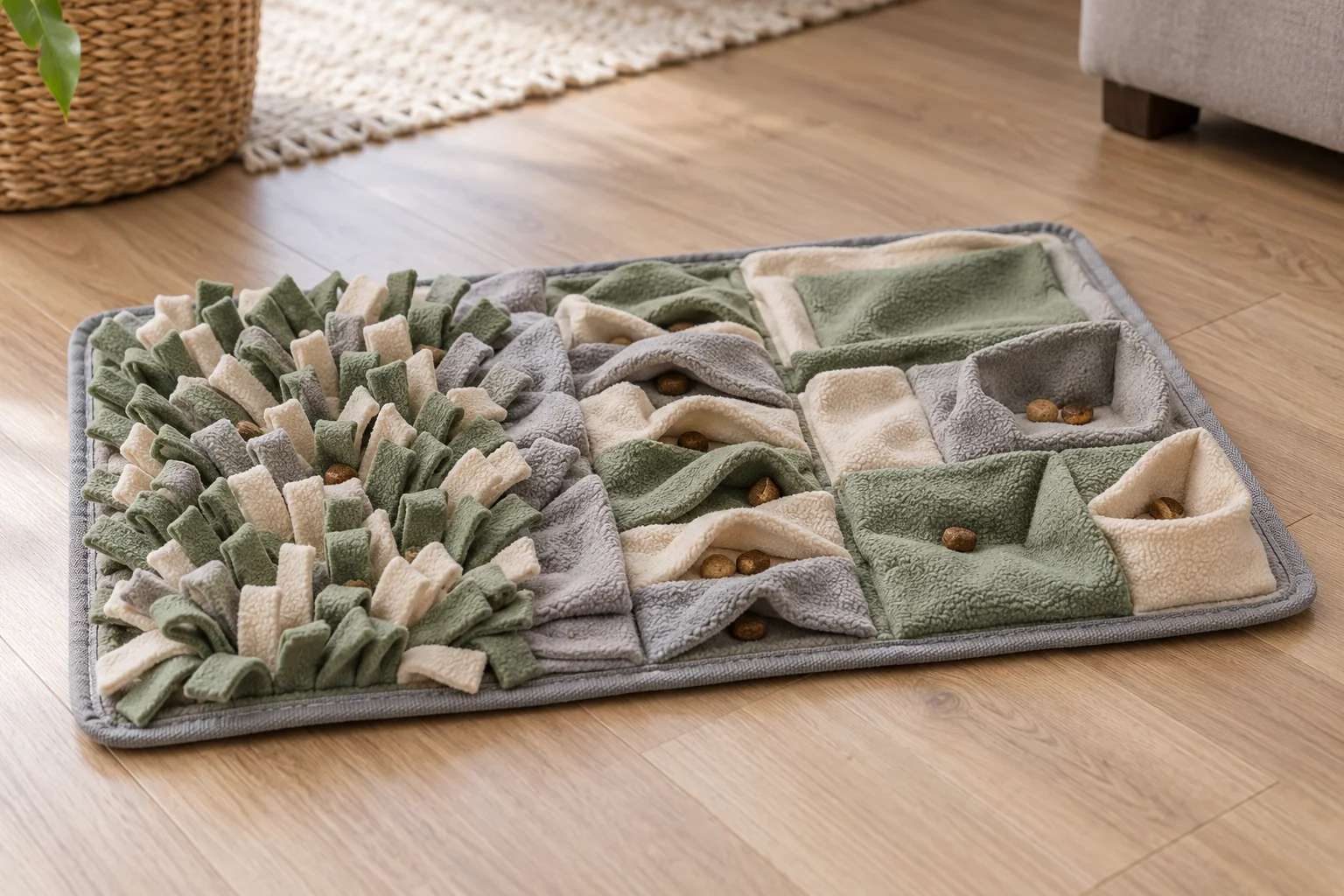
At home, inspect the actual mat and observe a supervised introduction. You can see whether a seam has opened or the mat moves across the floor. Those observations help decide whether to continue using that item; they do not establish a tested lifespan or certify its materials.
A mat that looks intact in a listing may have attachment details the photograph does not show. Look for underside images, care information, and an explanation of any removable pieces before ordering.
Separate Material Information From Safety Claims
“Fleece” or “polyester” identifies a broad material description. It does not tell you the complete composition of the backing, coatings, thread, or other components.
If a seller advertises “non-toxic” or a certification, ask which product, materials, and claim the documents cover. A badge or an odor check is not a substitute for that information. Keep ordinary sample observations separate from compliance or safety conclusions.
Fabric Strips and Attachment Points
Look at where the fabric joins the base. Strips may be tied through openings, while flaps and pockets may be stitched onto a fabric surface. Identify the construction actually used rather than assuming every mat is assembled the same way.
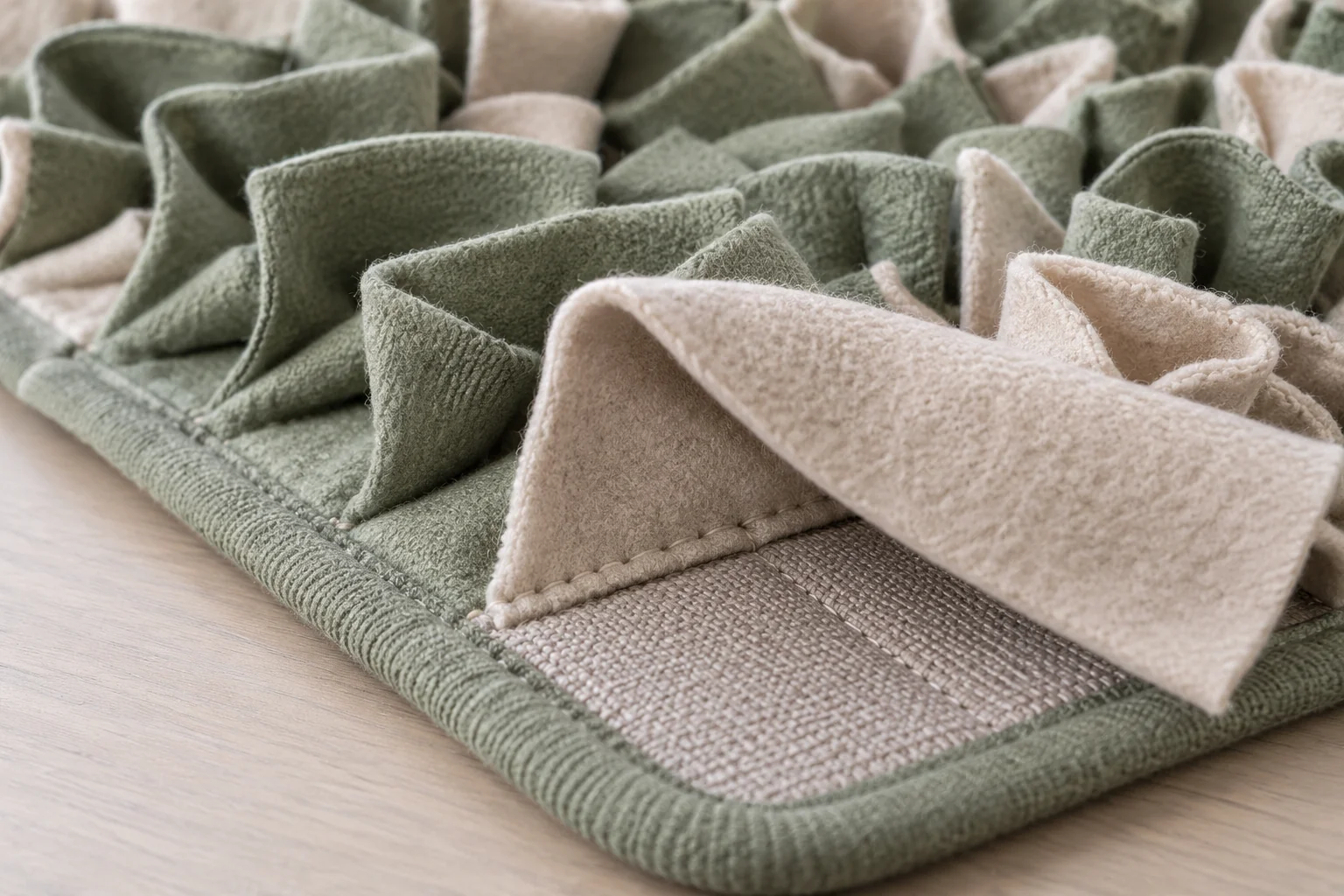
During an ordinary inspection, look for loose strips, open seams, exposed fill, or parts separating from the base. Do not pull hard on an unfamiliar product as a homemade strength test. A brief tug does not prove how a connection will hold up during use or washing.
Inspect the Areas Hidden by the Folds
Move the fabric aside so you can see the base and the edges of pockets. Dense folds can make the attachment points difficult to inspect, and food may remain beneath overlapping pieces.
Compare whether you can reach these areas without dismantling the mat. If a pocket is permanently sewn closed around an internal layer, the seller’s care instructions need to account for that assembled construction.
For purchasing several mats, record the surface construction and attachment method by model. A close photograph and an identified sample give you a clearer reference than a general request for “strong stitching.”
Backing, Base, and Stability
Examine the underside and assess how the mat behaves on the floor where it will be used. A backing advertised as non-slip still needs to be considered with the actual surface and the dog’s movement.
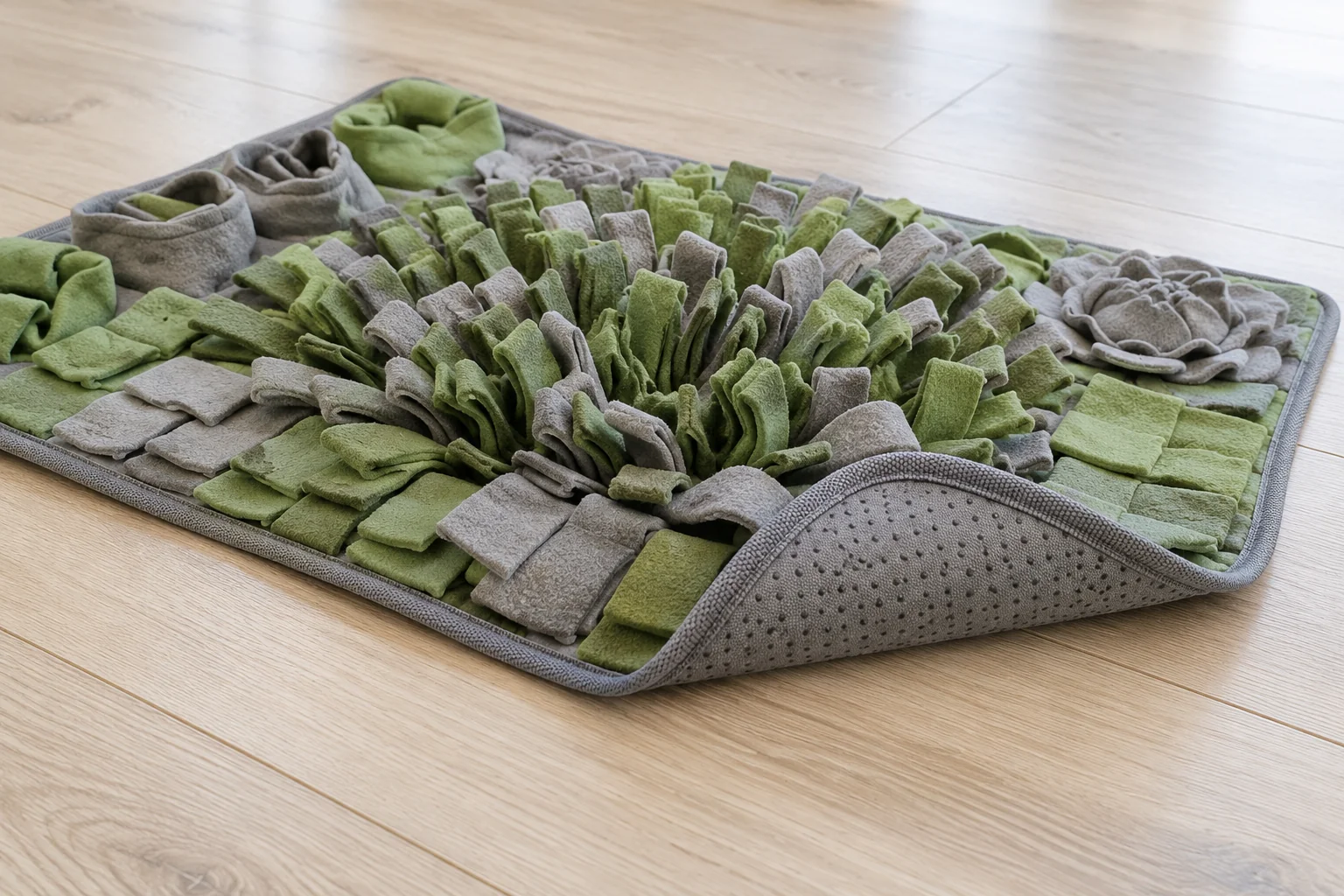
Textured fabric, rubber-like dots, and other backing constructions are not interchangeable specifications. Photograph or record the actual underside when comparing samples, including exposed edges and the way the backing connects to the rest of the mat.
If the mat keeps folding, flipping, or traveling during ordinary supervised searching, stop and reassess the setup. More food or deeper hiding places do not resolve an unstable base.
Some products include ties or adjustable cords. Use them only as the exact instructions describe, with the same attention to reachable hardware and loose lengths as the rest of the mat. Do not add homemade restraints or infer that attaching the mat to furniture makes it appropriate for unattended use.
For a sourcing brief, describe the floor and intended activity alongside any requested backing performance. A statement such as “non-slip base” still needs an agreed method and applicable product evidence before it becomes a performance claim.
Pocket Construction, Difficulty, and Size
Choose pockets that your dog can explore and you can empty. A simple surface may be enough for a beginner, while folds and covers create a different search task.
Start with a few pieces of the dog’s usual dry food visible on top. Hide food more gradually if the dog is willingly searching. If it begins tearing at the equipment, end the session rather than trying to make the puzzle harder.
Size includes the working area and the practical space needed to use, clean, dry, and store the mat. Compare those dimensions with your available floor and storage space. Body weight alone does not tell you which pocket arrangement the dog will enjoy.
Before choosing a complicated design, look at how you will retrieve food the dog misses. A pocket that hides food successfully also needs a workable clearing and cleaning method. The extra complexity is useful only if it suits both the activity and the maintenance routine.
Washing Method: Read It Before You Buy
Choose a mat with care instructions you can follow for the exact model. “Washable” is incomplete without a washing method, any relevant restrictions, and a drying method.
Real product instructions differ. That is a reason to compare the documentation, not to borrow another mat’s wash cycle. A familiar fabric does not establish how the assembled backing, thread, attachments, and internal layers should be treated.
| Information to find | Why it affects the purchase |
|---|---|
| Hand or machine washing | Determines which cleaning process the product permits |
| Cycle, temperature, and detergent restrictions | Identifies the limits actually documented for that model |
| Dryer permission or air-drying directions | Helps you plan when the mat can be used again |
| Removable components | Shows what must be separated and reassembled |
| Care for backing and attached parts | Keeps the instructions tied to the whole product |
Clear Food and Inspect the Mat After Use
Remove leftover food and inspect the folds, pockets, and underside after the session. Clean the item as its condition and instructions require, and follow the specified drying method before storage or reuse.
Do not wait for a universal two-week interval if the mat is soiled. Equally, do not invent a stronger cleaning treatment because the label is missing. Resolve missing instructions with the seller or select a product with documented care.
For a household using the mat regularly, drying time belongs in the choice alongside washability. You may prefer a simpler design that fits the care routine over a more elaborate one that is difficult to turn around between uses.
The same documentation questions are useful when comparing pet mat construction and care at category level. Furrowa’s general pet-mat page is not confirmation of a snuffle-mat product line; any specific foraging design needs its own scope review.
Supervised Use and When to Choose Another Activity
Stay with the dog during snuffle-mat use and put the mat away after the food is gone. Keep the food within the dog’s daily allowance rather than treating each search as an additional meal.
A dog that tears off or tries to eat the fabric needs the activity stopped. Neither reinforced stitching nor a different surface material automatically makes that dog a suitable user. Seek individual advice if swallowing objects is a concern.
Remove a mat from use when strips, pockets, seams, or backing are damaged. Follow the maker’s replacement or repair guidance; do not continue using a damaged area just because the rest of the mat still holds food.
When fabric searching does not suit the dog, choose a different supervised activity. A simple food-search game in an appropriate clean area may avoid using a fabric item. Any alternative equipment still needs its own assessment; silicone is not an automatic safe substitute for a dog that destroys mats.
FAQ
Are snuffle mats machine washable?
Some models permit it; others have different instructions. Find the care directions for the actual product before buying. Machine-washing permission does not automatically include tumble drying.
How often should I wash a snuffle mat?
Use the condition of the mat, the food used, and the model’s care directions to plan cleaning. Remove leftovers after use and do not leave a soiled mat in service until an arbitrary date. Avoid borrowing a fixed schedule from another product.
Does a “non-toxic” label prove a mat is suitable?
No label alone settles the decision. Ask what evidence covers the actual product and claim. You still need appropriate use, intact construction, documented care, and supervision.
Are snuffle mats safe for dogs that chew fabric?
A dog that tears or eats fabric is not a suitable candidate for continued use of that mat. Stop the activity and obtain individual advice about alternatives. A tougher-sounding label does not address the behavior.
What can I use instead of a snuffle mat?
Consider a supervised search for some of the dog’s usual food in a suitable clean area, or another activity the dog enjoys. If choosing different equipment, assess its own instructions and construction rather than assuming another material solves the problem.
Conclusion
Before ordering the mat in your cart, find its underside details and complete care instructions. Make sure you can inspect the attachments, empty the pockets, and carry out the stated washing and drying method. If those details are missing, choose a better-documented product before planning the first supervised search.