Compare durable puzzle toys for dogs by their food-access mechanism, reachable parts, size, and cleaning design. Then match the task to how your dog actually plays. A durability label does not establish that a puzzle can withstand chewing, and a harder puzzle is not automatically a better choice.
Begin with the intended action. Does the dog need to lick food from a cavity, push a dispenser, or move a slider? That tells you which parts deserve attention before you compare materials or difficulty labels.
What “Durable” Means in a Dog Puzzle Toy
Durability describes how a particular toy holds up under its intended use. It needs a defined product, activity, and basis for the claim. Appearance alone cannot tell you how long a puzzle will last with your dog.
For a purchase, separate what is documented from what you still need to observe. The maker may specify the intended user, operating method, care limits, or replaceable parts. Your first supervised sessions show how the dog interacts with that model. Neither is a lifetime guarantee.
Avoid reading “heavy duty” or “indestructible” as permission for unrestricted chewing. If the product is meant to be nudged with a nose, chewing through its covers is a different activity.
A useful comparison records the actual construction: body shape, openings, moving components, connections, and accessible edges. You can then identify a concrete question, such as whether a lid is removable, instead of asking a seller whether the whole toy is “strong enough.”
Structures and Moving Parts to Inspect
Food holders, rolling dispensers, and puzzle boards ask for different actions. Compare those actions before deciding which construction suits the dog.
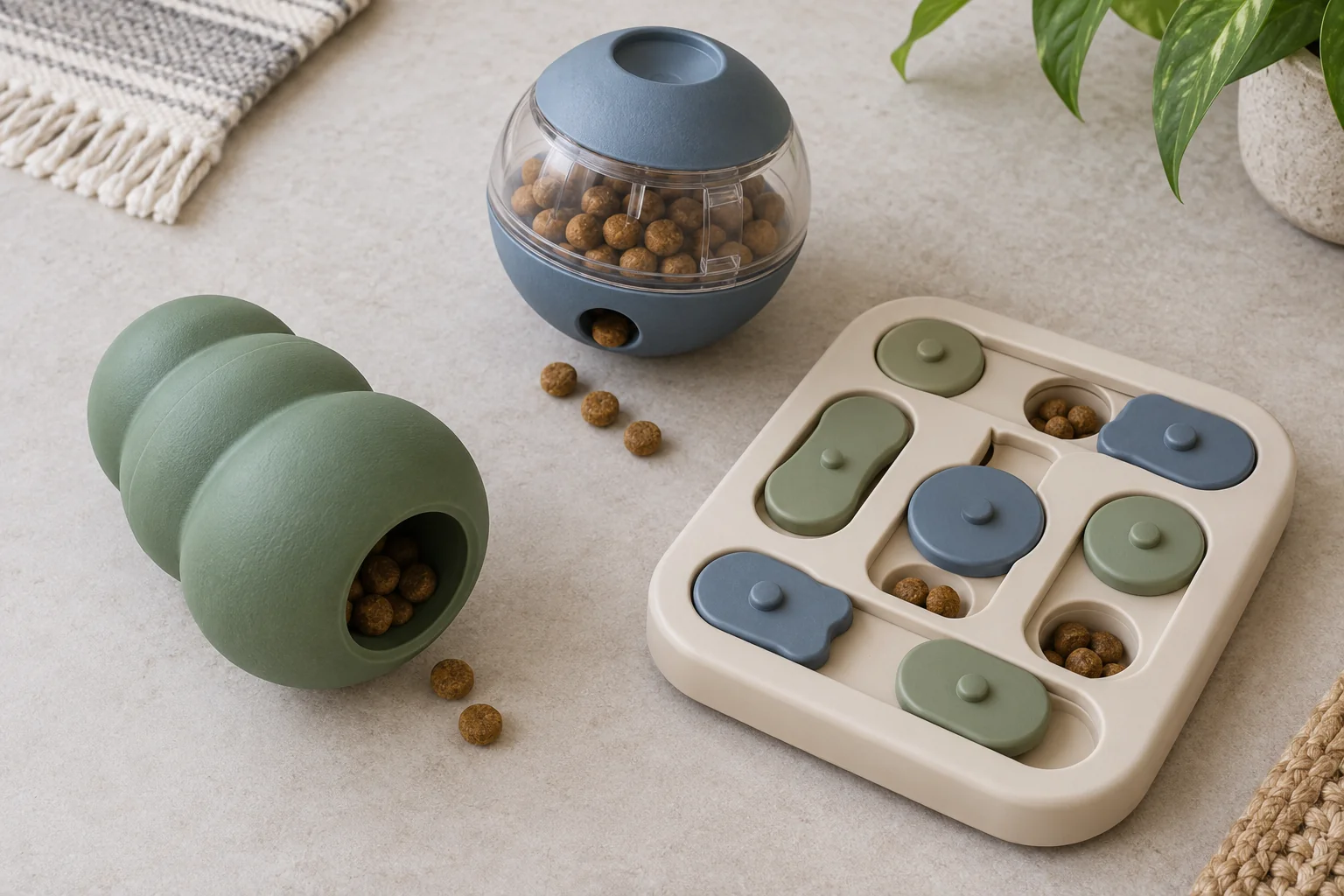
| Puzzle format | Main action | Details to examine before purchase |
|---|---|---|
| Food holder with a cavity | Reaching food through an opening | Access openings, internal cleaning reach, and permitted food preparation |
| Rolling or wobbling dispenser | Moving the body to release food | Filling closure, dispensing adjustment, and room for movement |
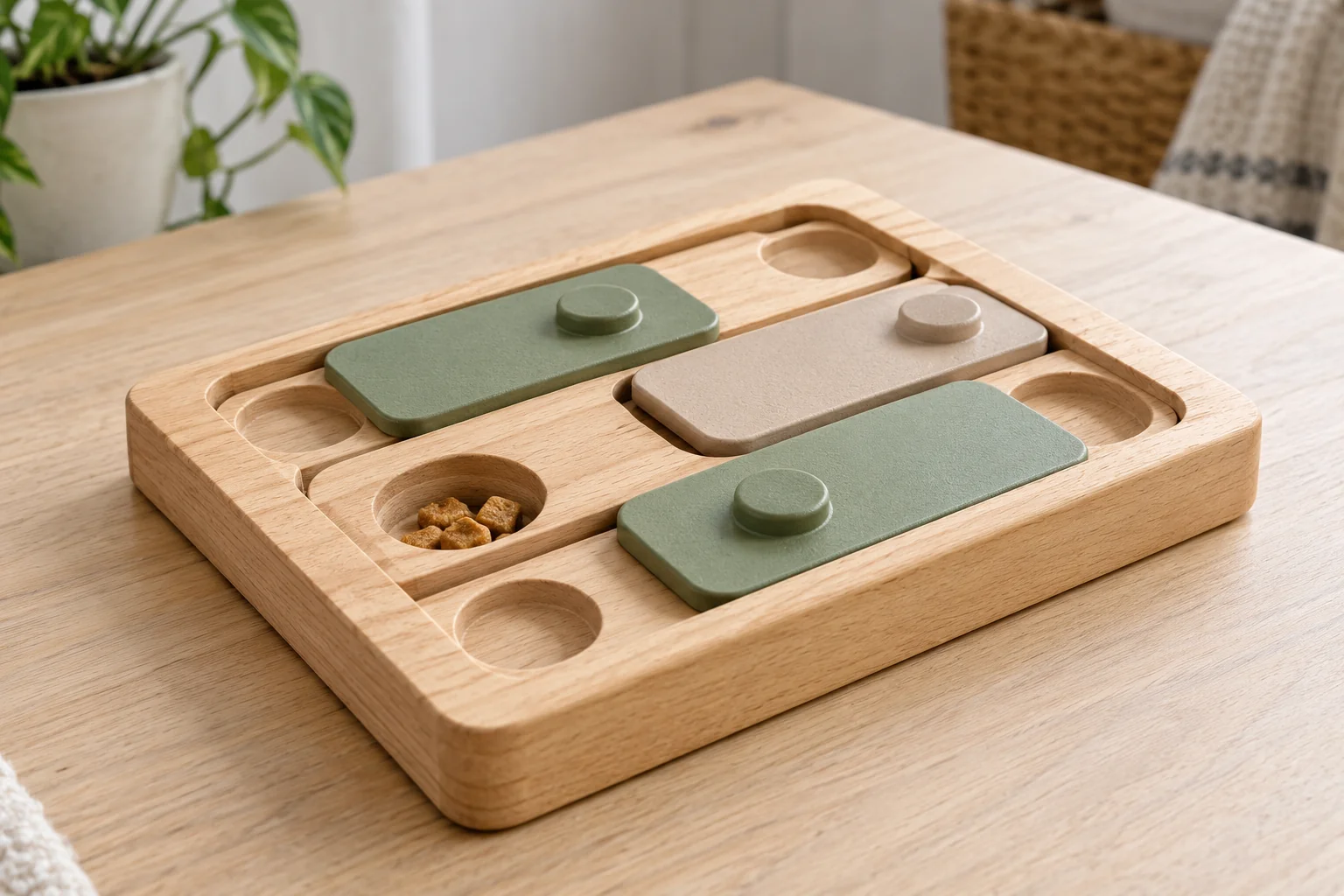
| Board with sliders or lids | Moving a cover to reveal food | Reachable components, removable pieces, hinges, and cleaning access |
Follow the Food Path
Trace how the food goes in, how the dog gets it out, and how you remove leftovers. A wide filling opening does not necessarily expose every internal corner, and a lid that lifts off for filling may be a separate component during use.
For a board, identify which pieces stay attached and which are intended to come away. Fixed pieces still need inspection; they are not automatically beyond the dog’s reach. Removable pieces add a handling task for you, especially when clearing the puzzle after a session.
Compare the instructions with the product photographs. If a picture shows several loose covers but the description does not explain their use, resolve that question before buying. More components can mean more setup and cleanup, without necessarily creating an activity your dog enjoys.
Foraging mats offer another form of food searching, but their fabric and washability questions differ from mechanical puzzles. They do not need to be treated as another board design.
Match Materials and Build to the Dog
Evaluate the complete puzzle rather than treating rubber, nylon, plastic, or fabric as a ranking. Different constructions within a material family can have different intended uses and care restrictions.
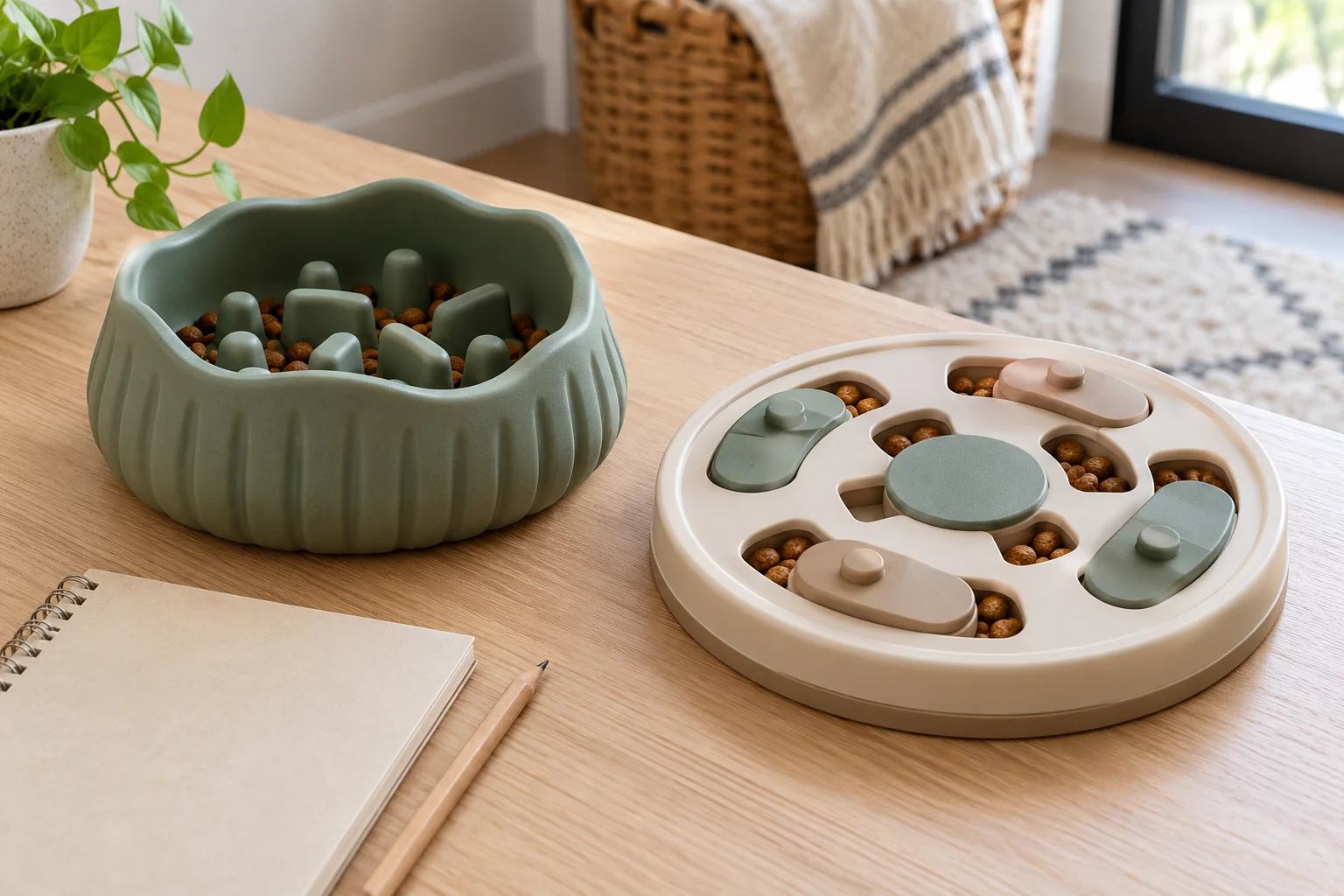
The dog toy materials guide can help distinguish a molded body from a textile shell or attached component. It does not certify a particular puzzle’s resistance to chewing or establish that a material is safe for every dog.
Size includes more than the overall width. Consider the maker’s dog-size guidance, the reach needed to operate the puzzle, the size of accessible components, and whether the dog can handle it as intended. A small-looking dispenser in a photograph may still be awkward or heavy.
A dog that bites covers instead of moving them needs the activity reassessed. Switching automatically to rubber, fabric, or silicone is not a safety solution. Stop a session that turns into dismantling and seek individual advice about suitable equipment when needed.
For commercial buyers, compare products against the same description of use. “Food dispenser operated by nudging” identifies a task; “for smart dogs” leaves the mechanism, user, and restrictions unclear. Furrowa’s confirmed dog toy categories are a category-level inquiry route, not confirmation that a particular mechanical or electronic puzzle is manufactured.
Difficulty Levels and How to Start Them
A useful starting level lets the dog obtain some food without needing to solve several unfamiliar steps. Make the first version easy and show how the relevant part moves.
Difficulty labels belong to the product range that uses them. A “level two” label on one maker’s board need not match another maker’s dispenser. Compare what the dog actually has to do: one cover, several covers, a sequence, or repeated rolling.
Where the design permits it, expose some food or use the easiest dispensing setting. Reward interest and give the dog time to explore. Add a step after the simpler version is being used comfortably, rather than because a calendar says it is time to progress.
Food size and preparation also affect access. Use only food and preparation methods permitted for that model. Freezing is not suitable for every puzzle, and filling every opening tightly can make a beginner’s task unnecessarily difficult.
If the dog repeatedly walks away, first consider the task and the reward. A different activity may be a better choice than a more elaborate puzzle. Interest matters more than completing the highest numbered level.
Cleaning Access and Maintenance
Choose a food puzzle you can clean after use. Before buying, identify the areas where food collects and the method the maker permits for reaching them.
Sliding tracks, recessed pockets, filling lids, and narrow chambers deserve separate attention. Ask whether the relevant parts open for cleaning and whether the instructions explain reassembly. A product that requires several small pieces to be removed may not suit a household that needs quick daily cleanup.
Follow the exact model’s washing and drying directions. Dishwasher approval for one component does not automatically cover the body, seals, or other parts. Do not infer freezer or washing limits from the word “rubber” or “plastic.”
After cleaning, inspect the puzzle before returning it to use. A cover that no longer sits correctly, a rough damaged edge, or a loosened connection changes the product you originally evaluated.
For a retail range, include care information in the comparison alongside structure and difficulty. Record any unanswered question by model. Avoid promising easy maintenance when the actual disassembly and cleaning procedure has not been established.
Supervision and Replacement Routine
Observe a new puzzle while the dog uses it, and continue to follow any requirement for supervised use. Familiarity does not cancel the product’s restrictions.
The purpose is to see the actual interaction: food searching, nudging, licking, chewing at a cover, or trying to lift the whole puzzle. Put the toy away if the dog starts removing pieces or using it outside its intended function.
Inspect parts before each session and after damage or cleaning. Changes such as a loose lid, cracked body, torn fabric, or a slider that no longer works are reasons to stop using the item and follow the maker’s replacement guidance. A toy does not become suitable again simply because food can still be loaded into it.
Keep the product reference and instructions with any spare parts. An apparently similar replacement cover may not belong to the same model. If the maker provides no repair or replacement route, do not improvise one for an item the dog can mouth.
FAQ
Are puzzle toys good for dogs?
A suitable food puzzle can offer an additional way to search and work for food. Choose a manageable task and supervise it as required. A puzzle is one activity within the dog’s routine, rather than a promise of improved intelligence or treatment.
Are any puzzle toys indestructible?
Do not use that word as a guarantee. Ask what intended use and product-specific evidence support the claim. The dog’s handling and the condition of the actual item still need attention.
What should I choose for an aggressive chewer?
A mechanical food puzzle is not automatically a chew toy. Choose equipment specifically intended for the dog’s use, and seek individual guidance if the dog routinely dismantles or swallows objects. A material substitution alone does not resolve that behavior.
What makes a puzzle suitable for a small dog?
Look beyond an overall “small” label. Compare the intended dog-size guidance, operating reach, body weight, accessible components, and the action needed to obtain food. Begin with a simple task rather than selecting by difficulty rating alone.
What is the most challenging puzzle toy?
There is no useful universal ranking. Compare the sequence and actions required, then choose a task just beyond what the dog already uses comfortably. The hardest product in a range may offer little value if the dog cannot engage with it.
Conclusion
Before buying, trace one complete cycle on the model you are considering: load the food, show the starting task, clear the leftovers, clean the hidden areas, and put it back together. If a step remains unclear, resolve it first. A puzzle that fits that daily routine is a better first purchase than one selected only for its toughness claim.