When asking “how tall should a cat bowl be?”, measure its rim height from the floor and check your cat’s access during ordinary feeding. Separate that height from internal bowl depth and stand height. There is no single measurement in this guide for every cat; compare the complete setup, its stability and familiar routine through these five checks.
Separate rim height, bowl depth and stand height
Record height from the surface on which the setup actually rests. The floor-to-rim measurement describes the assembled feeding height; internal depth describes the space inside the bowl.
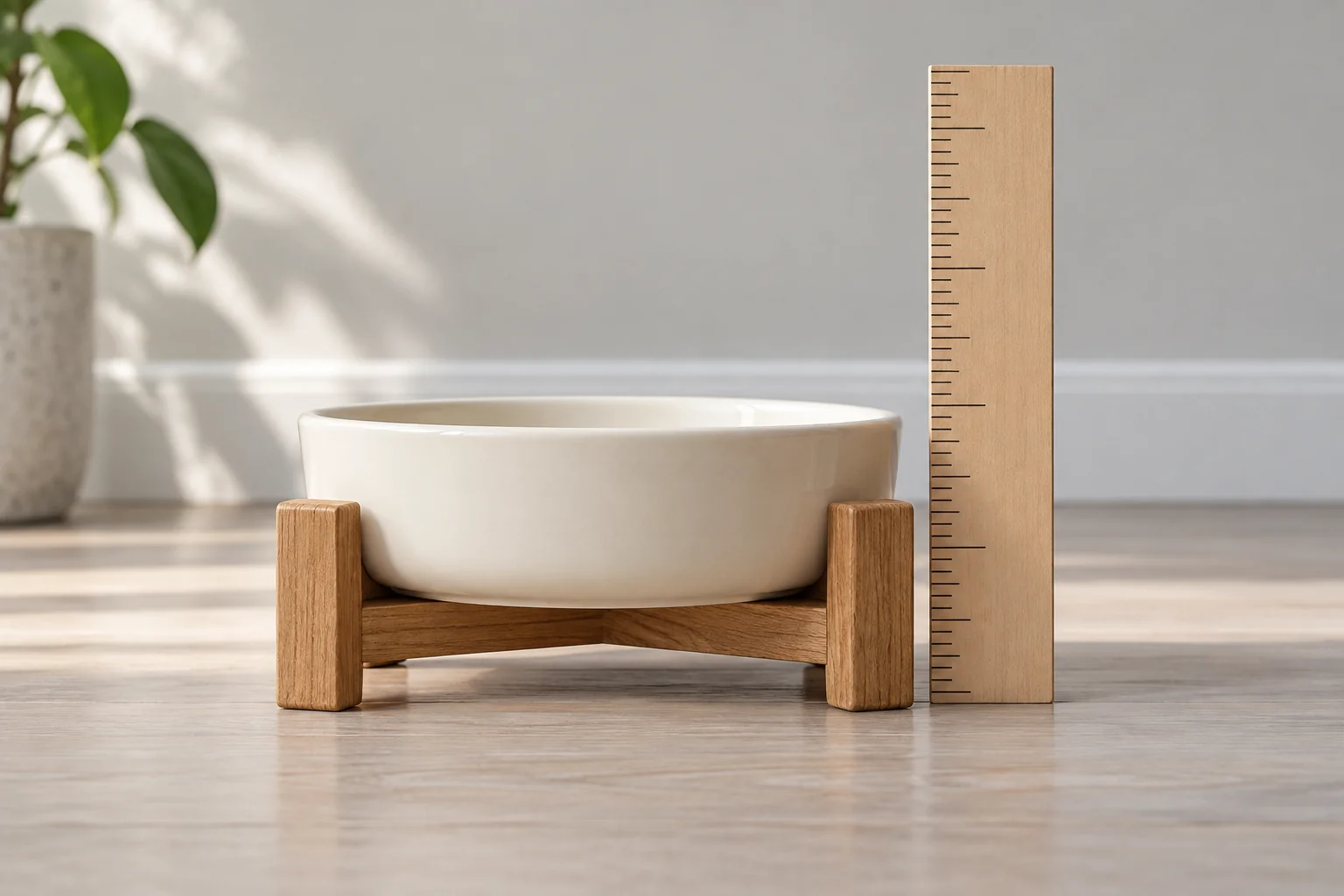
Place the bowl or assembled holder on a level surface. Measure vertically from that surface to the rim, then measure internal depth from the interior bottom to the rim. If a mat or platform is part of the intended setup, record it too. Measurements taken on an empty table may not describe the final arrangement on the floor.
| Detail | How to describe it | What it helps you compare |
|---|---|---|
| Floor-to-rim height | Vertical distance from the supporting surface to the rim | Height of the assembled feeding setup |
| Internal depth | Interior bottom-to-rim distance | How far food sits below the opening |
| Stand dimensions | Height and shape of the holder | Support and compatibility information |
| Bowl seating | Where and how the bowl rests in the holder | Whether the assembled height differs from the separate parts |
| Tilted rim | Front and back rim heights, recorded separately | Access and fill-level differences in a tilted setup |
Avoid simply adding a bowl’s advertised height to a stand’s advertised height. The bowl may sit partly inside the holder, or the stand measurement may already describe the assembled rim. Ask what the listing measures and confirm it with the intended bowl in place.
Photograph the sample from the side beside a ruler, without the cat present. Keep that image with the measurement notes. It gives you a repeatable reference when comparing a replacement bowl, another stand or a supplier’s drawing.
How tall should a cat bowl be for everyday access?
Use the familiar setup as a starting point and observe how your cat reaches the food. Check the actual rim and food position rather than assigning a height from breed, weight or a chest-height formula.
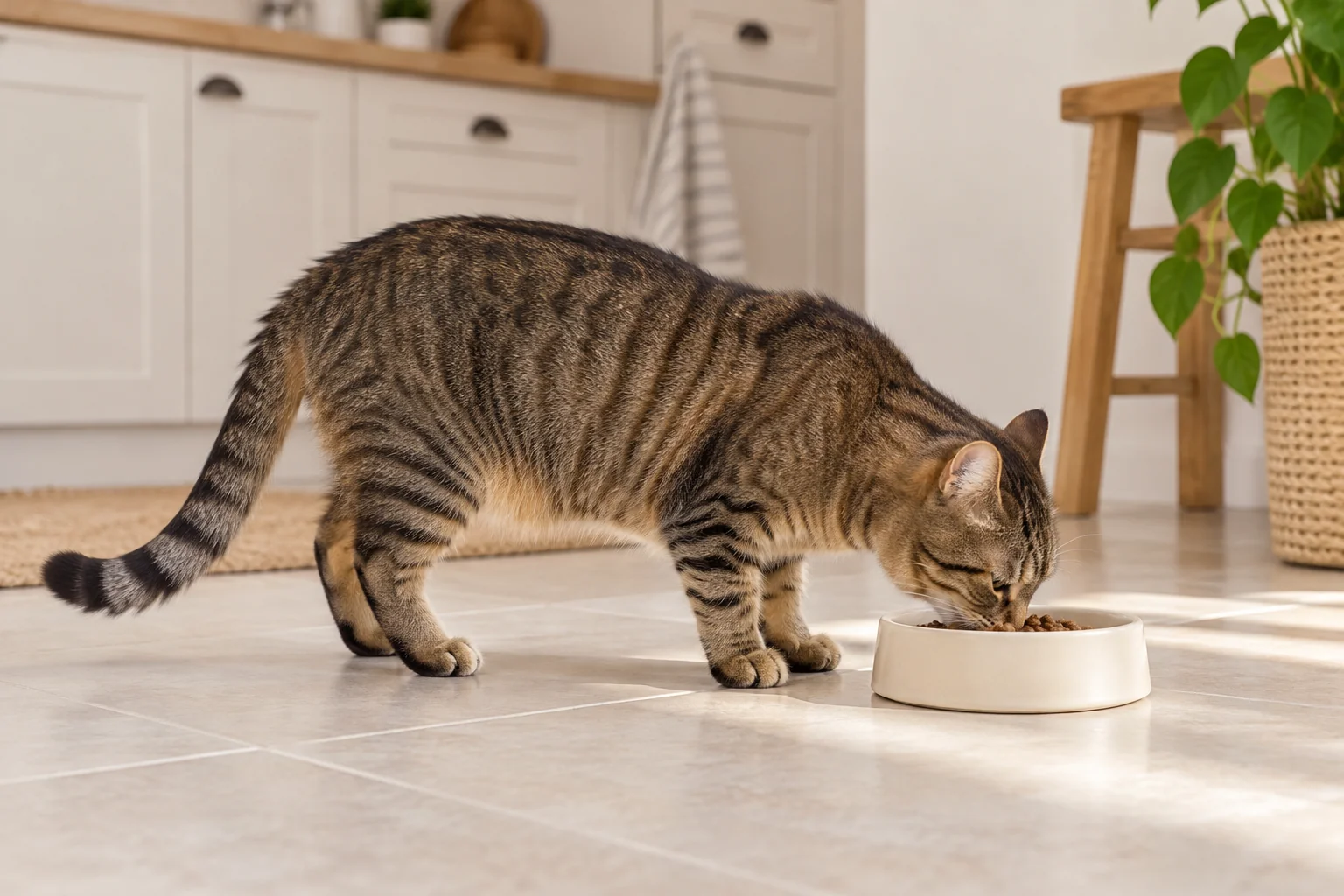
Let the cat approach voluntarily. Notice where it places its feet, whether it can reach the meal and whether the bowl moves during normal use. Keep the food and location consistent when comparing a suitable alternative, so the difference in equipment is easier to identify.
Do not hold the cat in a chosen posture to make a stand look appropriate. A photograph of one pose is less useful than observations across ordinary meals. Record what happens instead of labeling a particular neck angle as correct for every animal.
If a familiar floor-level bowl works, there is no need to select a raised stand solely to match an online height chart. If considering a different setup, check it against the individual cat’s access and the instructions for the complete bowl-and-stand configuration.
A change in eating, movement or behavior deserves attention beyond equipment selection. Discuss health concerns with a veterinarian. Frequent vomiting or vomiting accompanied by decreased appetite or weakness needs veterinary assessment; changing bowl height should not replace that assessment.
Check internal depth and tilt at the chosen height
Assess where the meal sits inside the bowl once the assembled height is known. A raised rim can still surround a deep interior, so the cat’s access cannot be judged from stand height alone.
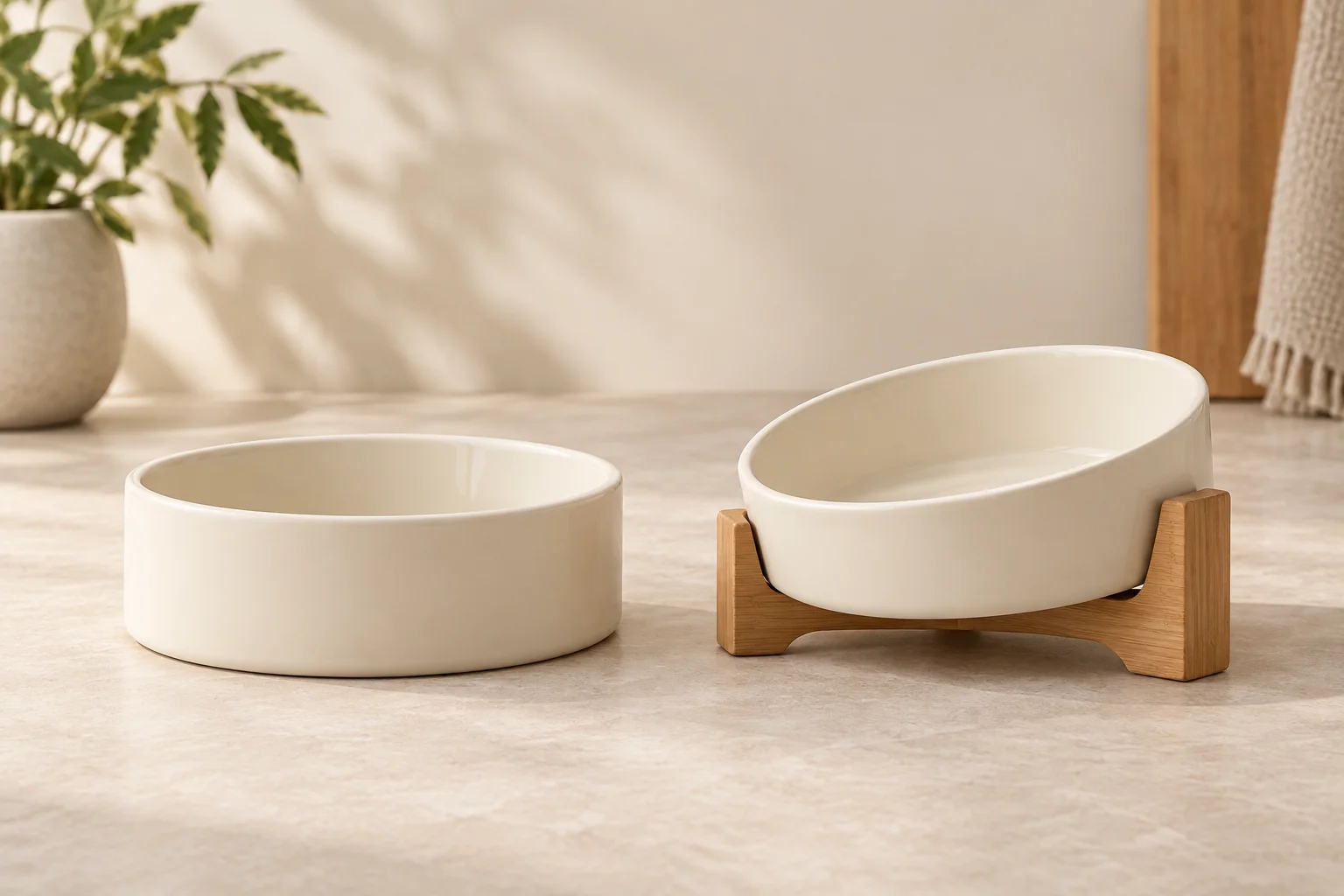
Use the established portion to check the position of food at the bottom and along the sides. Compare how much of the meal remains accessible as the bowl empties. Keep this as a depth check; choosing the full range of bowl diameters is a separate task.
For a tilted bowl, record the lower front rim and the higher rear rim. With the setup empty and on a level surface, inspect how the bowl seats in its support. If it will hold water, check the fill level against the lower rim before use. That rim limits how high the waterline can sit without flowing over it.
Do not transfer a stated capacity from an upright bowl to a tilted configuration without checking the measurement method. Ask whether the supplier measured the bowl upright or assembled in the proposed holder. A tilt angle does not, on its own, establish a suitable height or a health benefit.
Compare the actual sample with its intended food or water use. Avoid selecting an angle from a universal recommendation or assuming it will change eating, digestion or vomiting. The relevant question here is whether the complete setup presents the contents accessibly and stays assembled as intended.
Inspect the complete bowl and stand assembly
Check the bowl in the stand it will actually use, on the intended supporting surface. A separate bowl photograph or stand-height measurement leaves compatibility unanswered.
Follow the maker’s assembly and fitting instructions. Before the cat uses it, check that the bowl seats properly, the stand rests evenly and there are no loose, broken or incorrectly fitted parts. If a proposed configuration does not fit as intended, resolve that problem with the maker instead of adding improvised spacers.
Make sure the bowl can be removed for cleaning without dismantling an arrangement that was not designed for that purpose. Check the setup again after reassembly. During normal use, note any movement of the bowl or stand and stop using an unstable configuration until it is resolved.
For an adjustable stand, confirm the permitted settings and how each setting locks. Do not assume every height within an advertised range is supported by every bowl. Ask which bowl models and configurations the instructions cover.
These checks describe practical inspection of a sample. They are not a tip-resistance test or proof that a base ratio, rim overhang or particular clearance will be safe for every cat and surface.
Check placement and document the proposed setup
Choose a location where the cat can approach the bowl and where you can remove it for cleaning and refilling. Measure the complete footprint along with rim height so a taller stand does not crowd the available area.
Plan individual food bowls for cats in a multi-cat household, and allow separate food and water locations. Raising a shared bowl does not replace checking access to separate feeding resources. Keep the location in the comparison when evaluating a different stand.
For a purchasing brief, record assembled rim height, internal depth, stand dimensions and the exact bowl or insert. If tilted, include both rim heights and the capacity-measurement method. Ask for a drawing that identifies the assembled dimensions and a sample of the proposed combination.
The custom pet bowl page provides a starting point for the bowl inquiry. For a wider configuration, review custom pet accessories and pet product manufacturing information. Confirm any proposed stand, adjustment or compatibility requirement for the particular project before treating it as available.
FAQ
Are taller bowls better for cats?
Choose by the individual cat’s access and the complete setup, rather than treating taller as a quality ranking. Compare a suitable configuration with the familiar one and check how the bowl seats. For a cat with health or mobility concerns, ask the veterinarian about its needs before relying on a stand-height recommendation.
Do cats prefer eating standing up or sitting down?
Observe the individual cat in its usual feeding routine instead of choosing equipment to enforce one posture. Check whether it reaches the meal voluntarily and whether the setup remains steady. A photograph of a sitting or standing cat does not establish the best bowl height for all cats.
Do cats prefer deep or shallow bowls?
Treat depth as a feature to compare alongside the assembled rim height. A stand raises the bowl but does not change its interior depth. Check access to the usual portion in suitable samples; neither the shallow nor deep label determines the fit on its own.
Conclusion
Measure the assembled rim height and internal depth before comparing stands. Keep a record of everyday access, the intended location and the exact bowl-holder combination. For a sourcing project, send the assembled dimensions and configuration requirements so the proposed setup can be discussed and checked against the same brief.