The best dog frisbee fits your dog’s pickup and carrying behavior, feels manageable to throw, and suits the place you play. Compare diameter, weight, rim shape, material, and the instructions for the exact model before choosing a disc.
A flexible rim, a floating claim, and a competition label answer different questions. None settles the whole purchase. A disc chosen for short backyard throws may need a different review from one chosen for a particular event or water retrieval.
Use these five buying tips to compare options and evaluate a sample. They apply to owners selecting a single toy and to buyers preparing a retail assortment, without relying on a universal breed ranking or an unsupported “indestructible” claim.
Match Diameter and Weight to the Dog
Start with the maker’s intended user and use instructions, then compare the disc’s actual diameter and weight. Size labels vary between ranges. A smaller-looking disc in a photograph is not necessarily lighter or easier for your dog to pick up.
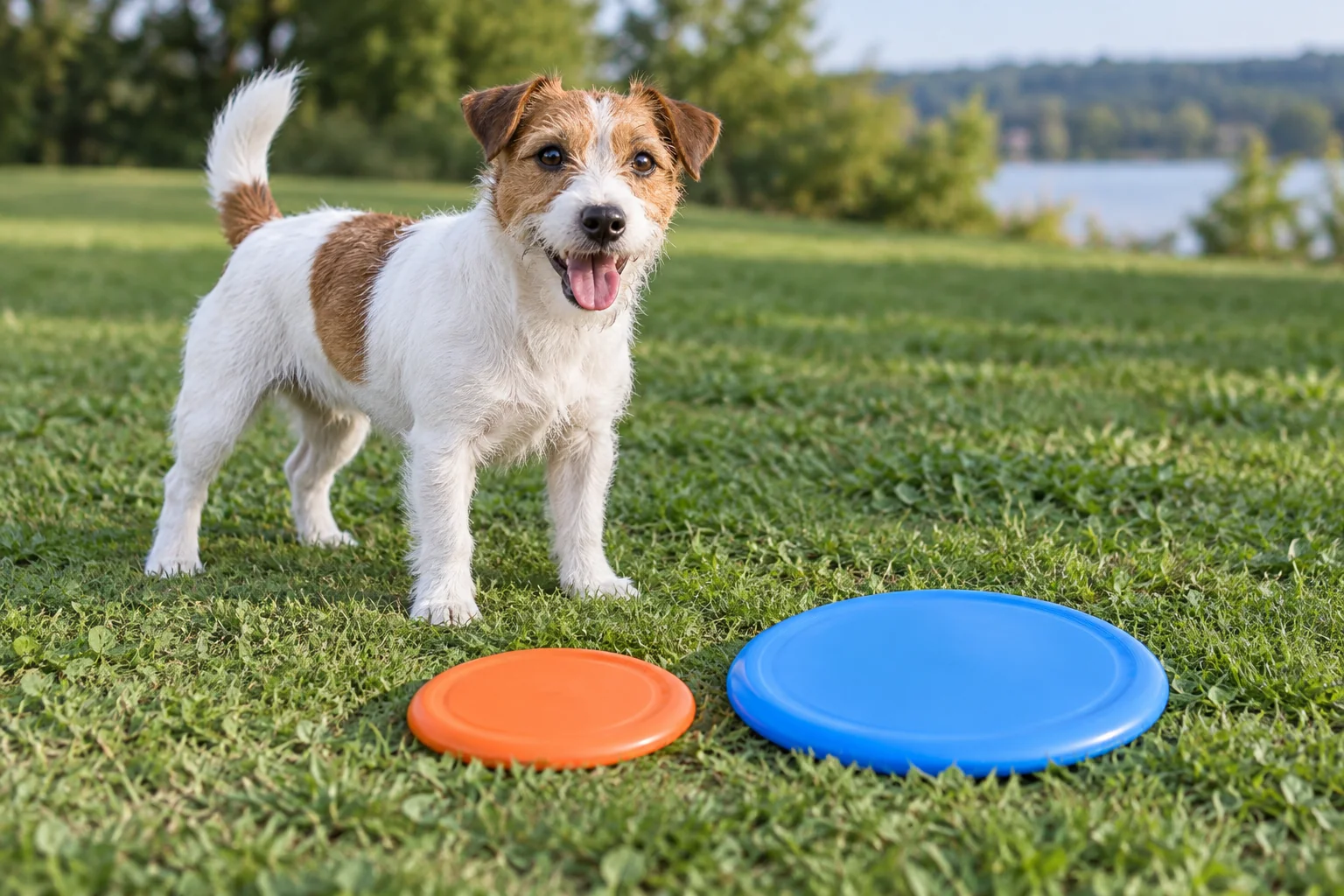
Check the measurement across the disc and the listed weight of the disc itself. A packaged weight may include several toys or accessories. When information is missing, ask for it before using that listing to compare a small and a large option.
Look at pickup as well as carrying
For an appropriate product, observe ordinary supervised pickup from the ground and a calm carry. The rim’s shape and the disc’s profile matter alongside diameter: your dog still has to find a comfortable place to grip it.
If the dog repeatedly leaves the disc behind or appears to struggle with it, reassess the model. Do not force it into the dog’s mouth or treat a successful pickup as proof of safety. The observation helps you decide whether to continue evaluating that product.
Small dogs and puppies need the exact product guidance
Do not assume every small dog needs the same diameter or weight. Check whether the maker identifies the model as suitable for your dog’s size and age. If the instructions are unclear, ask the maker; discuss individual health or activity concerns with your veterinarian.
Keep the first comparison simple. A clearly identified dog-fetch disc with complete measurements is easier to assess than a listing that only says “for all dogs.” Avoid buying a full set before you know whether the particular model suits the dog and handler.
Compare Materials and Rim Construction
Compare the complete disc rather than ranking it by the material name alone. Rubber, flexible plastic, and fabric-based designs can have different profiles, surfaces, and use restrictions. Confirm what the actual model is made from and how the rim is constructed.
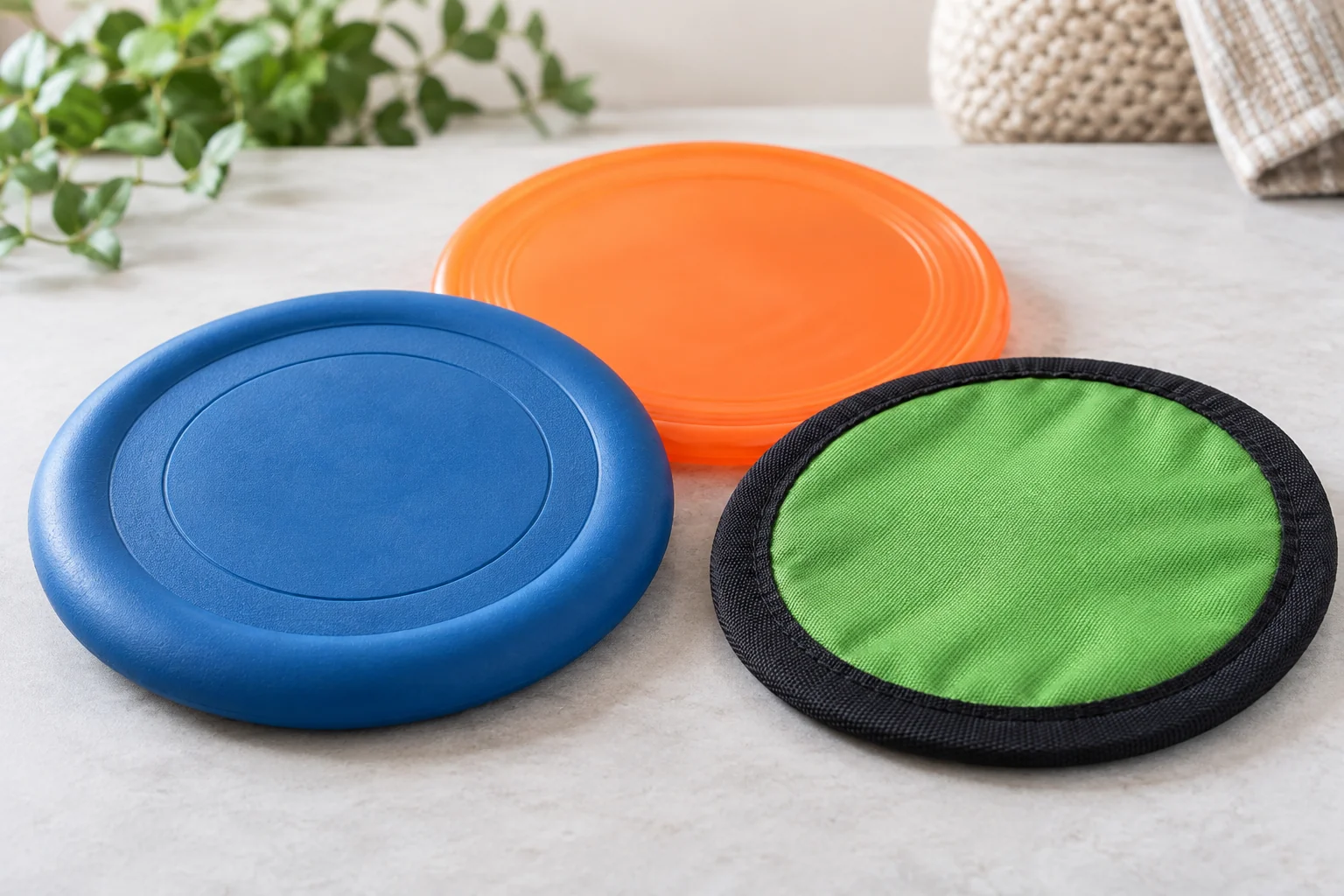
The table identifies useful sample checks. It does not assign universal flight distances, safety scores, or durability ratings to whole material families.
| Disc construction | What to compare on a sample | What still needs confirmation |
|---|---|---|
| Molded rubber | Rim flexibility, surface, profile, and weight | Intended use, size guidance, care, and any floating claim |
| Flexible plastic | Rim shape, surface finish, and how the disc feels to grip | Exact material description and the model’s use restrictions |
| Fabric-based design | Cover, seams, edge construction, and any exposed filling | Whether the model is intended for outdoor or water use and how to clean it |
A material category cannot tell you whether a disc will resist your dog’s handling or remain suitable after damage. Our dog toy materials guide covers the broader differences between materials and structures; the particular disc’s instructions should guide its use.
Inspect the entire edge
Look around the rim for cracks, tears, rough damage, loose stitching, or parts separating from the disc. Inspect both surfaces as well. Use the manufacturer’s replacement guidance if the condition changes after play.
Choose a product intended for dog fetch rather than assuming a human sports disc is interchangeable. Disc golf, recreational throwing, and dog retrieval involve different product designs. A familiar circular shape is not enough to establish suitability.
Flexibility does not mean chew permission
Some dog discs are explicitly intended for fetching rather than chewing. Check the instructions even when the product is marketed as tough or puncture-resistant. Put it away after the game if it is an interactive fetch toy.
If your dog holds the disc down and starts tearing or chewing it, pause play and reassess. Buying another material does not remove the need to supervise or inspect the toy. A “heavy-duty” description also needs a specific explanation from the maker.
Choose a Flight You Can Throw Consistently
Evaluate how the actual disc behaves in your hands before asking your dog to retrieve it. Begin with simple throws in an open area and observe direction, landing, and control. A promised maximum distance says little about whether that disc works for your usual game.

Compare candidates under similar conditions. Changing the throw, wind, and playing area at the same time makes it difficult to identify what changed. A sample comparison is more useful when you can repeat the ordinary throws you plan to use.
Keep the playing area part of the decision
Short backyard retrieval and throws across a larger open field call for different space planning. Choose a place where you can control the direction of the throw and keep the game clear of obstacles, roads, and other users.
Test throws without the dog first if you are learning a new disc. If it regularly lands outside the available area, adjust the game or reassess the disc. Do not use a long-distance claim as a reason to keep throwing beyond the space you can manage.
The choice of disc also does not require aerial catches or high jumps. Keep activity appropriate for your dog, and seek qualified guidance before progressing to demanding sport work. This buying guide is about equipment selection, not a jumping or rehabilitation program.
Compare the grip when conditions change
Check whether you can hold and release the disc comfortably in the conditions you normally encounter. Follow its instructions for wet, cold, or other restricted use. Do not assume that all flexible plastics or all rubber discs behave alike in those conditions.
For a retail assortment, describe the sample’s intended use accurately. A casual fetch disc should not become a “competition distance disc” just because the product photograph shows a dog on a sports field.
Confirm Floating and Competition Claims Separately
For water play, choose a disc whose manufacturer explicitly identifies the exact model as floating and suitable for that use. A soft construction or a foam-looking rim does not confirm buoyancy. Neither does another disc in the same range being labeled as floating.
Check the instructions and inspect the product before use. Supervise retrieval in a suitable setting, and do not encourage the dog into water simply to test a toy’s advertised feature. Individual suitability for water activity needs its own consideration.
Read beyond the main listing title
Look for a clear model-specific statement in the product details or instructions. If the title says “water toy” but the details do not explain its intended use, ask the maker. Record the answer alongside the model and size so replacements match the product you evaluated.
A bright color may help a person locate a disc against a particular background, but it does not establish that the toy floats or suits every dog’s vision. Treat appearance as a practical preference rather than a performance guarantee.
Check the actual event’s rules
For organized disc play, confirm the current rules for the event and division before buying. Ask the organizer whether the exact disc model is accepted. A product’s competition label does not establish eligibility everywhere.
Keep the rule date and any organizer confirmation with your equipment notes. Rules and accepted models can change. Avoid applying one organization’s diameter or brand restriction to all forms of dog disc sport.
Inspect a Sample and Write a Clear Buying Brief
Evaluate an appropriate sample before ordering multiple discs. Check the measurements, rim condition, instructions, and ordinary handling. Keep the product code so a reorder does not quietly substitute another size or construction.
For commercial buyers, a written comparison sheet is more useful than a list of “soft,” “durable,” and “best.” Separate the facts supplied for the exact model from observations made while evaluating its sample. Do not turn a brief trial into a claim about lifetime, injury prevention, or every dog’s use.
Ask the supplier to confirm:
- Disc diameter, profile, and weight, with units.
- Material and construction, including the fabric cover or rim where applicable.
- Intended user, play setting, and restrictions on chewing or tugging.
- Care and replacement instructions.
- The basis for any floating, competition, or durability claim.
If an order needs a particular tolerance, agree on the requirement and measurement method for that product. There is no universal hardness number or mold specification that makes every dog disc suitable. Product-specific evidence is needed for precise performance or compliance claims.
The dog toy manufacturers page gives context for Furrowa’s confirmed toy categories. Check the proposed flying-disc scope directly before assuming that a particular polymer, mold, competition model, or custom design is available.
FAQ
What is the best frisbee for a beginner dog?
Choose an appropriate dog-fetch model with clear use instructions and a size you can evaluate calmly. Start by checking pickup and ordinary retrieval; the dog does not need to make aerial catches for you to assess whether the toy suits a simple game.
How do I choose a frisbee for a small dog?
Compare the exact diameter, weight, rim profile, and maker’s size guidance. If a listing offers several variations, confirm which one you are ordering. Do not transfer another product’s small-dog recommendation to the whole category.
Is there an indestructible frisbee for dogs that chew?
Do not treat that description as a guarantee. Ask what the maker means by the claim and check whether the model is intended for chewing at all. A fetch disc should be removed from play when damaged, according to its instructions.
What frisbee is used in dog competitions?
The answer depends on the event and division. Check the current organizer’s rules and confirm the exact model before purchasing a set. A list of popular discs is not an approval list for every competition.
Can I choose a floating disc by its material alone?
No. Verify a floating claim for the exact model and size, including its intended use and restrictions. Different constructions within a material category can require different decisions.
Conclusion
Choose the disc you can handle consistently and your dog can use as intended in the available space. Keep its size, weight, model, and use instructions together so future purchases match the product you evaluated.
For a sourcing inquiry, contact Furrowa with the proposed disc construction, measurements, play setting, and target market so the relevant product scope can be confirmed.