A dog ball size chart helps you compare the outside diameter of fetch balls. Choose from the actual product’s size guidance, then consider how your dog picks up and carries the ball, its construction, and any launcher you use. Weight and breed alone do not identify a suitable diameter.
Start with the measurement on the listing. A label such as “medium” only makes sense within that particular range, and a photograph rarely gives a useful sense of scale. A ball that fits a launcher can still be unsuitable for the dog retrieving it.
The five checks below take you from reading a listing to evaluating a sample. They also give retail buyers a way to compare products without turning a supplier’s size labels into a universal dog-size chart.
Read the Dog Ball Size Chart by Actual Diameter
Compare diameter in the same units before comparing small, medium, or large labels. Diameter is the distance straight across the ball through its center. It differs from the distance around the outside and from the dimensions of the package.
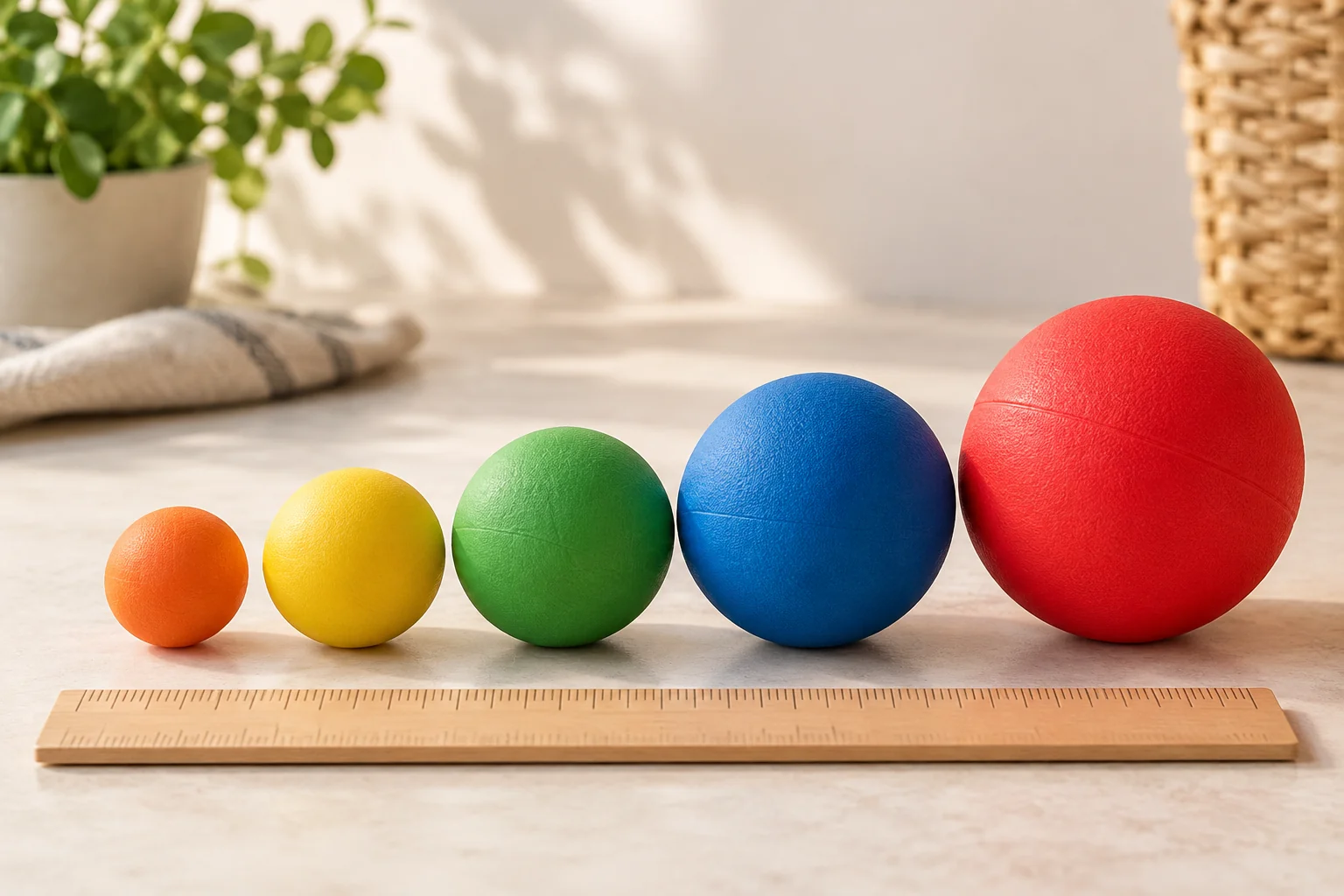
The table shows example measurements and their inch-to-centimeter conversions. These are comparison examples, not recommended sizes for particular breeds or weights, and they do not define an industry-wide sizing system.
| Example outside diameter | Equivalent in centimeters | How to use the measurement |
|---|---|---|
| 2 inches | 5.08 cm | Compare with another listing’s actual ball diameter |
| 2.5 inches | 6.35 cm | Check the exact size option and any launcher requirement |
| 3 inches | 7.62 cm | Confirm that the measurement refers to the ball, not its package |
| 3.5 inches | 8.89 cm | Compare the product’s intended use and user guidance |
| 4 inches | 10.16 cm | Treat it as a separate size option, not an automatic upgrade |
Measure the ball rather than the packaging
For a simple check, rest the ball between two parallel, upright surfaces without squeezing it. Measure the gap between them. Calipers can also measure outside diameter, but close the jaws gently against a soft ball so the reading reflects its resting size.
A tape wrapped around the ball measures circumference. If that is the only available measurement, divide it by pi to estimate diameter for a round ball. Direct measurement is preferable when the surface is deeply textured or the shape is no longer round.
Record the units with the number. “Size 6” could mean centimeters, a product code, or a label within the range; it is not enough information to order a replacement. For a textured design, ask whether the stated diameter includes the raised surface.
Check the selected variation
Online listings often combine several sizes on one page. Confirm that the selected variation, product code, and description agree before ordering. A gallery image may show the whole range even when the basket contains just one size.
Keep the original product label or a note of the size and model. When a ball goes missing, that record is more useful than trying to match a new product to a photograph of your dog holding the old one.
Check the Intended Dog and Carrying Fit
Use the manufacturer’s guidance for the exact ball as the starting point. Then observe ordinary, supervised pickup and retrieval with a suitable product. A general chart cannot account for every dog’s mouth shape, behavior, or willingness to carry a particular ball.
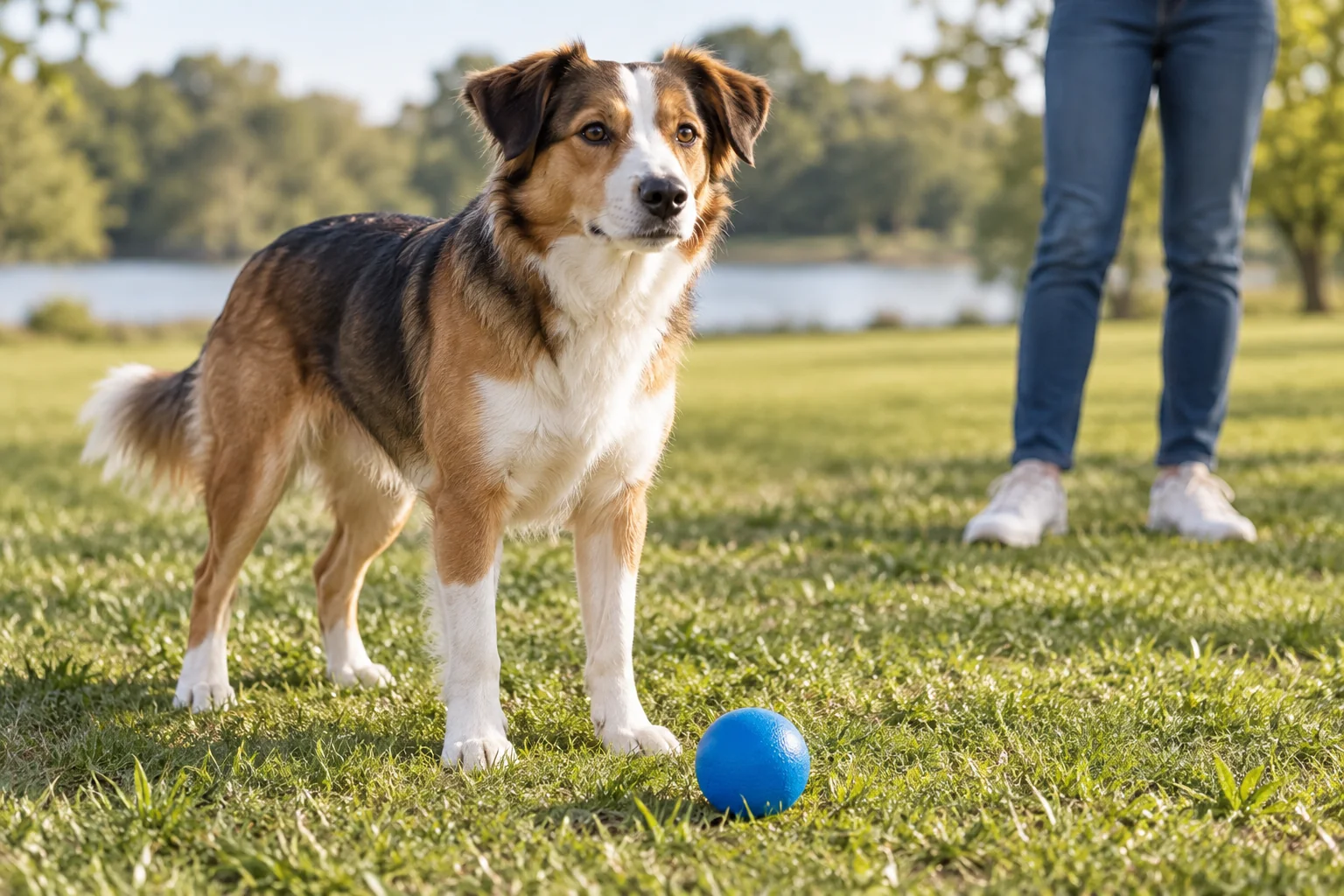
Do not push a ball into your dog’s mouth, measure inside the mouth, or test whether the dog could swallow it. If you are unsure about fit, keep that product out of play and ask the manufacturer or your veterinarian for guidance.
Look at whether your dog picks it up willingly, carries it without obvious difficulty, and releases it during the game. Repeatedly leaving it behind or struggling to lift it is a reason to reassess the choice. Those observations help identify a poor match; they do not prove that a ball is safe.
Use weight guidance within its product range
If a manufacturer gives weight bands, use them for that manufacturer’s specified product. Do not transfer the bands to a different brand, material, or shape. Two balls with the same outside diameter can have different surfaces, firmness, and weight.
The same caution applies to breed recommendations. Dogs within a breed vary, and a breed name says little about how an individual dog handles a toy. Buy from the actual product information rather than a chart that assigns one diameter to every dog of a named breed.
Keep each dog’s ball separate when needed
A shared toy should meet the relevant guidance for every dog that could reach it. Choosing for the largest dog alone does not establish that the others can use the same ball comfortably.
Separate play sessions or store different sizes separately when the dogs need different products. This is also useful when one dog retrieves calmly while another settles down to chew the ball. Their play habits call for different decisions even if their body weights are similar.
Compare Construction Alongside Size
Diameter describes the resting size, not the entire toy. Compare the ball’s firmness, surface, weight, and intended use before treating two equal-size options as interchangeable. A fetch toy’s instructions may differ from those of a toy intended for chewing.
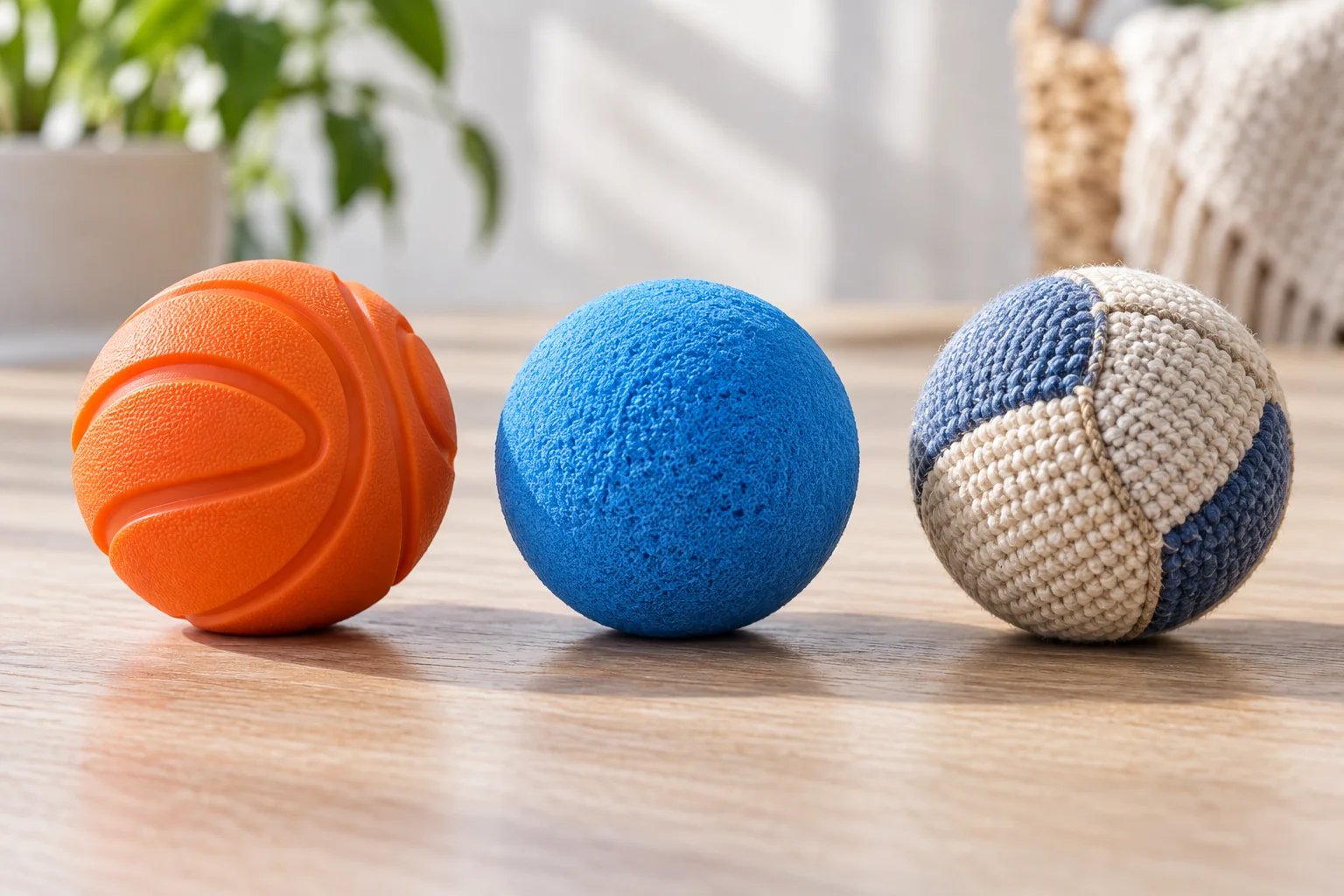
Rubber, foam, covered, and hollow designs need product-specific checks. The material name alone does not tell you how much a ball changes shape, whether it floats, or how long it will last. Our guide to dog toy materials explains the wider differences between materials and construction.
Inspect the sample before play
Check for tears, cuts, loose components, damaged coverings, and a shape that no longer resembles the new product. Follow the maker’s replacement guidance. A familiar diameter is not a reason to keep a damaged ball in use.
For a soft ball, gently handling a sample can help you compare its feel with another option. It cannot reproduce a dog’s bite or establish a safe compression threshold. Avoid treating a hand-squeeze test as proof that a hollow design will retain a particular size in use.
Keep size and material decisions together. If the texture or firmness changes, reassess the product rather than assuming that the diameter of a previously suitable ball settles the question.
Confirm Launcher Fit and the Play Setting
A ball launcher needs a compatible ball size and design, as specified by its manufacturer. Confirm the exact launcher model and ball variation. A similar diameter or a broad “launcher compatible” claim may not identify the combination you own.
Do not force a larger ball into the cup or modify either item to make it fit. If compatibility is unclear, ask the manufacturer before using the combination. A successful trial fit does not replace the product instructions.
Keep a separate note for equipment compatibility
Write down the launcher model next to the ball model and size. That makes replacement orders easier, especially when a household or retailer handles several similar-looking products. Keep incompatible sizes out of the same storage bag.
The play setting also matters. Choose an open area appropriate for the game and check it for obstacles before starting. For water play, verify that the exact ball is intended for that use and that its maker states it floats; a rubber construction alone does not establish buoyancy.
Supervise fetch and put the toy away afterward. If your dog stops retrieving and starts pulling the ball apart, end the game and reassess the toy. A size chart does not turn a fetch product into an unattended chew toy.
Confirm the Sample and Replacement Details
Before buying several balls, check one suitable sample against the listing, instructions, and equipment you plan to use. Record its model, outside diameter, and any relevant use restrictions. This gives you a practical reference for replacement purchases.
Retail and wholesale buyers need the same clarity across a product range. A supplier’s “small, medium, large” assortment should have a separate product code and measured diameter for each option. Otherwise, a packing list can look correct while leaving the actual sizes ambiguous.
Put measurable questions in the sourcing brief
Ask the supplier to confirm these details for the proposed sample:
- Outside diameter, units, and the point used to measure a textured surface.
- Product weight and whether the listing shows one ball or a multipack.
- Material and construction of the actual model.
- Intended use, user guidance, and replacement instructions.
- Any claimed launcher compatibility, tied to a named model.
If dimensional tolerance matters, agree on the measurement method and acceptable variation before placing an order. This guide does not prescribe a universal tolerance, hardness range, or wall thickness. Such requirements belong to the specific product and its approved sample.
For a rubber-toy sourcing inquiry, the wholesale rubber dog toys page provides category context. Confirm the available models and specifications directly; a category page does not establish that a particular diameter, launcher combination, or custom design is available.
FAQ
What size ball should I get for my dog?
Start with the exact product’s size guidance and intended use. If two options seem plausible, ask the maker to clarify the choice before play rather than assuming that the larger option is automatically suitable. Keep a record of the model as well as its diameter.
Why do two “medium” dog balls have different diameters?
Size labels belong to individual product ranges. Use the measured outside diameter to compare them, and check the chosen variation rather than relying on the page’s main photograph. Matching labels do not establish matching fit.
Can I use package dimensions as the ball diameter?
Only if the listing explicitly identifies a dimension as the ball’s outside diameter. A three-part measurement may describe the packaged item or a multipack. Ask for the ball measurement if the description leaves this unclear.
What should I do if a previously suitable ball changes shape?
Remove it from play and check the manufacturer’s replacement instructions. Keep the model details for ordering a replacement, but do not use the changed shape as your new sizing reference.
What if I cannot confirm whether a ball suits my launcher?
Use a combination that the manufacturer explicitly identifies as compatible. Send the maker the launcher model and the ball’s product code; the label “medium” on both items is not enough to confirm a match.
Conclusion
Keep the actual diameter, product code, intended use, and launcher model together when choosing or replacing a fetch ball. These details make a dog ball size chart useful without giving it more authority than the product information supports.
If you are preparing a sourcing brief, contact Furrowa with the proposed ball type, size options, intended use, and target market so the relevant product scope can be checked.