The best herding ball for dogs suits push-and-roll play, the individual dog, and the space available. Compare the exact product’s diameter, weight, shell or cover construction, and use instructions. A large size or an “indestructible” label does not settle those questions.
Herding balls vary considerably. A hard-shell push ball and a fabric-covered inflatable ball may belong to the same broad play category while needing different setup, care, and sizing decisions. Start by identifying the actual construction before comparing size labels.
These five buying tips focus on recreational push play and practical product checks. They help owners evaluate a choice and give commercial buyers clear questions for a supplier, without assigning one diameter to every dog of a particular breed.
Choose a Ball for Push-and-Roll Play
A herding ball is chosen for a game in which the dog moves the ball along the ground. That differs from carrying a mouth-retrievable fetch ball back to a handler. Confirm that the particular product is intended for the kind of push play you want.
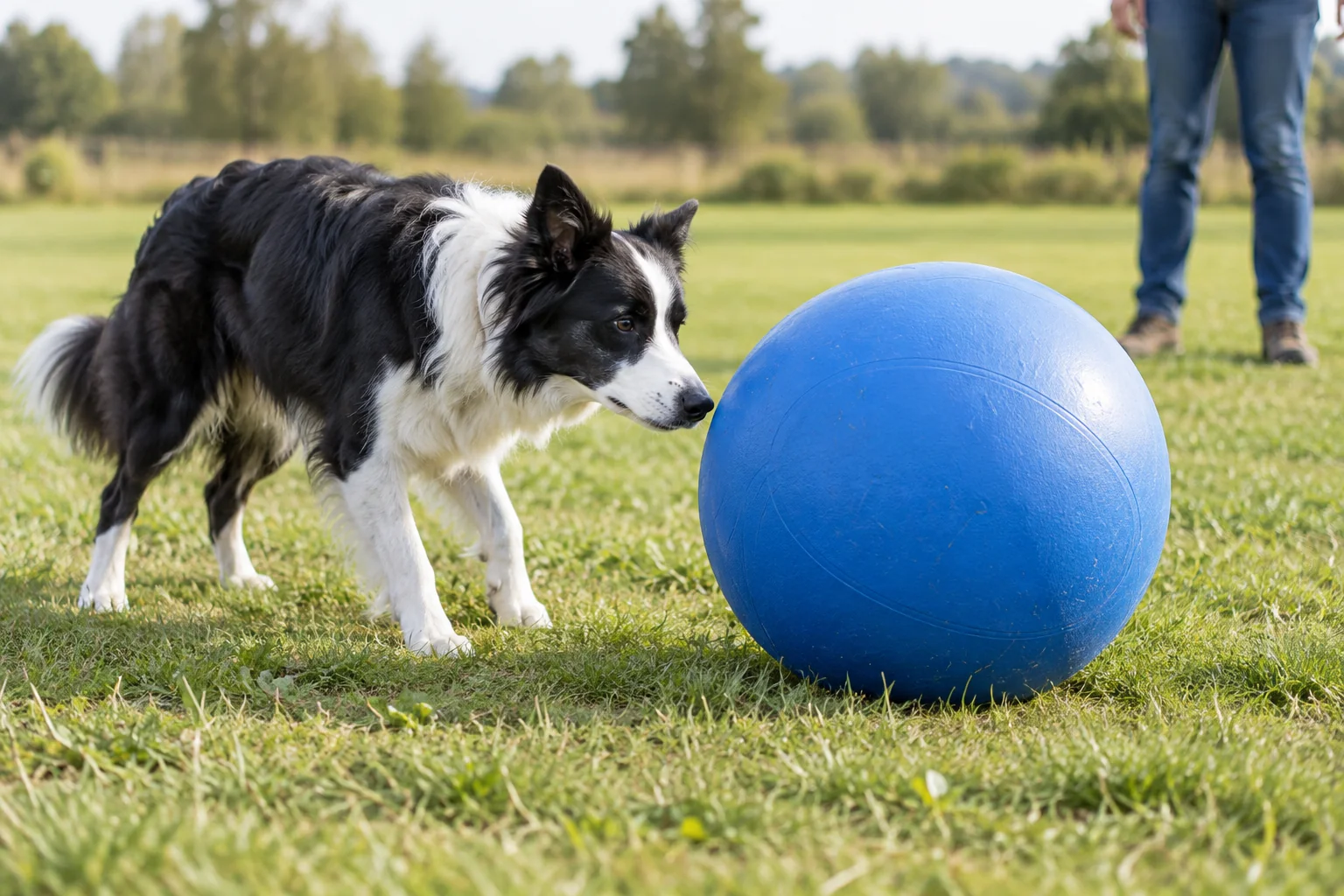
Look at the instructions before looking at the breed pictured on the listing. A large photograph of a working dog does not establish which dogs, surfaces, or games suit the product. The actual model and its intended use are the useful reference points.
Observe the kind of play your dog offers
With an appropriate toy, watch ordinary supervised interaction. Is the dog engaging with the intended push game, ignoring the ball, or repeatedly trying to grip and chew it? That observation helps you decide whether to continue evaluating the product or choose another activity.
Do not encourage biting a hard-shell push toy if the maker says it is not a chew toy. End the session if the interaction no longer matches the product’s instructions. A tougher-looking ball does not turn chewing into its intended use.
You also do not need a herding breed to ask whether a dog enjoys a push game. Breed labels can describe the audience for a product, but they cannot guarantee interest. Let the individual dog’s response guide the choice rather than buying a large ball solely because of ancestry.
Separate recreation from formal sport
Backyard push play and organized ball-herding sport have different requirements. If you plan to participate in an event, check its current equipment rules and ask the organizer about the proposed ball. A retail description mentioning a sport is not enough to establish event eligibility.
Keep this distinction in a buying brief too. “Recreational push toy” and “equipment for a named competition” are different product requests and need separate confirmation.
Compare Hard Shells and Covered Inflatable Balls
Identify the construction of the exact model. Hard-shell designs and covered inflatable systems have different parts to inspect and maintain. Neither category gives a universal answer about toughness, comfort, or suitability for a particular dog.
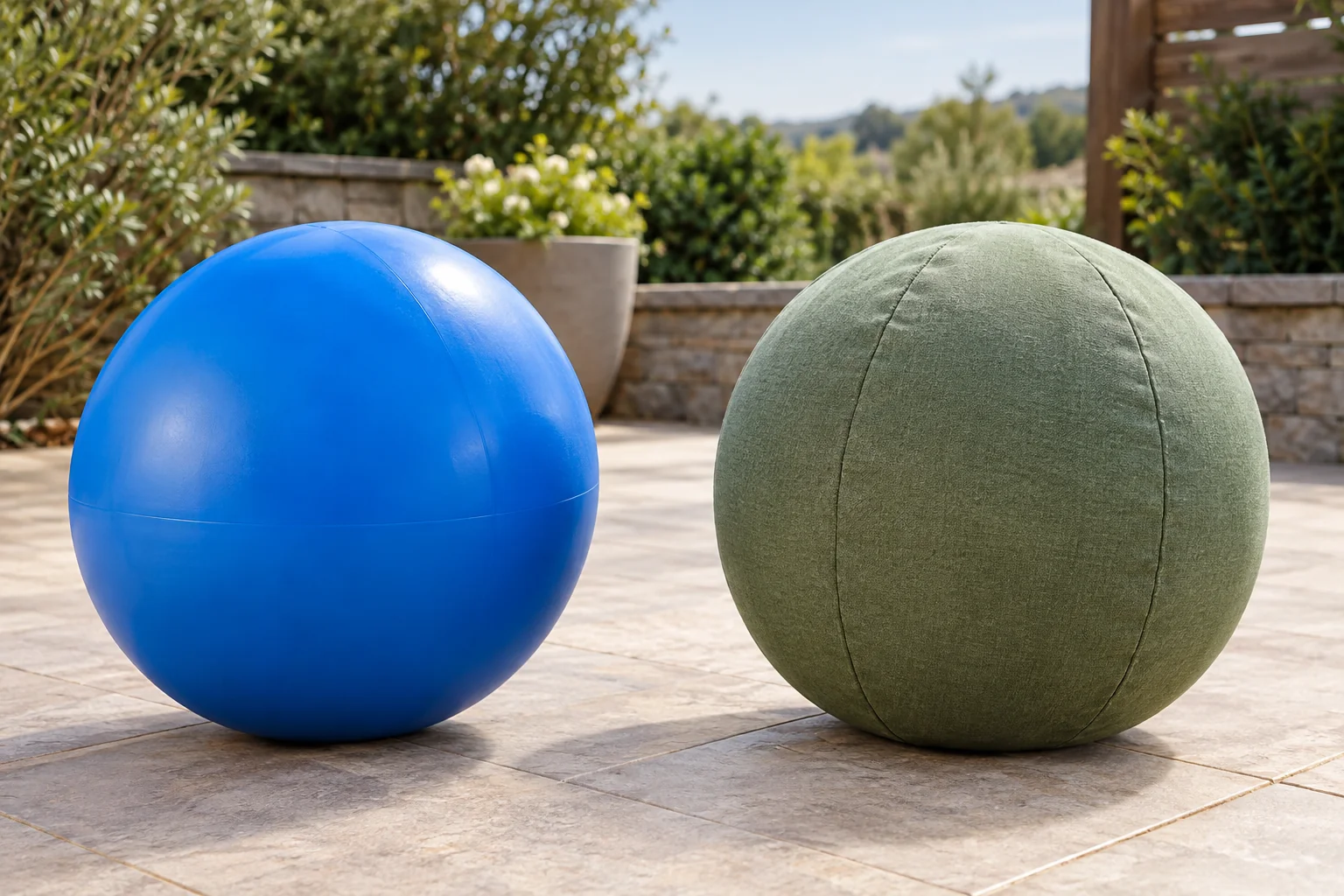
Use the following comparison to decide what information to request. It describes checks rather than ranking the two constructions by unsupported performance claims.
| Construction | Parts and details to confirm | Questions for the maker |
|---|---|---|
| Hard-shell push ball | Shell material, surface, seams, and any plug or opening | What is the intended use, and what condition requires replacement? |
| Fabric-covered inflatable ball | Cover, closure, inner bladder, valve, and setup instructions | How should it be inflated, cleaned, stored, and repaired or replaced? |
Inspect the hard-shell surface
Check the whole shell for damage, rough edges, cracks, or loose parts. If it has an opening or plug, confirm that it is secure and follow the instructions for its use. Do not assume every hard plastic ball has the same material or manufacturing process.
A maker may offer model-specific features such as a removable plug. That does not establish that another ball can be filled, drilled, or modified in the same way. Follow the exact product instructions rather than transferring a feature from a different listing.
Check the covered system as a complete product
A fabric-covered inflatable ball includes more than its outer surface. Confirm how the bladder fits inside the cover, how the closure is secured, and what the inflation instructions require. Keep the cover and bladder matched to the specified model.
Before use, check the cover, seams, closure, and any exposed valve area. A cover that looks intact from a distance may still need attention at a seam or opening. Follow the maker’s instructions if the ball loses shape or a part becomes loose.
Terms such as “reinforced,” “heavy-duty,” or “anti-burst” need a product-specific explanation. They do not prove a universal lifetime, damage resistance, or suitability for unattended play.
Choose Herding Ball Size for the Actual Product
Use the size guidance for the particular model and construction. Compare diameter and weight together, and check whether the listing gives a resting or inflated measurement. Do not copy a covered inflatable product’s chart onto a hard-shell ball.
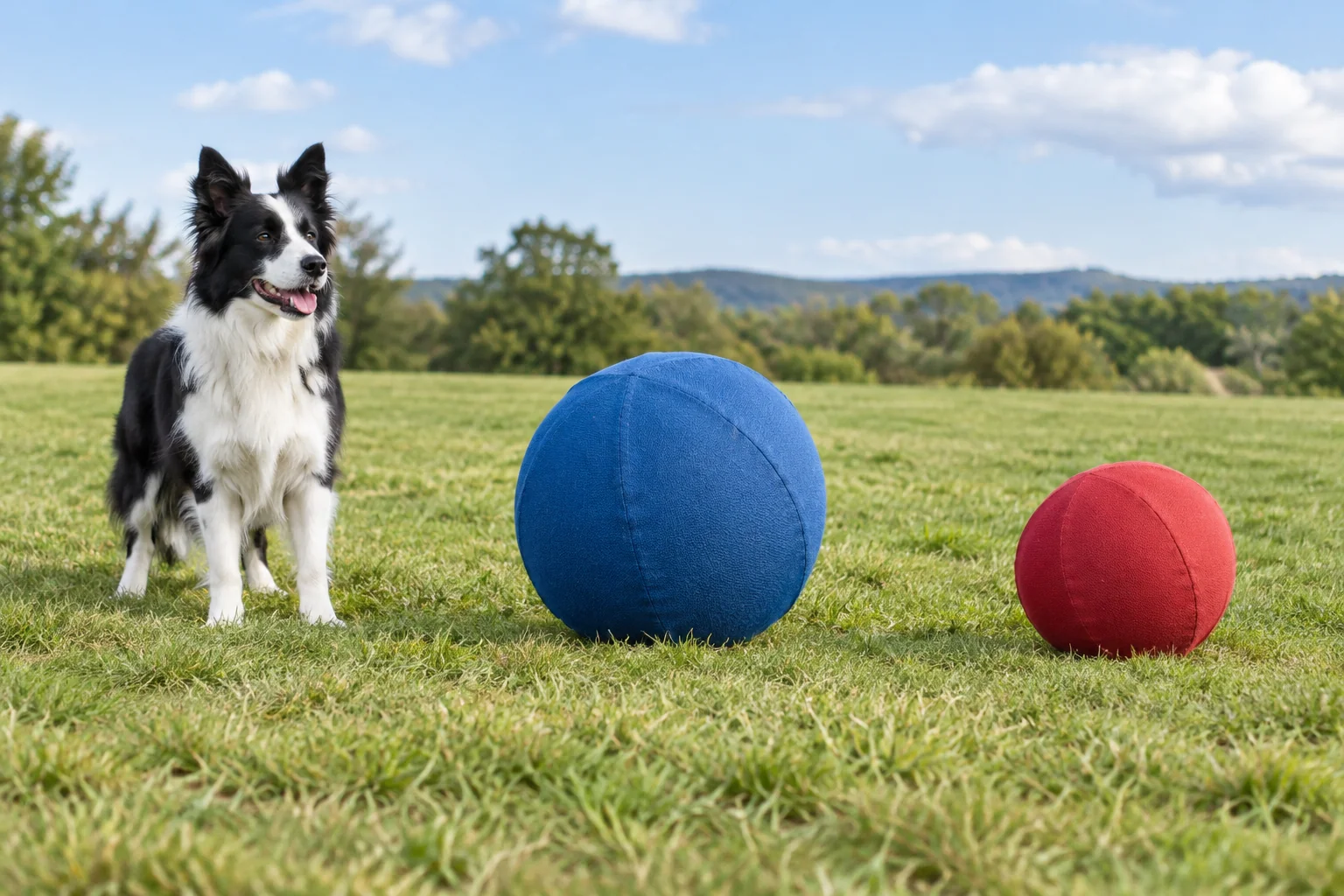
A universal shoulder-height rule cannot settle every purchase. Manufacturers may describe their own size ranges differently. If the instructions use the dog’s height, follow their stated measuring method and apply the result only to the identified product.
Read the units and setup conditions
Record the diameter with its units and model code. For an inflatable design, check the recommended setup rather than inflating until it resembles a picture. A number on the package may refer to the cover, bladder, or intended inflated ball; ask if it is unclear.
Weight deserves its own field on the comparison sheet. Two balls with similar diameters can be different products to handle and store. Do not assume the larger choice is automatically a better match or that a lighter ball is suitable for every dog.
Consider the space before moving up a size
Measure the available play and storage area. A ball that fits through a doorway still needs room for the game around it. Check where it could roll and whether you can end the game without having to retrieve it from a road, stairway, or confined gap.
If you are deciding between sizes, ask the maker about the dog and the actual setting. Describe the intended game, not just a breed name. Keep an unsuitable sample out of play while the question is unresolved.
For shared use, assess the product for every dog that could access it. A ball selected for one dog does not automatically suit the others. Separate sessions may be more practical than trying to choose a single product for very different users.
Check the Ground, Boundaries, and Supervision
Choose an open, level area where you can supervise the game and control access to hazards. Check the ground for sharp debris and the boundaries for roads, steps, obstacles, and places where the ball could become trapped.
Review the manufacturer’s surface and setting restrictions too. A photograph on grass does not confirm use on concrete, near water, or indoors. Indoor use needs explicit consideration of the product, the available space, and the surroundings.
Walk the area before starting
Remove movable obstacles and check the route the ball is likely to take. Leave room between the play area and fences, walls, parked equipment, or furniture. If you cannot keep the game within a manageable area, choose another setting or activity.
Watch the dog during play rather than relying on a preset time limit. Pause when the dog disengages, appears uncomfortable, or starts using the toy in a way the instructions exclude. If there is a health concern, stop using the toy and seek appropriate veterinary advice.
A product choice cannot guarantee a particular behavioral benefit or prevent injury. Keep the game optional and supervised, and put the toy away afterward if that is what its instructions require.
Reassess when conditions change
Wet ground, a new play area, or a different dog can change the practical decision. Check the setting again rather than assuming that yesterday’s game establishes suitability today. This is especially useful when taking a large push toy to an unfamiliar shared space.
Confirm Care, Spare Parts, and the Sourcing Scope
Choose a product you can inspect and maintain according to its instructions. Before ordering, check how it should be cleaned, stored, and replaced. For a covered inflatable design, ask whether the correct replacement cover or bladder is available.
Keep the product code and setup instructions with the toy. If a component needs replacing, use the maker’s specified part and guidance. A cover or bladder from another range may look similar without being a confirmed match.
Replace damaged components according to the instructions
Do not treat a scuffed, cracked, torn, or misshapen product as proof that it has become more familiar to the dog. Inspect the condition and follow the maker’s withdrawal or replacement guidance. Avoid improvised changes to the shell, cover, valve, or closure.
An “indestructible” sales label is not a useful maintenance instruction. Ask what damage the maker says to look for and what to do when it appears. A clear replacement policy is more actionable than a broad promise about toughness.
Give a supplier a specific product request
For a commercial inquiry, identify the proposed format before discussing customization. Include:
- Hard-shell or covered inflatable construction.
- Diameter, weight, and intended user guidance.
- Intended play setting and use restrictions.
- Components, setup, care, and replacement information.
- Target market and any product-specific evidence the order requires.
Confirm the supplier’s relevant product scope before agreeing on samples or tooling. A business offering pet toys or textile accessories does not necessarily manufacture hard-shell herding balls, inflatable systems, or every component in them. Precise material, wall thickness, durability, and compliance claims need evidence for the proposed product.
FAQ
Are herding balls good for dogs?
They can be an option for a dog that engages with the intended push game, provided the exact product and setting suit the dog. They are not a guaranteed match for every herding breed or a treatment for behavior problems. Observe the individual dog rather than relying on a breed label.
How do I know what size herding ball to get my dog?
Use the particular model’s chart and stated measuring method. If the recommendation is unclear, send the maker the dog’s relevant measurements and a description of the play space. Do not combine size rules from different constructions into one chart.
What is a good soft herding ball for dogs?
Compare the actual surface, construction, size guidance, and intended use of the models you are considering. A fabric cover may be part of an inflatable system, so check its closure, bladder, and setup instructions as well as the outer feel. “Soft” alone does not establish suitability.
Is there an indestructible herding ball for large dogs?
Do not treat that label as a guarantee. Ask for the exact product’s limitations and replacement guidance, and supervise its use. A large dog or a hard shell does not remove the need to inspect the toy.
Can I use one size chart for hard and inflatable herding balls?
Use each product’s own guidance. Record the construction and any inflation conditions beside the stated diameter so you can compare the listings accurately. Matching diameter labels do not make the products interchangeable.
Conclusion
Identify the construction first, then check the particular product’s size guidance against the dog, game, and available space. Keep setup and replacement instructions with the model details so the choice remains practical after purchase.
For a sourcing question, contact Furrowa with the proposed ball format and requirements. Confirm the relevant product scope first; hard-shell herding-ball manufacture is not established by Furrowa’s general pet-product offering.