A cat scratching post should be tall enough for your cat to scratch at full stretch, with a stable base beneath it. Match your cat’s upward reach to the exposed covering on the finished product. Decorative caps and perches count toward overall height but add no scratching room.
Start with Your Cat’s Voluntary Reach
Watch your cat scratch an existing vertical surface. The height reached with the front paws gives you a starting point for comparing cat scratching posts, especially if the cat already uses a taller surface in your home.
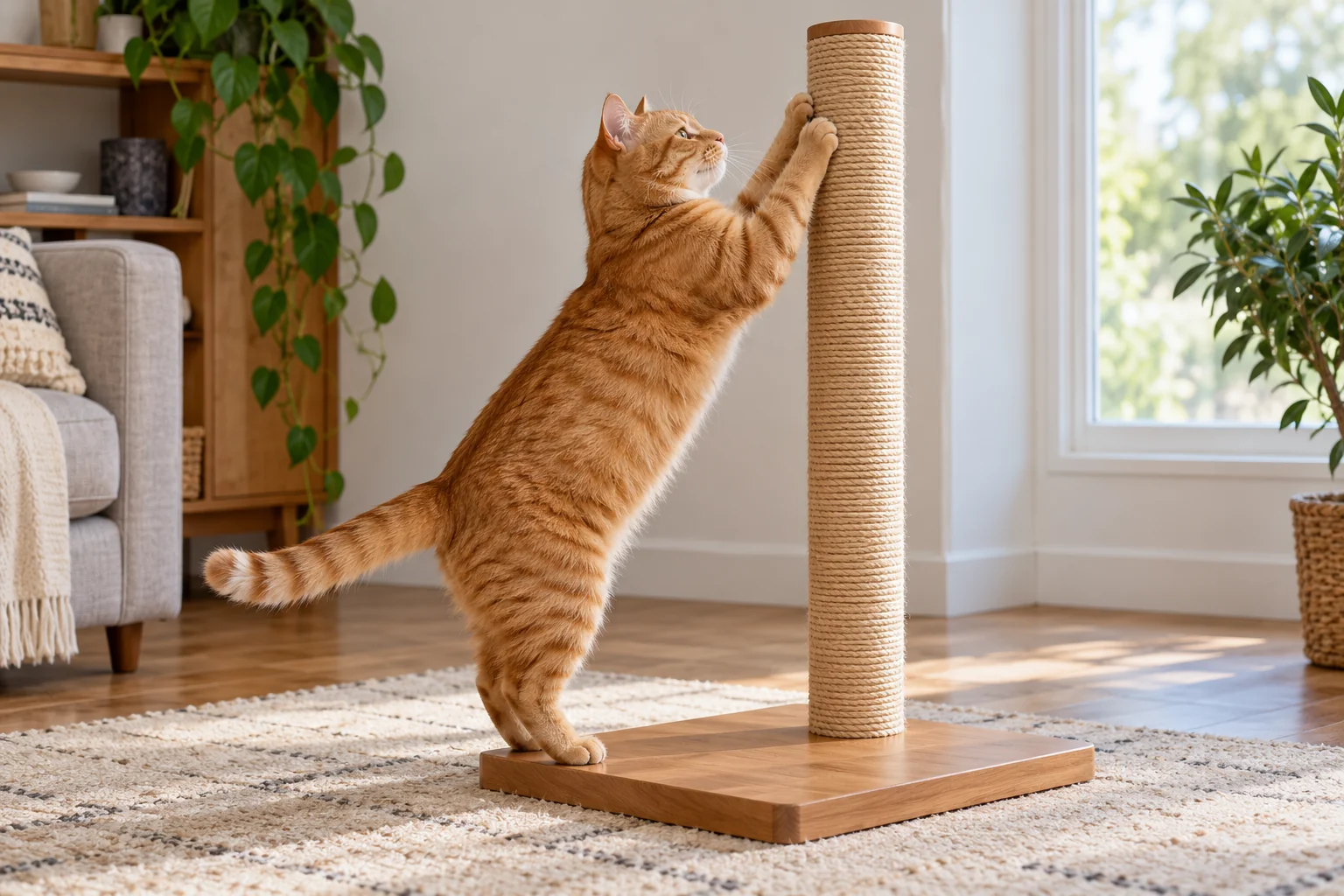
Take the measurement after the cat moves away. A nearby doorframe or other fixed reference can help you estimate the reach without interrupting the cat or holding its paws in position. Record where the hind paws were standing, too: a cat stretching from a raised step gives a different floor-to-paw measurement from one standing on the floor.
Measure from the surface supporting the hind paws to the level reached by the front paws. A nose-to-tail measurement taken while the cat is lying down leaves out the upright stretch.
When You Haven’t Seen a Full Stretch
A photograph of your cat standing next to its current post can help show whether the paws approach the top. However, a single photograph may capture a short scratch rather than the cat’s full reach. Leave the post available and watch another voluntary session before treating that position as the final measurement.
For a growing kitten, revisit the comparison as its reach changes. For a larger adult, use its observed stretch as the reference.
Separate Scratching Height from Overall Product Height
The exposed scratching surface is the part your cat can put its claws into. Overall product height runs from the floor to the highest component, which might be a cap, cushion, perch, or decorative fitting.
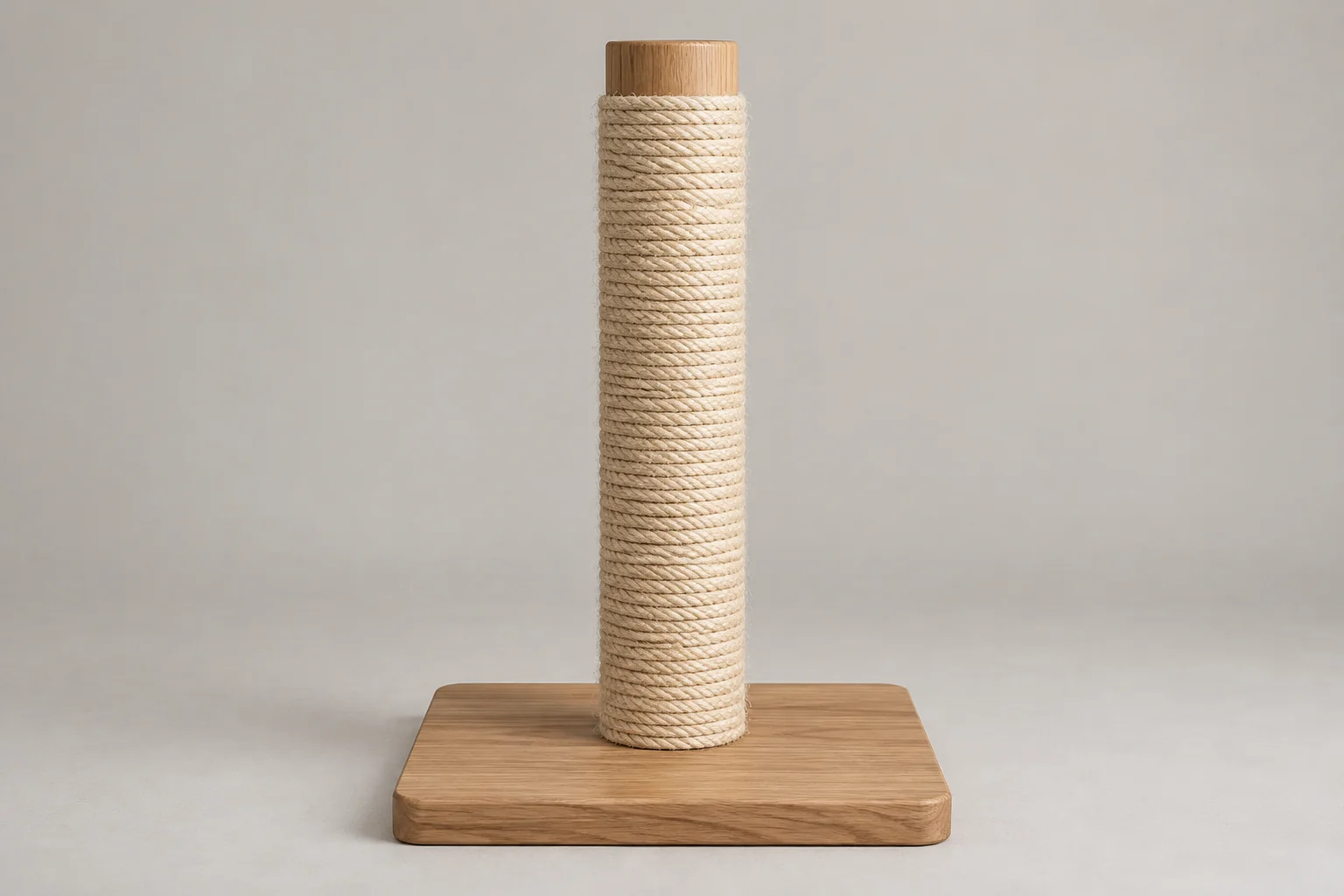
Read the product drawing alongside a clear side view. Identify where the covering begins, where it ends, and whether a platform interrupts it. A tall post with a short covered section can leave less usable scratching room than a simpler design with covering extending farther up the column.
Also account for the standing position. If the cat stands on the product’s raised base, measure the reach from that surface when comparing the upper scratching area. If the base is too crowded for the intended position, the advertised post height alone will not explain how the cat can use it.
| Product detail | What it tells you | What it leaves unanswered |
|---|---|---|
| Overall assembled height | Highest point of the finished product | How much of the column is covered |
| Covered section length | Amount of exposed scratching material | Where that section sits relative to the cat’s paws |
| Base height and shape | Surface available beneath the post | Whether the cat has room to stand in its usual position |
| Top cap or perch | Added component above the column | Whether it blocks access to the upper covering |
For online shopping, a dimensioned side view is more useful than a cropped photograph showing only the upper half. If the listing gives one height for several sizes, obtain the drawing for the exact version you intend to order. This resolves the measurement gap before you have to assemble and return the wrong size.
Give the Taller Post a Stable Place to Stand
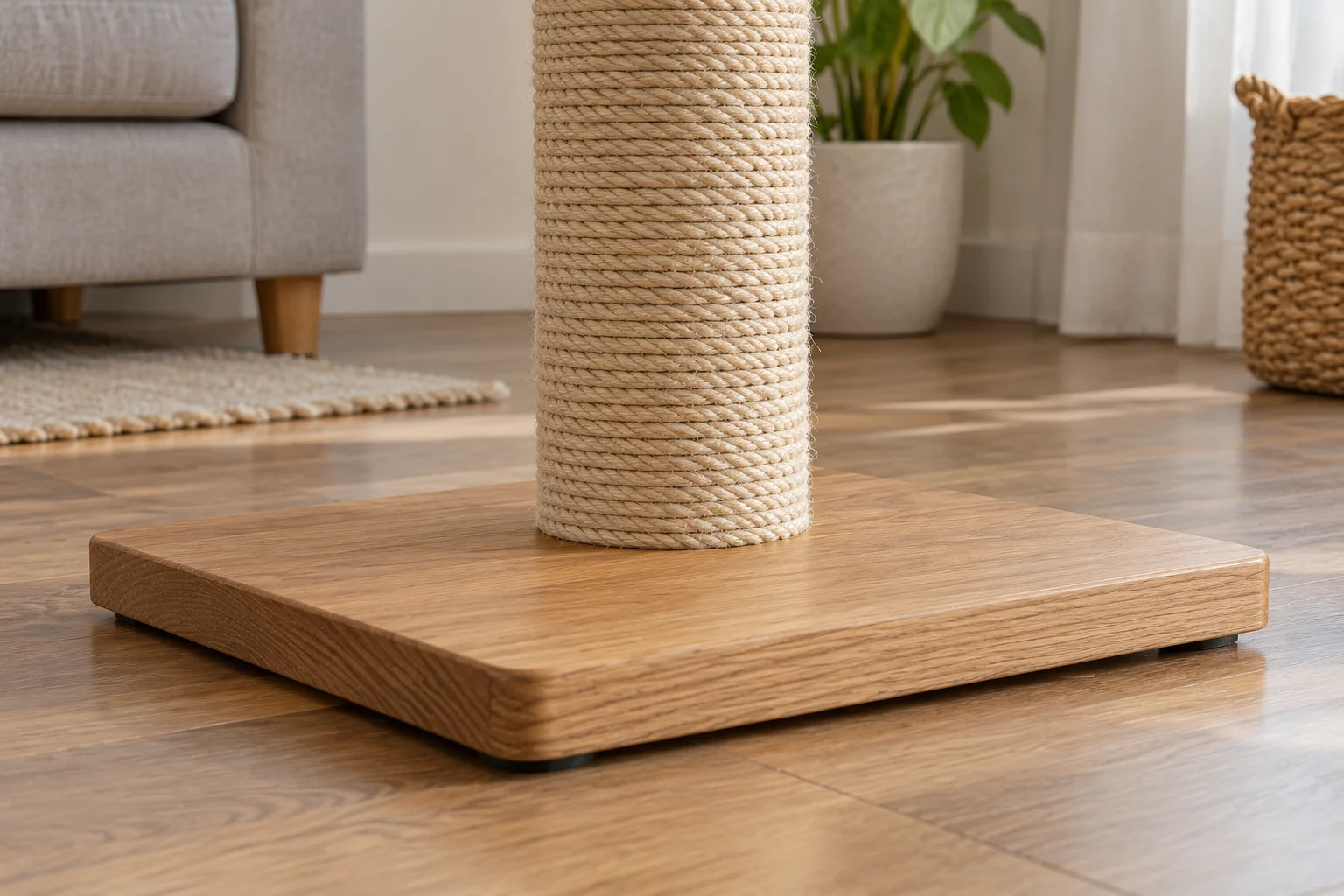
Assess the post and base as an assembled unit on the floor where it will stand. Base dimensions, weight, shape, and the post connection all belong in that assessment. Follow the model’s assembly and installation instructions; a base dimension alone is not a stability test.
During Assembly
Lay out the parts against the diagram and fit the supplied hardware as directed. Seat the bottom connection fully, with no gap from a reversed part or wrong fastener. Finish assembly before introducing the cat.
On the chosen floor, all intended base contact points should rest evenly. A product that rocks against an uneven surface needs its placement or assembly resolved. Avoid improvising a stack of loose objects beneath it or adding unapproved weight to conceal the problem.
If the post shifts, loosens, or tips during use, stop access until the cause is resolved according to the maker’s guidance.
Leave Room Around the Base
A post needs enough surrounding space for the cat to approach and stand in its scratching position. A wide base squeezed behind a chair may technically fit the room while leaving the useful side of the column inaccessible. Position the complete product, including any projecting feet, away from a doorway or frequently used walking path.
Match the Height to the Scratching Position
A vertical post suits an upward stretch. A horizontal pad serves a different position, and an angled scratcher gives another option. The direction your cat currently scratches helps you decide which format to offer.
For a cat that reaches up a furniture edge, a taller vertical surface is a sensible option to compare. A cat that regularly scratches a rug may use a horizontal surface instead. Offering another orientation can also help when you have seen both types of scratching; choosing the tallest upright model does not settle that preference.
Older cats may find a horizontal or lower-gradient surface easier to access. A new reluctance to stretch or a change in movement deserves veterinary advice rather than an assumption that age alone explains it. A different scratcher can provide an accessible option while the cat’s needs are assessed.
A cat tree’s total height includes platforms and other components, so a tall tree can still contain only short scratching sections. A separate post may fill that gap without replacing the climbing furniture.
Put the Usable Surface Where the Cat Will Find It
Start near the place where your cat already scratches, or near a regular resting spot. The post should be easy to approach, with the covered area facing the space the cat uses.
A new post placed beside a favored furniture edge gives the cat an alternative in the same location. Putting it in a distant room changes both the surface and the location at once. If the cat ignores it, you will have less information about which change mattered.
Give the cat time to approach voluntarily and reward use of the offered surface. Once the post is being used, a gradual move may help you find a more convenient position.
If the cat continues using furniture, look at the actual interaction: can it reach the covered area, does the product move, and is the scratching direction familiar? Resolve the specific mismatch you observe. Buying progressively taller posts without observing use can leave the same surface or placement problem in place.
In a shared home, separate scratching locations give cats alternatives to one busy spot. Keep those locations accessible within their normal living areas.
Put Usable Height on the Buyer’s Specification Sheet
For retail or private-label sourcing, list exposed scratching dimensions separately from overall assembled height. That gives the supplier and the person reviewing the sample the same reference point.
A useful request includes the intended standing position, covering boundaries, base dimensions, assembled product drawing, supplied hardware, and installation instructions. Where several sizes share a product family, each size needs its own measurements and assembly details.
Compare the assembled sample with that request. Record any difference between the drawing and the sample before approving the listing or packaging. For example, a cap that extends above the covering should remain part of the overall height, while the covered section keeps its own dimension.
Request any stability evaluation with its sample, setup, method, and acceptance criteria identified. Keep transport-packaging evidence separate from the in-use evaluation.
For product development, the cat tree and scratching post category provides a relevant starting point for discussing the format. Include your usable-height requirement in the brief so it is not lost inside a single overall dimension.
FAQ
Do cats like vertical or horizontal scratchers?
Preferences vary. If your cat uses both directions, keep both options available and watch which one it chooses in each location.
Where is the best place to place a scratching post for my cat?
Choose an accessible spot near existing scratching or a regular resting area. When two possible locations seem suitable, keep the same post and change only its location; that makes the cat’s response easier to interpret. Leave enough space for its usual scratching position.
How many scratching posts should a cat have?
Plan around the rooms your cat uses regularly. Separate locations give cats in a shared home an alternative to one busy spot, and another surface can fill a location gap while keeping a post the cat already uses.
Conclusion
Record your cat’s voluntary reach, then use it to compare the exposed area on the post you’re considering. If the listing provides only overall height, request a side view with the covering boundaries marked.