The best slow feeder dog bowl keeps food accessible while placing obstacles between mouthfuls. Start with channels your dog can reach, room for the usual meal below the ridges, and a shape you can wash thoroughly. More complicated patterns are not automatically a better choice. A dog that cannot reach the remaining food needs a different setup, rather than a harder puzzle.
Slow feeders use ridges, domes, or divided spaces to change how food is gathered. Their usefulness depends on the dog, food, and bowl together. A fixed promise about minutes per meal cannot tell you whether a particular feeder will work in your household.
Comparing Slow Feeder Patterns
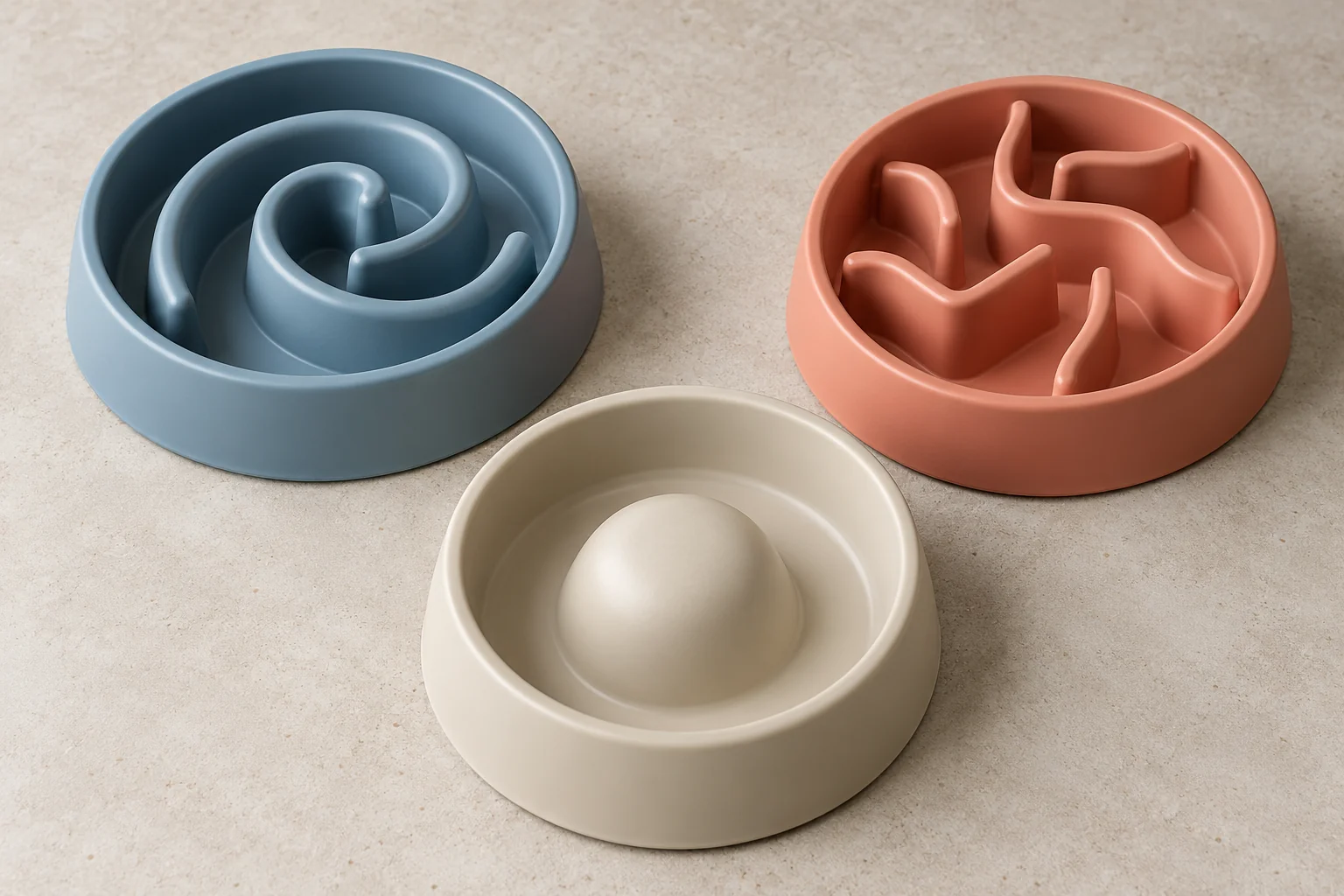
A spiral gives food a continuous curved path; a maze divides it among smaller spaces; a center dome leaves a ring around one obstacle. Compare the accessible spaces between the barriers before counting how many barriers a design has.
| Format | Where the food sits | What to compare | Cleaning consideration |
|---|---|---|---|
| Spiral or curved channels | Along a winding track | Channel width, ridge height, and access near the center | Whether a sponge or brush reaches along the track |
| Divided maze | In several connected or separate spaces | Access to corners and spaces at the bottom | More junctions to inspect for residue |
| Center dome | Around one raised obstacle | Width and depth of the surrounding ring | Access around the dome and outer wall |
| Removable insert | Between fins or other barriers inside an existing bowl | Fit, movement, and access around the insert | Both the insert and the bowl need washing |
| Textured lick surface | Across shallow grooves or small raised features | Suitability for a spreadable meal or topper | Residue between the surface features |
A curved track can be a sensible starting candidate if its spaces are easy for your dog to reach. A maze adds more divided areas, but deeper corners may hold food beyond the dog’s reach. The shape names do not establish a difficulty scale across different products: two spiral bowls can have very different channel widths and heights.
A center dome leaves fewer separate spaces to compare. Examine the ring around it, especially where the outer wall is high. A wide opening at the top can conceal a much narrower space near the bottom.
Lick surfaces and puzzle toys are related formats, with different uses. A textured surface may suit spreadable food, while a puzzle toy can involve moving parts or releasing food from compartments. Decide whether you need a feeding bowl or an enrichment activity before comparing them as equivalent options.
Matching Channel Depth to Your Dog’s Reach
Food should remain reachable without the dog repeatedly pressing its face against barriers. Observe the dog using a simple pattern first. The useful evidence is whether it can collect food from each part of the bowl while the bowl stays in a workable position.
Short Snouts and Broad Faces
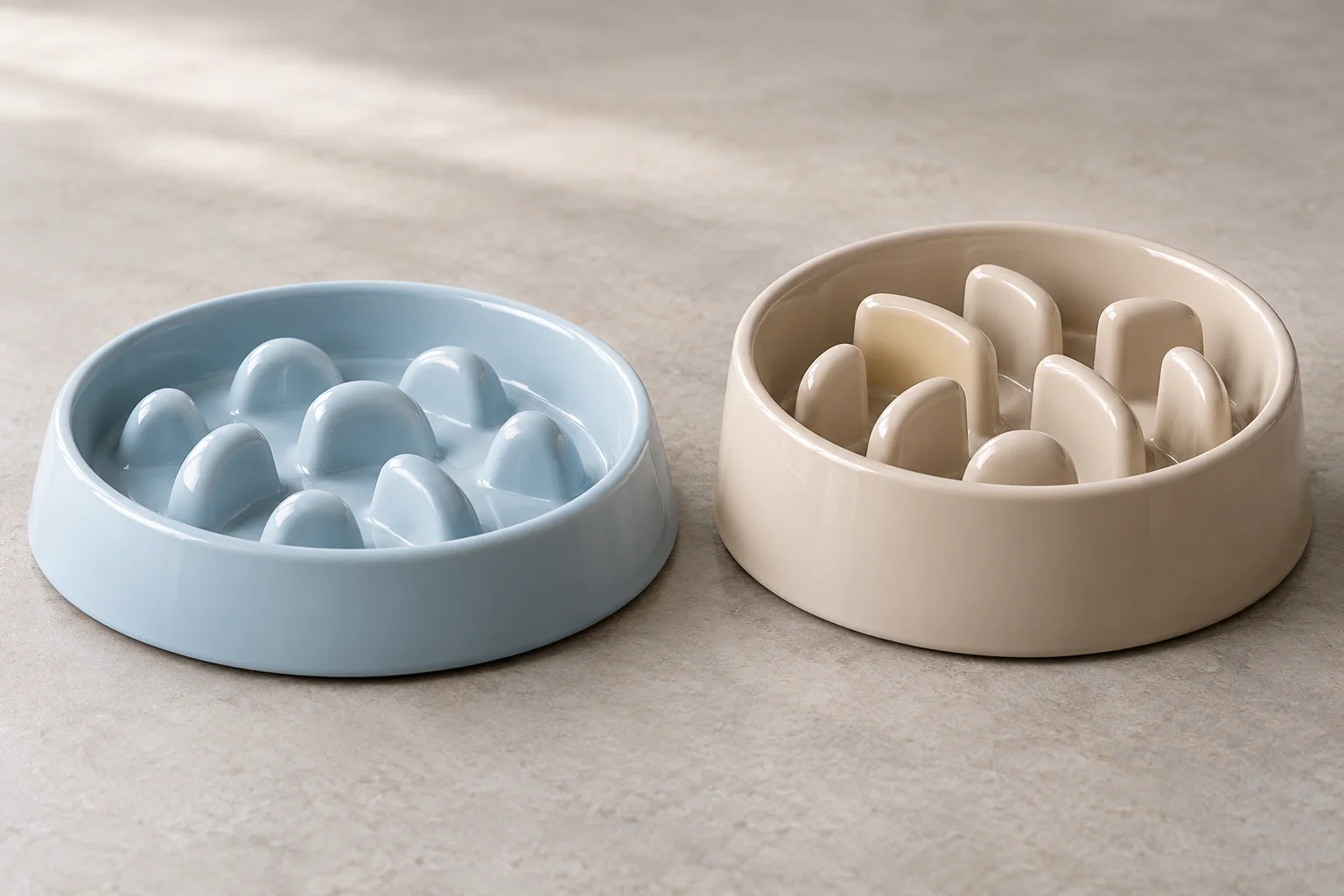
A shallow dish with open spaces is a useful candidate for a short-snouted or broad-faced dog. Compare how much room lies between the rim, internal obstacles, and food. Tall barriers may make a wide bowl harder to use than its outside diameter suggests.
Breed names help locate candidate products, but they do not establish the right pattern for every dog. There is no single required tilt angle or ridge height for all flat-faced breeds. Watch the particular dog: persistent face contact, difficulty reaching food, or refusal to continue calls for an easier design.
If eating involves breathing difficulty or another health concern, seek veterinary advice rather than trying to solve it by changing obstacle height.
Longer Muzzles and Larger Dogs
A longer muzzle does not automatically call for a deep maze. Begin with accessible channels and consider a more divided pattern only if the dog can use it comfortably. A design that is quickly emptied may still be a better fit than one that leaves part of the meal unreachable.
For a larger dog, compare the base footprint and how the feeder behaves at the usual eating spot. Persistent sliding or tipping can make the pattern irrelevant because food ends up outside the channels. A holder or stable base may help; adding more obstacles alone does not address that problem.
Usable Capacity and Food Above the Ridges
The usual meal needs to fit among the obstacles, below the level where food forms an unobstructed pile. Exterior dimensions or brim capacity do not show how much food the channels accommodate. A slow feeder’s usable capacity depends on its particular shape and the food being served.
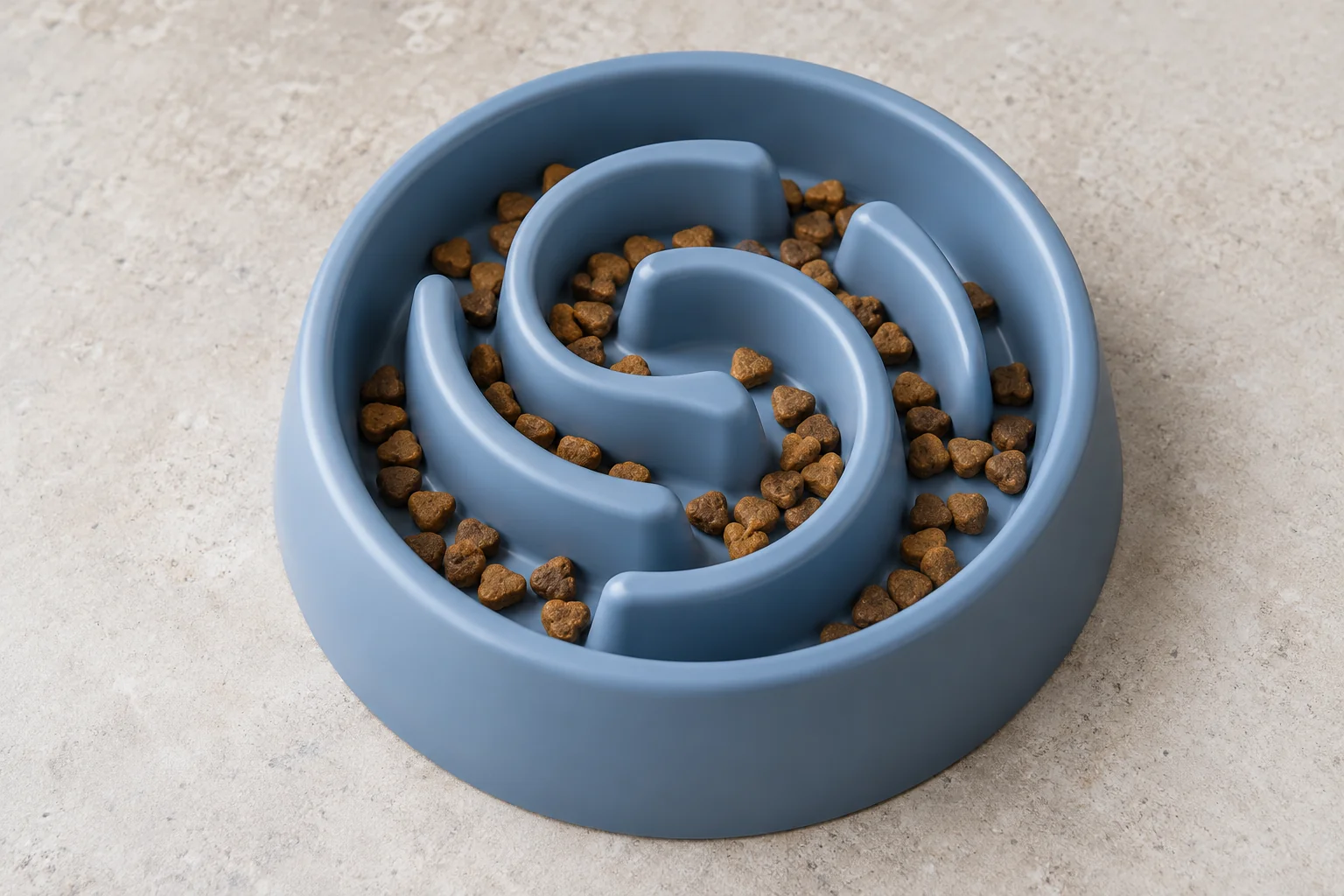
Compare the intended portion with the actual spaces available instead of applying a fixed capacity multiplier.
For an initial fit check:
- Measure the dog’s normal meal without changing the portion to suit the bowl.
- Spread it among the channels or around the dome.
- Look for food piling over the barriers, bridging narrow spaces, or collecting where the dog cannot reach.
- Choose a different capacity or pattern if the portion does not fit usefully.
Dry pieces, soft food, and chunky meals settle differently. A cup rating may describe brim volume, a suggested portion, or capacity for one food type. The product description should explain which measurement it uses.
The dog bowl measuring and capacity guide covers general bowl measurements. For a slow feeder, add the obstacle layout to that sizing assessment rather than choosing by dog weight alone.
Small Dogs and Puppies
A smaller dog needs reachable food as well as an appropriately sized dish. Closely spaced barriers can leave small pockets difficult to empty, even when the meal fits. Compare the depth at the bottom of the channel, not only the opening visible from above.
With a puppy, introduce a simple setup under supervision and keep the usual feeding plan. If using the feeder becomes chewing, pawing, or repeatedly overturning the bowl, pause and reassess the design. A more difficult pattern is not a necessary next step.
Food Consistency and Cleaning
Dry pieces can sit loosely in a track, while wet food can spread into corners and along barrier walls. Choose a layout that works for the meal you serve and leaves enough access to remove residue afterward.
Dry Food
Compare how the actual kibble fits between the obstacles. Large pieces may bridge a narrow channel; small pieces may collect at its deepest point. A bowl suited to one kibble shape may be awkward with another.
Dry-food bowls still need daily washing. Empty appearance is not the same as a clean surface, especially along the inside of barriers and underneath removable pieces.
Wet Food and Spreadable Meals
Open curves and accessible corners are useful when food has to be spread or scooped out. Before choosing a deep maze, consider how a sponge or brush will reach the bottom. Cleaning access is part of the pattern decision.
A shallow textured surface can be an option for spreadable food. Keep the meal or topper appropriate to the dog’s existing diet, and distinguish a small enrichment serving from a bowl that must hold the complete meal.
Wash wet-food feeders after each use. For hand washing, remove residue with warm soapy water, scrub accessible surfaces, rinse, and dry. Machine washing is an option only where the product’s instructions permit it; an ordinary dishwasher claim does not establish compatibility with every high-heat cycle.
Raw feeding introduces a separate food-handling decision. A material or pattern does not make raw food risk-free. If that is the household’s feeding routine, obtain appropriate feeding and hygiene advice rather than relying on a slow feeder’s marketing claims.
Standalone Bowls Versus Removable Inserts
A standalone feeder supplies the vessel and obstacles together. An insert allows you to keep an existing bowl, but introduces an additional part to fit, remove, and wash. Choose between them according to the current setup, rather than assuming the insert will fit every dish.
A Standalone Feeder
A one-piece bowl avoids fitting a separate insert to the base. The practical questions are access around the built-in barriers, movement at the feeding spot, and storage. Its empty footprint can take up more space than an ordinary bowl of similar usable capacity.
Where the base has feet, a ring, or another attachment, include those parts in the care check. Built-in ridges do not make every component permanently secure.
A Removable Insert
Compare the insert’s dimensions and attachment method with the existing bowl’s inner shape. A suction-base model needs a surface on which its attachment works; follow its fit instructions rather than guessing from the bowl’s outside size.
During the first uses, watch for lifting, movement, or the dog pulling the insert out. Remove it if the dog starts chewing it, and stop using a damaged insert. Flexible fins do not make an accessory suitable to leave with a dog that treats it as a chew toy.
Take the insert out for cleaning so that the hidden surfaces and bowl underneath are accessible. After washing, reassemble it as directed. This additional step may decide whether an insert is convenient in a busy feeding routine.
What to Include in a Sourcing Brief
A sourcing brief should make the feeding task reproducible for comparison: the intended food, normal portion, target access needs, and cleaning method. Samples can then be reviewed against the same practical questions instead of a generic promise to slow every dog.
| Specification area | Useful information |
|---|---|
| Feeding format | Standalone bowl, fitted insert, or textured feeding surface |
| Food and capacity | Intended food type and the portion accommodated below obstacles |
| Geometry | Channel widths and depths, ridge shape, and access near corners |
| Base or attachment | Footprint, holder compatibility, or insert retention method |
| Material and finish | Component identities, smooth edges, and food-use documentation for the actual product |
| Care | Permitted washing process, disassembly, and parts that need separate treatment |
Measurements should describe the chosen sample; they are not universal recommendations for all dogs. If testing or compliance information is required for the destination market, agree on its scope with the supplier. A material grade or hardness number alone does not establish feeding access, tear resistance, or finished-product safety.
The custom pet bowl category provides context for stainless steel and ceramic bowl projects. Include the proposed obstacle layout and feeding format in your brief so that discussions start with the particular design you need.
FAQ
Do veterinarians recommend slow feeder dog bowls?
A slow feeder may be an option for a fast eater, but this guide cannot establish a universal veterinary recommendation. If the reason for changing bowls is a health problem, discuss that problem with your dog’s veterinarian. The feeder should not be treated as a medical treatment.
Can you put wet food in a slow feeder dog bowl?
Yes, where the product is intended for that use. Compare access to the food and to the surfaces afterward. A spreadable meal may work better in open, shallow spaces than in deep corners that are difficult to empty and wash.
What slow feeder design can a flat-faced dog use?
Start by comparing shallow, open designs and watching the individual dog’s access. There is no required angle or obstacle height that works for every flat-faced dog. Stop if the dog has difficulty using the feeder.
What size slow feeder dog bowl should I choose?
Choose one that accommodates the normal meal below the obstacles while keeping the food reachable. Use the actual portion and pattern together, rather than relying on a breed chart or multiplying the portion by a fixed amount.
What are the downsides of a slow feeder bowl?
A poorly matched pattern can leave food unreachable, make washing awkward, or encourage tipping and chewing instead of eating. Supervise introduction and change the setup if those problems occur. Extra complexity is useful only when the dog can still use the feeder.
Conclusion
Try a simple, accessible pattern with the usual meal and observe which spaces the dog can empty. Then wash the feeder, including any hidden surfaces under an insert. If either food access or cleaning fails, change the layout before choosing a more difficult pattern. That meal-and-wash comparison is a practical way to narrow the next purchase.