When comparing dog toys vs cat toys, start with the intended game, product scale and accessible parts. Fetch and tug products, small batting toys and person-guided teasers serve different activities, although some formats overlap. Choose for the individual animal and the particular product. A species label, a sturdy appearance or successful use by one pet does not establish suitability for another.
How Play Behavior Shapes Each Design
Fetch, tug, carrying and food-search activities give dog toys different jobs to perform. Cat toys can provide stalking, pouncing, batting, carrying or person-guided play. Those examples help explain product shapes without treating either species as having one fixed play style.
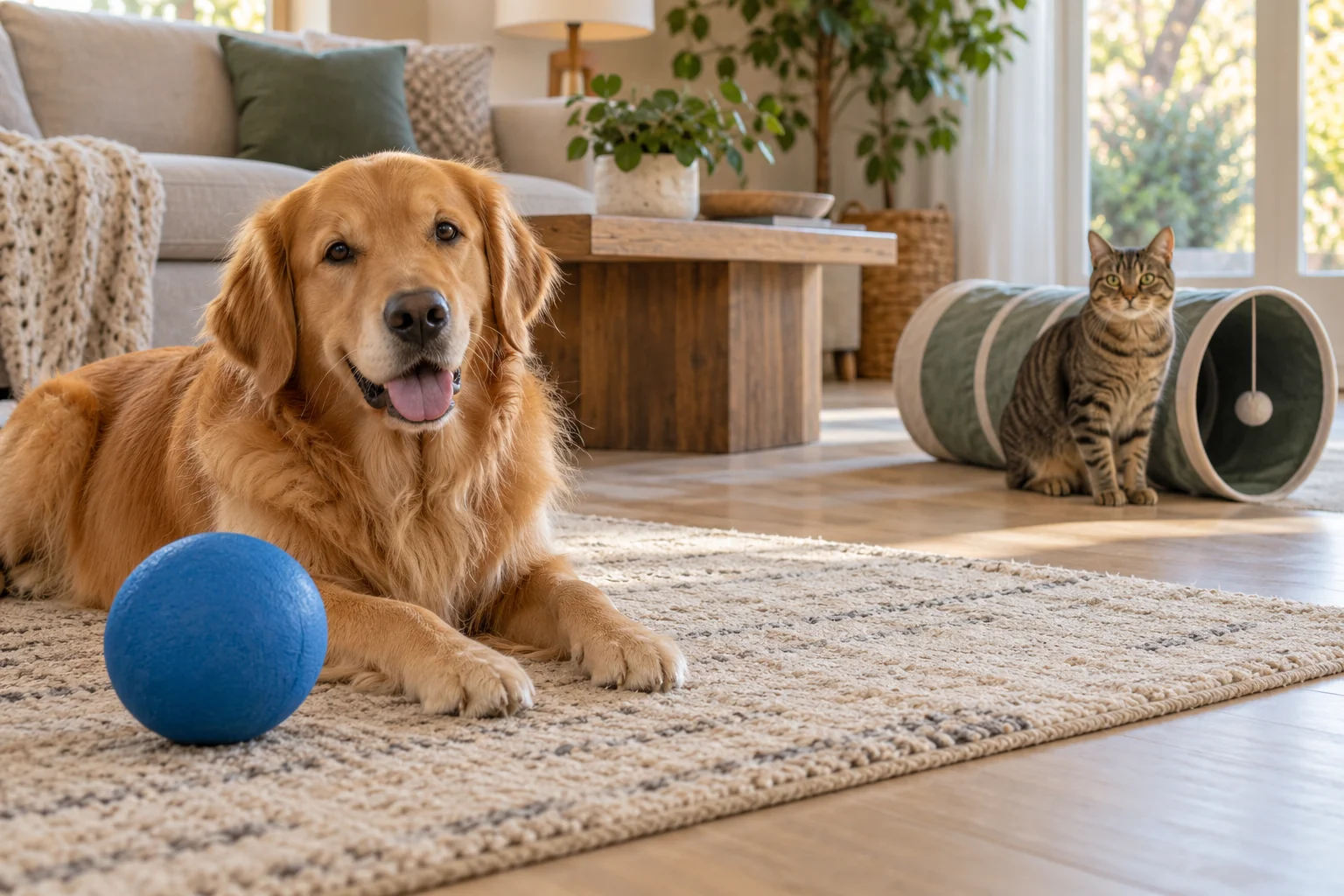
Compare the game before choosing its equipment. A handle may let a person participate in tug; a rolling object gives an animal something to chase; a teaser attachment lets a person control movement. The parts should support the intended activity rather than simply make a toy look interesting on a shelf.
| Activity | Dog-product formats to consider | Cat-product formats to consider |
|---|---|---|
| Carrying | Soft shapes or other products intended for carrying | Soft shapes sized for the particular cat |
| Chasing | Fetch or rolling products for the available space | Batting balls, rolling shapes or guided teasers |
| Shared play with a person | Fetch and tug products with their specified use | Wand-and-attachment designs used as directed |
| Searching for food | Food-dispensing products suited to the dog | Feline food puzzles or dispensers suited to the cat |
| Exploring a space | Appropriate activity equipment for the dog | Boxes, tunnels and hiding structures |
A ball for fetching and a ball enclosed in a track create different tasks despite sharing a basic shape. Compare how the animal reaches and moves the object in each design.
Watch what each pet does with a familiar toy. Carrying it, opening its seams and pulling at an attachment are different behaviors to account for. Buying a second version of a toy that the animal ignores may add little; changing the activity or participating in play may be more useful.
Size, Weight and Small Parts
An appropriate size for one pet can be unsuitable for the other. Dog-toy guidance warns against toys small enough to be swallowed or lodge in the throat. For a mixed household, assess the whole object and its accessible parts against the animal that may actually reach it.
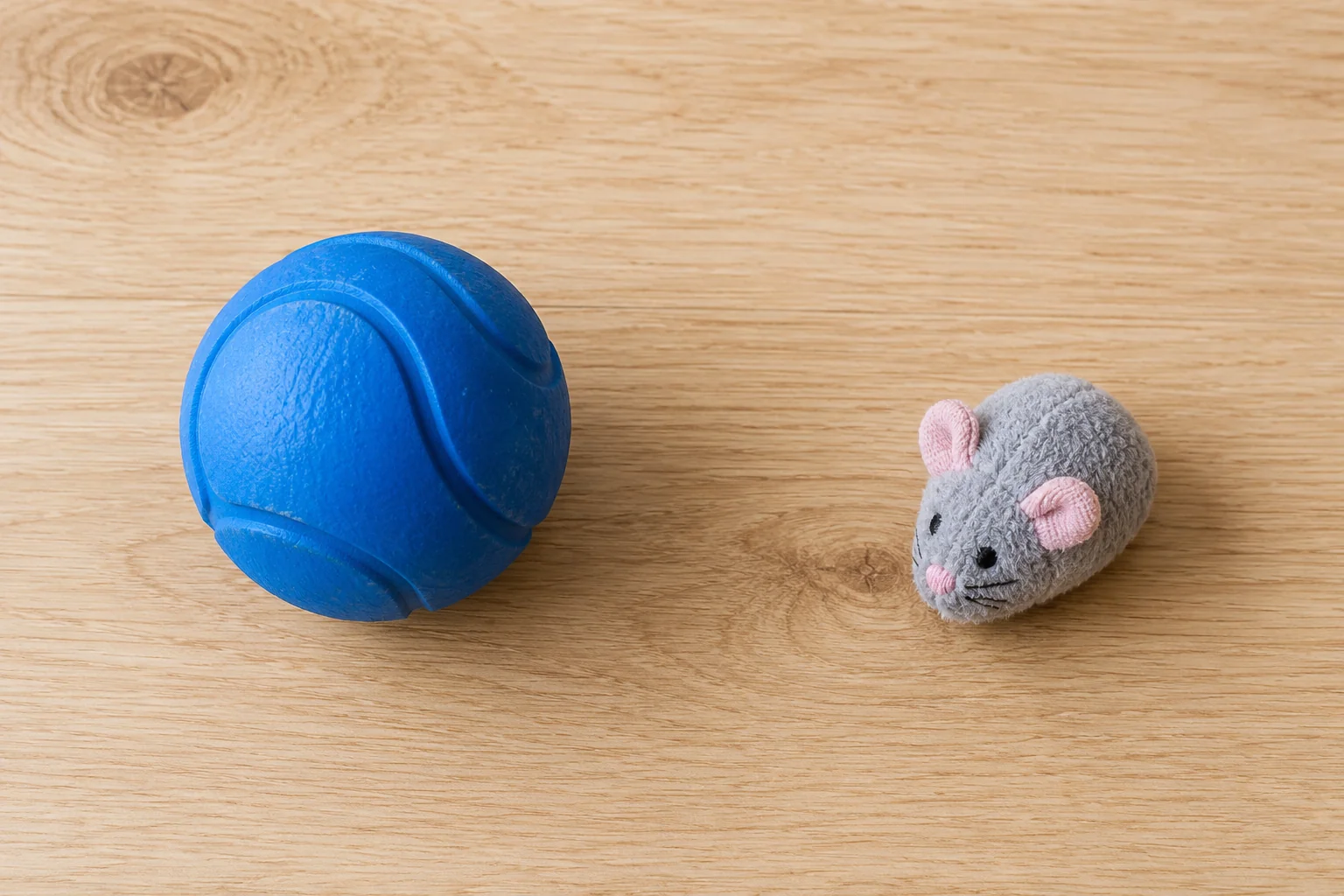
Weight also affects whether the intended game is workable. A cat may ignore an object it cannot readily move, while a dog may pick up a small batting toy in a way its design did not anticipate. Select size and weight for the actual animal and activity rather than applying one cutoff to every pet.
Look beyond the outline of the toy. A body, tail, cord, connector or sound component can have a different role and attachment method. A feature intended for a person’s hand should not be treated as an approved chewing part simply because the animal can reach it.
Keep loose decorations and damaged pieces out of play. Toys with strings or other attachments need the intended-use and supervision conditions appropriate to their design. In a household with a chewing cat, those features also need attention on the cat’s own toys.
If an item is intended only for the cat, store it where the dog cannot gain access between sessions. Watching a first encounter cannot resolve a size mismatch or approve later unattended use.
Sound, Movement and Interaction Patterns
A toy’s movement can explain more about the game than its animal label. A person moving a teaser controls where the attachment travels; a fetch toy depends on a throw and return; a track constrains how a ball moves. Choose the interaction you can provide in the space available.
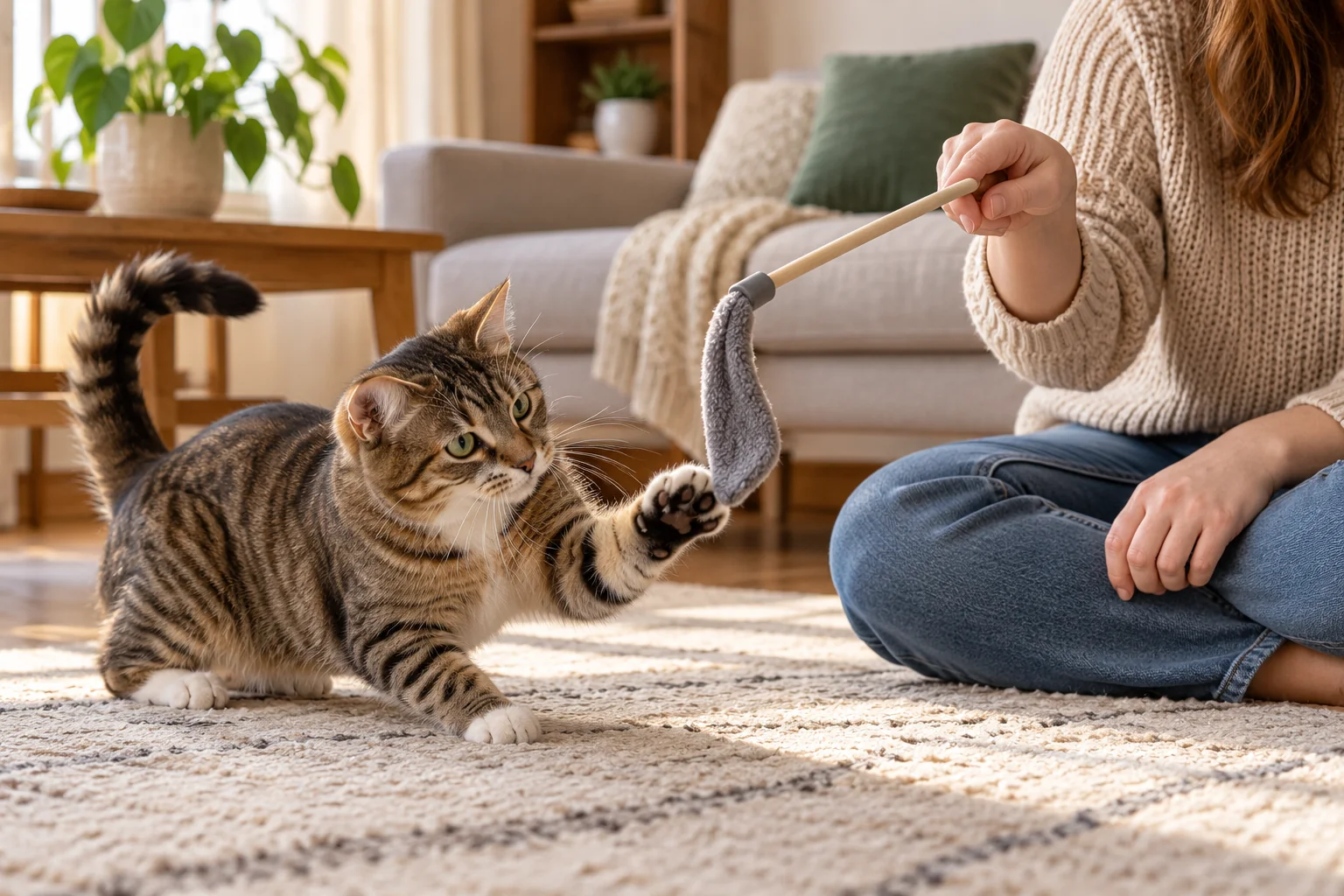
Cats can enjoy stalking and pouncing on moving objects, but individual preferences vary. Some engage when a person moves the toy; others explore a rolling object or food puzzle. Dogs likewise differ in whether they carry, chase, manipulate or chew a product.
Sound is another feature to assess individually. One animal may follow a squeaking object while another tries to reach the sound component. Observe that response alongside the intended game, and keep the component description with the product information.
Person-guided play and independent use need separate decisions. A product demonstrated with a person should not become an unattended toy by assumption. Use the specific instructions and consider what the animal actually does with the equipment, including whether it starts dismantling it.
For cats that enjoy moving through a hiding structure, the cat tunnel and teaser collection shows two distinct formats. A tunnel offers openings and a hiding space; a wand lets a person guide an attachment. Select between those interactions for the cat rather than treating both as the same activity.
Materials in One View
Fabric, filling, plastic, rope and other materials appear across pet toy categories. Their arrangement and intended use matter more than assigning one species a “tough” material list and the other a “delicate” one.
A soft toy can combine a textile shell, filling and a sound component. A molded object may contain an opening or a separate connector. Compare the actual parts your pet can reach and how they connect, using product-specific evidence for any strength or durability claim.
For the dog side of the comparison, the dog toy materials guide explains material and construction categories in more detail. Use it when the material choice itself needs further comparison; this article focuses on how the finished format fits the animal and activity.
Care is a complete-product question too. A washable outer fabric does not establish how an insert, adhesive or other attached part should be cleaned. Keep the instructions with the particular model rather than applying one method to everything in the toy basket.
An opened seam, exposed contents or a loose component is a reason to remove either pet’s toy from play, even if most of its body remains intact.
Sharing Toys in a Mixed Household
Separate access is often the practical answer when a product suits one pet’s activity but not the other’s. The cat can have its small batting toys in a space the dog cannot enter, while the dog keeps its own play equipment elsewhere. Shared ownership of the room does not require shared toys.
Start with the objects both animals can currently reach. Identify which are intended for each pet and which require a person to participate. Put away an item if its contents or intended use are unclear until that information is resolved.
Evaluate a proposed shared item against both animals separately. Its size, attachments, intended game and cleaning instructions need to make sense for each intended user. If the information covers only one species, obtain clarification about the particular product rather than extending the label yourself.
Clean and store products as directed, then inspect them before their next use. Avoid improvising a repair that adds tape, glue or loose components to an item the pets will mouth. An approved repair or replacement method needs to suit the original construction.
Paper and cardboard can prompt different behavior too: one pet explores a box while another tears off and eats pieces. Choose a separate activity for an animal that dismantles the shared structure.
You can still offer variety through separate equipment. A short game with the dog and a person-guided session with the cat may meet different preferences without requiring one object to perform both jobs. Keep the arrangement manageable for the people who will supervise it.
What Buyers Should Specify for Each Species
A range serving cats and dogs needs product records that identify the intended user and activity. Give each item its own size, components, attachment details and use instructions. A broad “pet toy” heading leaves those decisions unresolved.
Describe the dog item through its proposed game and construction. A fetch product, a tug product and a food dispenser require different references. Record the requested features and the evidence needed for any performance claim instead of treating “dog toy” as a durability standard.
Describe a cat item with the same precision. For a teaser, separate the handle, connector and attachment; for a tunnel, separate the panels, supports and openings. Identify which parts are replaceable and which are fixed, subject to the selected model’s actual options.
If a product will be marketed for both species, ask what information supports that scope. Resolve the intended uses and limits before approving its label. A sample can establish visible dimensions and construction; it does not, by itself, prove every proposed safety or durability claim.
Keep the approved component list, sample reference and instructions aligned. A later change to an attachment or size should be reviewed against the intended users rather than accepted as a cosmetic revision.
FAQ
Are dog toys OK for cats?
Some formats may suit an individual cat, but the dog label does not establish that. Consider whether the cat can use the particular item as intended, including its size, weight, attachments and instructions. Do not equate choosing from the dog aisle with choosing something more suitable.
What is a good cat toy for a dog?
There is no general cat-toy recommendation that applies to every dog. If a dog is attracted to a cat’s toy, identify the game it enjoys and choose a product intended for that dog’s use. Keep small cat items out of reach rather than relying on supervision to resolve a size mismatch.
Why is my dog interested in cat toys?
Movement, sound or a different texture may interest the dog, but its interest does not tell you whether the item is appropriate. Notice whether it follows the movement, carries the object or tries to remove parts, then use that observation when selecting its own equipment.
What is the most stimulating toy for cats?
Preferences vary. Try a format that matches an activity your cat already engages in and offer it in the intended way. A person moving an appropriate teaser may produce a different response from leaving a toy still on the floor; no universal product winner follows from that observation.
Conclusion
Review one item that currently moves between your cat’s and dog’s play areas. Decide which animal and activity it actually suits, then give it an appropriate storage place. If its use cannot be established for both pets, provide separate equipment instead of treating the shared basket as the approval.