The elevated dog bed vs floor bed choice comes down to the complete sleeping setup: the surface your dog rests on, the way it gets on and off, and the place the bed occupies. A raised frame can hold fabric or a cushion; a floor bed can be thin, deep, flat, or bolstered. Height alone does not decide comfort.
Compare two actual beds in the intended room rather than choosing a category winner. The following guide focuses on access, usable space, care, and daily handling, with individual preferences taking priority over broad claims about which type every dog should use.
Compare the Complete Bed Structure
An elevated dog bed has a sleeping surface above the floor, supported by a frame or legs. A floor bed rests directly on the floor. That is the basic distinction, but both categories contain different constructions and surfaces.
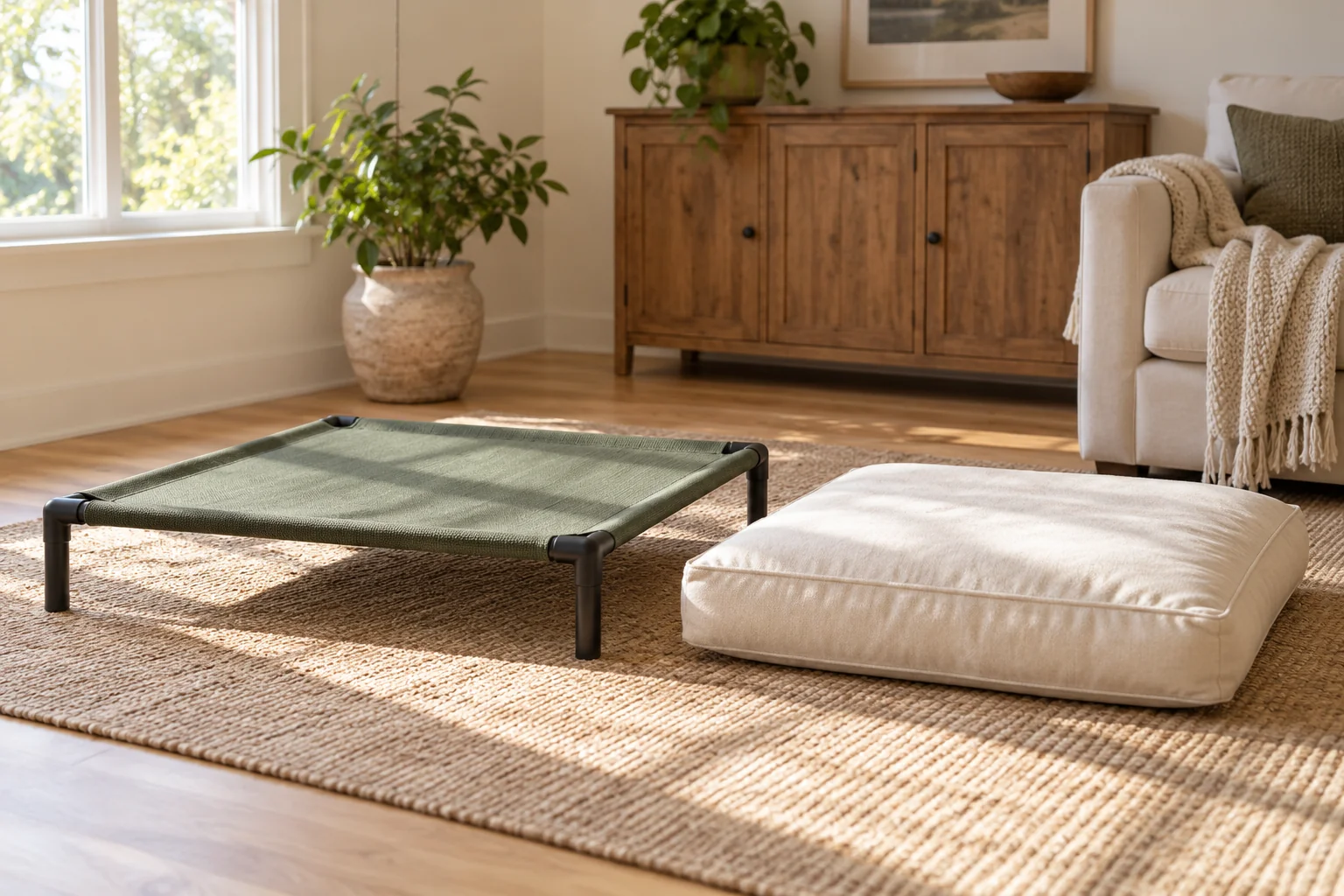
A cot-style bed commonly holds a fabric panel across a frame. Other raised designs hold a mattress or cushion. Calling either one “elevated” tells you about its position; it does not tell you how soft the surface is, how the dog enters, or which parts can be removed for cleaning.
Likewise, a floor bed may be a simple mat, a filled cushion, or a mattress with a removable cover. Bolsters can reduce the flat area available to lie on even when the outside dimensions look generous. Compare the assembled bed with all the parts you intend to use.
| Question | Elevated bed | Floor bed |
|---|---|---|
| What supports the sleeping surface? | Frame or legs, with a fabric panel, mattress, or cushion | The floor beneath a mat, filling, or mattress |
| How does the dog enter? | Depends on surface height, surrounding frame, and any entrance opening | Depends on cushion depth, bolsters, and any entrance opening |
| What takes up room? | The whole frame, including projecting feet or legs | The full cushion, mat, or bolster outline |
| What needs cleaning? | Surface, frame, and any added soft components | Cover, filling or insert as permitted, plus the floor underneath |
| What changes the feel? | Fabric tension or the mattress and accessories used | Filling, mattress construction, cover, and accessories used |
The guide to choosing a dog bed is useful if you are still deciding among mats, mattresses, and bolstered shapes. Resolve that broader sleeping preference before treating a raised frame as the deciding feature.
Match the Sleeping Surface and Entry to Your Dog
The dog needs enough usable room to settle and change position, along with an entrance it can manage comfortably. Watch how it uses its current bed: whether it stretches, curls up, rests against an edge, or leaves part of its body outside the sleeping area.
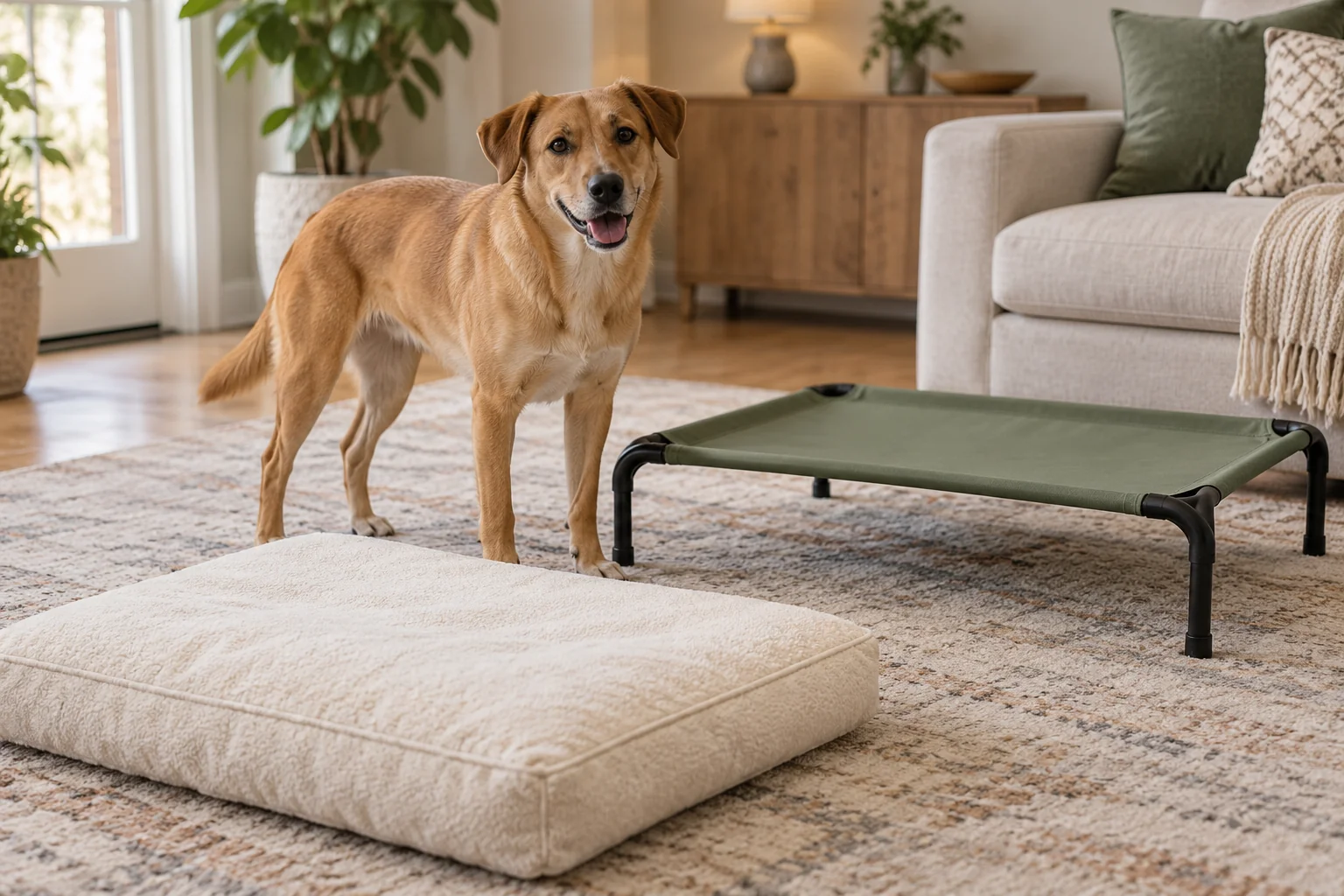
Use those observations to compare the next bed’s surface. A taut panel feels different from a loose cushion, and a raised mattress feels different from a bare cot. Labels such as “orthopedic” do not settle the choice by themselves. The relevant questions are about the actual construction and the dog’s needs.
Surface height and ease of entry are also different measurements. A deep floor cushion with a high bolster may present a more complicated entrance than its category name suggests. On a raised bed, the position of the frame edge and the sleeping surface both matter. Avoid choosing from a photograph that hides the entry side.
For sizing, distinguish the full outline from the area inside the frame or bolsters. The dog bed size chart and measuring guide explains this comparison in more detail. Measure the place where the dog will actually lie, then allow room in the surrounding space for getting on and off.
If the dog has pain, difficulty moving, or trouble settling, ask your veterinarian about its individual bedding and access needs. Neither a suspended surface nor a foam mattress is automatically the right answer for every mobility problem. A category comparison cannot prescribe a bed for a medical condition.
Choose a Position in the Room
A bed that fits the dog still needs a suitable place to stand. Look at the complete footprint, the approach to the entrance, and what happens around that spot during the day. A quiet corner may be more useful than a visually tidy position beside a busy doorway.
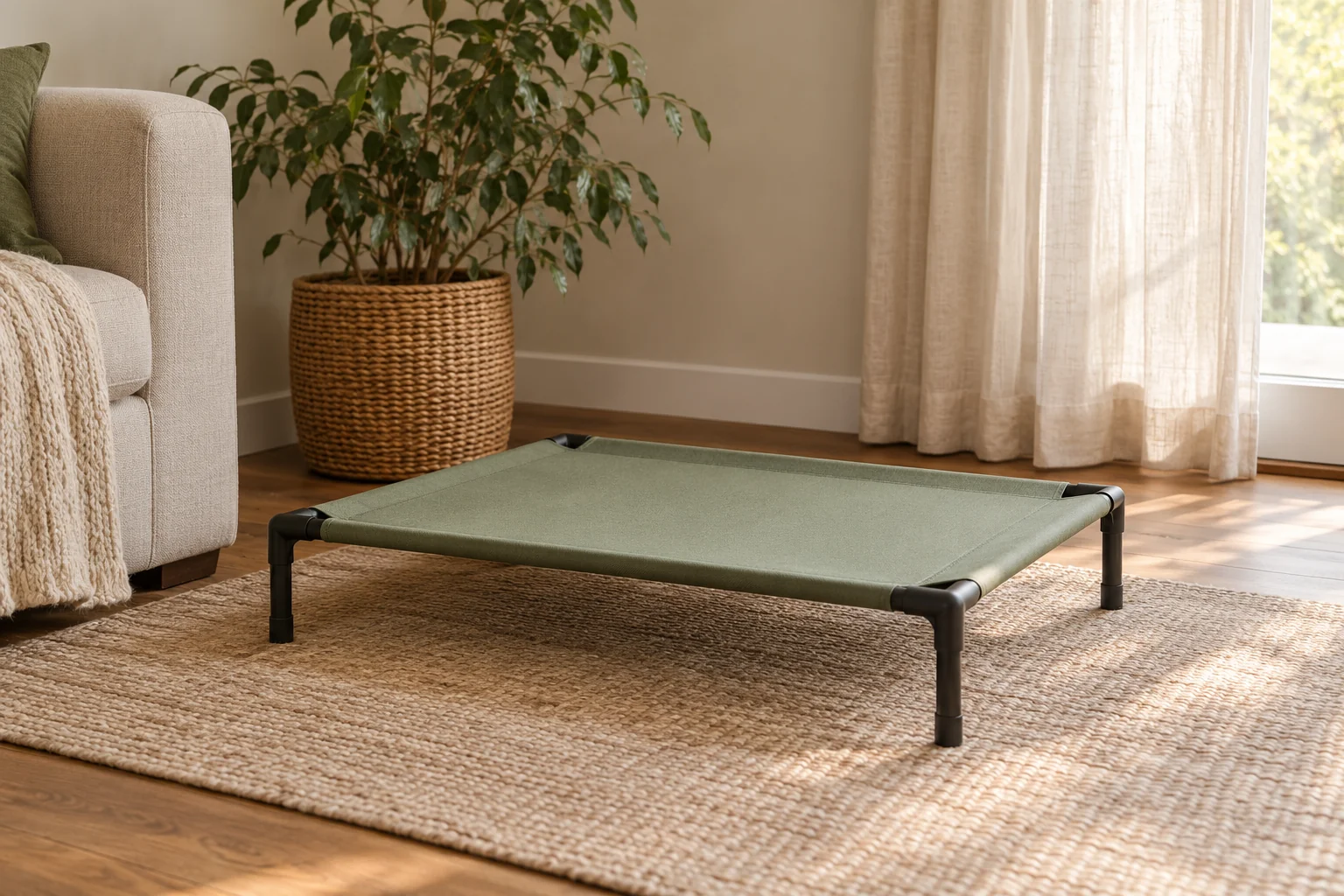
A raised frame leaves a gap beneath its sleeping surface. That gap does not guarantee a cooler dog, and adding a thick cushion creates a different setup from a bare fabric cot. A floor mattress is also affected by its surface, surrounding room, and location. Compare the arrangement you plan to use, rather than assuming that elevation controls the temperature.
For everyday positioning, leave a clear approach and room for the dog to turn. Legs should not protrude into a regular walking route, and a loose corner of bedding should not become an obstacle. If the dog uses more than one resting spot, consider whether this bed offers a useful alternative or occupies the only route to another favorite place.
Sunlight, drafts, and activity around the bed can change through the day. Observe the dog’s response after moving the bed, especially if you are replacing a familiar sleeping location. It may be the position, rather than the construction, that needs adjusting.
A patio or garden adds another question: is this exact model intended for outdoor use? Materials and care requirements differ. A raised design is not automatically weatherproof, and a soft floor cushion is not automatically unsuitable for every sheltered setting. Use the stated placement and storage limits of the individual bed.
Compare the Cleaning Routine Component by Component
Cleaning convenience depends on the parts you can reach and the care each one needs. An empty frame and removable panel can be a different job from a frame with a separate cushion. A floor mattress with a removable cover is different again.
Work through the assembly before buying. Where does hair collect? Can the cover come off without dismantling the whole bed? Is the sleeping panel removable, and what cleaning method is permitted? A product photo rarely answers all of those questions.
For a raised bed, account for the frame, connections, feet, and any soft layer you add. For a floor bed, separate the outer cover from the filling or insert. A machine-washable cover does not establish that the whole mattress can be washed in the same way.
Drying and reassembly are part of the routine too. If a cover takes time to dry, the dog still needs a suitable resting option while it is off the bed. A replacement cover or panel is useful only if it is available for the exact size and configuration.
Keep expectations specific. A gap under a bed may make the floor easier to reach with some cleaning tools, but the bed and surrounding area still need cleaning. Elevation does not make a surface free of hair, allergens, pests, or odor. Nor does a soft bed’s filling tell you, on its own, how cleanable the complete product is.
Think About Assembly, Moving, and Replacement Parts
Daily handling can decide between two otherwise suitable beds. A frame may need assembly and a clear place to store its parts; a floor cushion may be simple to move yet take up more space in storage. Compare the packed and assembled forms if you expect to travel with the bed.
For a frame, locate the assembly instructions, intended load information, and replacement-part details. The complete structure matters more than a single material label. Metal, plastic, or wood alone does not establish stability, weather resistance, or the life of the finished bed.
For a soft bed, look at how the cover closes, whether the insert comes out, and which components are replaceable. This is particularly relevant when moving a large bed between rooms or keeping a spare cover for cleaning. Carrying a filled cushion and dismantling a frame are different tasks, so choose the one that fits your routine.
Chewing is a separate issue from height. A raised cot may have no loose stuffing, but its fabric, edges, feet, or added accessories can still be accessible. A floor bed also has its own exposed components. Remove damaged bedding from use; a bed described as durable is still not a chew toy.
If you add a cushion or mat to a frame, include that combination in the comparison. It can change the available lying space, entry height, and cleaning job. Accessories should suit the intended arrangement rather than turning a bed that fits into one with awkward access.
Specify the Setup for a Product Range
For a brand or retailer, “elevated versus floor” is too broad to serve as a production brief. Define the complete bed, including the sleeping surface, entry, outer footprint, removable parts, and intended setting. Two products with the same size label can offer different usable spaces.
The pet bed manufacturing category covers relevant soft-bed and cushion formats. A suspended cot or rigid raised frame is a distinct construction to discuss explicitly; the category page does not confirm that every frame design is offered.
Keep the initial specification concise:
- Describe the bed type and every included or optional component.
- Record outer dimensions, usable lying area, and the entrance arrangement.
- State intended placement and component-specific care requirements.
- Identify which parts should be removable or available as replacements.
- List proposed claims separately from the evidence needed to support them.
Sample review can establish whether the agreed layout, components, and appearance match the brief. Claims about load capacity, durability, cooling, or medical benefit need appropriate evidence for the exact product; they are not established by seeing a finished sample.
The pet product manufacturing overview outlines the broader specification and production discussion. Once the bed configuration is defined, send the dimensions, surface details, and unresolved construction questions through the product inquiry form. That gives the conversation a concrete starting point without assuming a frame or treatment capability.
FAQ
Is an elevated dog bed better than a floor bed?
Neither category is better for every dog. Compare the actual surface, usable space, entry, location, and care routine. A raised frame with a mattress and a bare suspended cot should not be treated as the same sleeping setup.
Do dogs like elevated beds?
Some do, while others prefer a different surface or location. Observe whether your dog settles on the bed and can change position and get off comfortably. A category preference reported elsewhere cannot decide what your individual dog will choose.
What are the disadvantages of an elevated dog bed?
Potential drawbacks include an entrance the dog finds awkward, a frame footprint that takes up too much room, assembly, or replacement parts that are difficult to obtain. Which matters depends on the model and where it will be used. A floor bed has different trade-offs, including cushion depth and component care.
Can an elevated dog bed be used outdoors?
Only within the individual model’s stated use and care limits. A frame and raised surface do not establish weather resistance. Consider the intended spot, shelter, cleaning, and storage instructions before treating an indoor bed as patio furniture.
Conclusion
Compare two complete setups in the place where your dog will sleep. If the main difficulty is getting onto the bed, focus on the entrance and surface height; if the dog settles well but cleaning is awkward, focus on removable parts. The useful next step is resolving that specific problem, rather than choosing height as a winner on its own.